
The Japanese regularly drop the word sumimasen into everyday speech.
It means sorry or excuse me, and is used to apologise to friends or strangers for even the most trivial of accidents or mistakes.
But for the Japanese government, upholding past apologies for its part in World War II is not so easy.
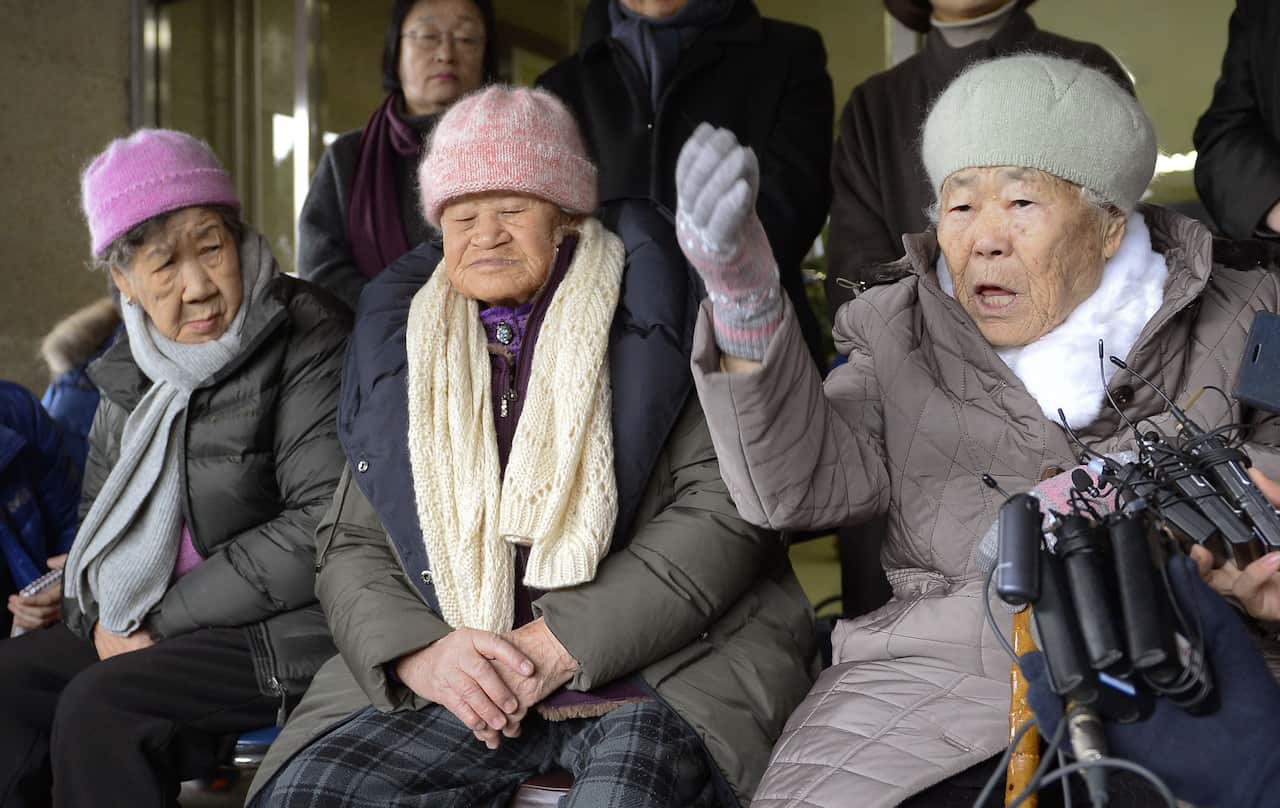
On December 28, 2015, Prime Minister Shinzo Abe made a telephone call to South Korean President Geun-hye Park, expressing his “most sincere apologies and remorse” over the wartime sufferings of Korean “comfort women”- women drafted into military brothels throughout the Japanese empire.
News that makes sense
Your trusted source for staying up-to-date with the world around you. Get free daily news updates and analysis, straight to your inbox.
But a crucial part of the audience for this conversation was the United States government, which both countries rely on for their security in the region.
“The American government put a lot of pressure on Abe to uphold apologies (by previous governments) and release a statement,” Tessa Morris-Suzuki, an historian from the College of Asia and the Pacific at the Australian National University points out.
On the other hand, some members of Japan’s Liberal Democratic Party (LDP) who helped Abe win office have strongly opposed any apology, out of concern the nation’s fathers and grandfathers were being portrayed as war criminals.
“To deal with the dilemma, the wording of the apology has been left brief and quite ambiguous, and no written statement was issued,” Morris-Suzuki said.
“Japan has promised to pay about $A12 million into a fund to help former ‘comfort women’.
"But it remains to be seen whether this payment will come with a clear acknowledgment of the wrongs of the past, or whether it will aim to buy the silence of the victims.”
Morris-Suzuki is particularly concerned about books and letters sent by leading politicians from Japan’s LDP in the months leading up to the December 28 apology.
The material was distributed to academics, journalists and politicians throughout the Western world (mostly in the United States.)
“The letters claim that history was being distorted by certain unnamed individuals, while urging the recipients to read the books as a corrective,” Morris-Suzuki said.
One of the books, Getting Over it! Why Korea Needs to Stop Bashing Japan, is by Oh Sonfa, a naturalised Japanese citizen of Korean origin.
“Oh’s book urges Japan to turn its back on China and particularly on South Korea, which she argues, suffers from incurable ‘narrow egotism and prejudice’ reflecting the nation’s history and its racial characteristics,” Morris-Suzuki said.
The second book, History Wars, Japan – False Indictment of the Century, is written and published by the right-wing Sankei newspaper.
“This book, which is full of inaccuracies, denies the involvement of the Japanese military in drafting ‘comfort women’, and denigrates the women as prostitutes who have lied about their pasts in order to receive money,” Morris-Suzuki adds.
Meanwhile, responding to right-wing pressure, Japanese history textbook publishers have removed the references to the “comfort women” which appeared in the textbooks published during the 1990s and into the first years of this century.
One test of the sincerity of the new apology will be whether those vanished references now reappear in Japan’s history education.
Then there is the matter of the Angelina Jolie-directed film, Unbroken, the tale of an Italian-American Olympic runner, who spent more than two years in a Japanese prisoner of war camp during World War II.
Responding to the film, a right wing group, the Society for the Dissemination of Historical Fact, reportedly protested its’ release in Japan, and was able to persuade Toho-Towa, the company which releases Universal’s films in the country, to not show the movie in theatres.
The film will now get just one screening, in February 2016, in the Shibuya district of Tokyo, after Jolie repeatedly called for it to be shown.
The horror of being a prisoner of war while at the mercy of Japanese guards is the theme of many well-known films, including Unbroken, A Town Like Alice and The Bridge on the River Kwai.
In British soldier Eric Lomax’s memoir and film of the same name, The Railway Man, the power of forgiveness to release people from the destructiveness of hate is a central message.
Starring Colin Firth and Nicole Kidman, it involves a Japanese interrogator, Nagase Takashi, accepting responsibility for torturing Lomax, decades after he was used as slave labour on the infamous Burma-Thai railway project.
It is perhaps themes like these that will make it easier for Japanese governments to come to terms with the country’s heinous systematic war crimes seven decades ago.
“There are people in Japan who have worked very hard to redress the wrongs of the past,” Morris-Suzuki said.
“In fact, Japanese civil society groups have done some great work on this. It is now up to the Japanese government to show that it can follow their lead.”







