
Opera Australia (OA) has dealt with what was becoming a significant boycott threat by sacking the Georgian soprano Tamar Iveri. The company had planned to bring her to Australia to perform the role of Desdemona in Otello.
Opera Australia confirms soprano Ms Tamar Iveri will not be performing in Otello. Opera Australia has agreed with Tamar Iveri, to immediately release her from her contract with the company.
So why the furore, and is OA right to have responded in this way?
After a gay pride march last year in Tiblisi, Iveri wrote an open letter to the country’s President in which she attacked the marchers in terms that are clearly abusive, offensive and could be read as an incentive to violence.
In response, La Monnaie Opera in Brussels has already dropped Iveri from its upcoming production of Verdi’s Un Ballo in Maschera, and in Australia a petition was organised to do the same.
Local activists have been in touch with the Georgian LGBT organisation Identoba, which clearly supports a boycott. A posting from Identoba claims Iveri’s future career will be confined to singing in Russia unless she finds a meaningful way of apologising. One of the basic rules before calling for direct action in a crisis is to reach out to the people most likely to be affected. There has recently been huge indignation in the United States about the introduction of sharia law in Brunei, often from people who clearly believe Brunei is in the Persian Gulf, and without contacting the strong gay and lesbian networks in southeast Asia.
(Tamar Iveri: Facebook)
By contrast, the Obama administration’s response to extreme homophobia in Uganda has been to listen to local voices, and carefully target their response in line with what might be effective.
Iveri’s letter, which she later withdrew from her Facebook page and for which she has apologised, is worth reading in full.
What emerges is a contradictory outburst of anger and venom, in which she both claims to have many “gay friends and relatives” and not to justify violence, while simultaneously using extraordinary stereotypes to condemn all homosexuals — actually she seems quite unaware of, or disinterested in, lesbians – and proclaiming the need to “break jaws”.
Subsequently she claimed in a statement on Facebook the post was written by her husband; I suspect they both contributed to the letter given its internal contradictions.
The language of the letter reflects a feeling that is growing in many parts of the world, a fear that recognising sexual rights, usually understood to mean homosexual equality, is to undermine traditional religious and cultural rights.
Iveri’s attack on the Georgian president is couched in terms of his “bending his head to the West”, in this case by condemning violence against gay demonstrators.
This recalls the language used by politicians Lee Kuan Yew and Mohammed Mahathir in the 1990s when they spoke of “Asian values”, and of the homophobic laws and statements currently coming from the leaders of Russia, Uganda, Nigeria and many other countries.
Recently a group of 13 States (Bangladesh, China, Côte d’Ivoire, Egypt, El Salvador, Mauritania, Morocco, Namibia, Qatar, Russian Federation, Sierra Leone, Tunisia and Uganda) tabled a draft resolution entitled “Protection of the Family” at the Human Rights Council, clearly aimed at moves to assert human rights status based on sexual orientation and gender identity.
A new global polarisation is occurring around sexuality, one that pits notions of individual rights against the most difficult assumptions of human rights language, namely the protection of religious and cultural difference.
Responses to proclamations by individuals such as Iveri need to be seen within the framework of this much wider debate and how calls for a boycott will be interpreted in many parts of the world where there is very strong and passionate opposition to recognition of sexual and gender diversity.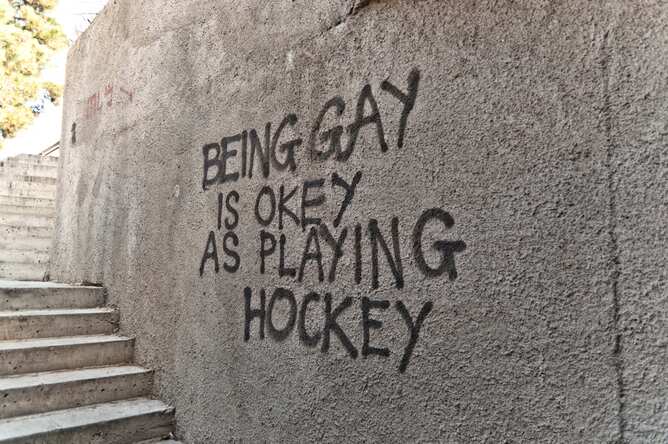 At one level, refusing to associate with Iveri sends a clear signal that her statement crossed a line that current Australian legislation, even if amended by George Brandis, regards as unacceptable.
Pro-gay sentiment on the streets of Tiblisi. Marco Fieber
But among a majority of the world’s population, Iveri’s outburst will have more resonance than it would in Australia – though it is worth recalling that 40 years ago her words might well have reflected public opinion.
This is not an argument for tolerating hate speech, but rather for a pragmatic assessment of how we can best respond.
One unintended consequence of Iveri’s contract now being cancelled is that it will reinforce the perception that “the West” is using homosexuality to wage a cultural war on those whose understandings of sexuality are very different; it might well increase homophobia in Georgia and make Iveri into a martyr for social conservatives.
This is exactly the outcome that many of those who are using sexuality as a means of strengthening their hold on power and maintaining a deeply patriarchal social order will like.
One of the consequences of social media is increasing campaigns for boycotts as a means of expressing outrage and opposition. To boycott an individual artist might well make us feel better, but will OA’s actions actually help those facing ongoing violence and persecution in Georgia?
Rather than Opera Australia cancelling her contract, there were alternatives in this case. The company could have been asked to dedicate a performance to international LGTB rights, and for Iveri to donate her fee that evening to an organisation supporting global rights such as the International Lesbian and Gay Rights Association. Dennis Altman does not work for, consult to, own shares in or receive funding from any company or organisation that would benefit from this article, and has no relevant affiliations.
Share


