Thousands of Australians find themselves in trouble abroad each year. So costly is the process of providing consular assistance, the federal government is considering a ‘user pays’ system.
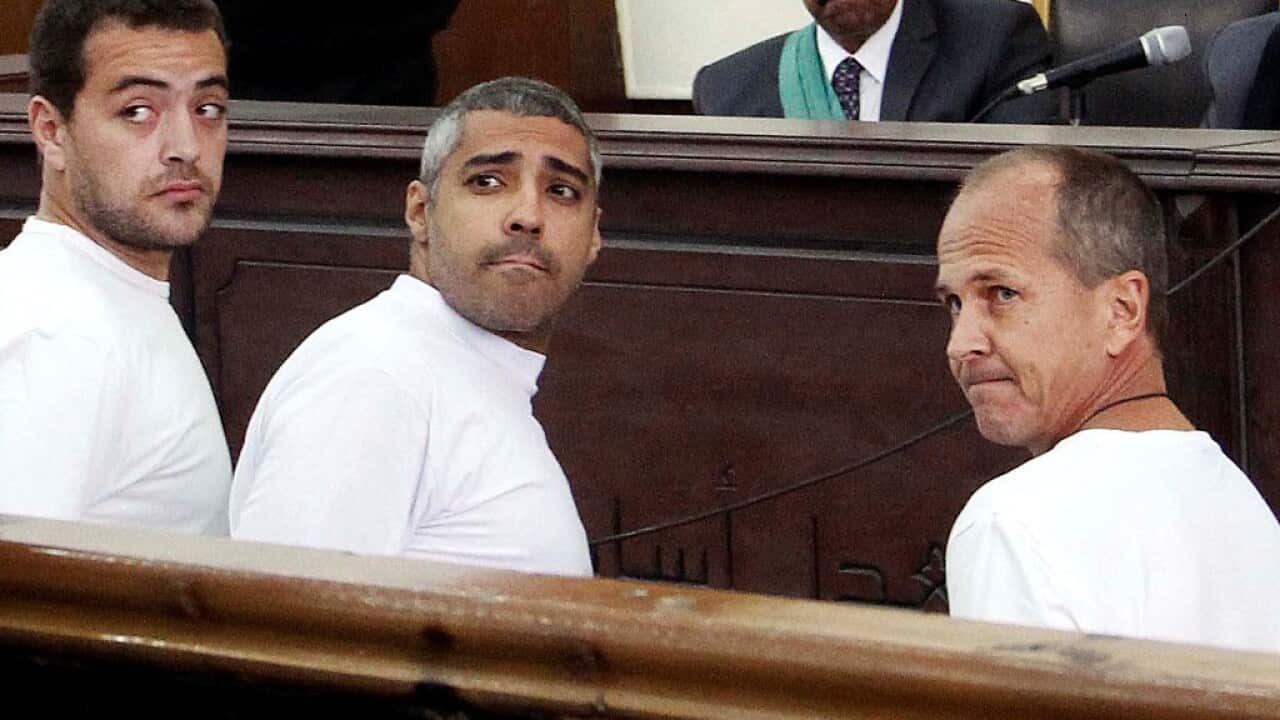
However, there are some situations that no amount of money can fix. And Australian journalist Peter Greste, along with two of his Al Jazeera colleagues is in just such a situation.
Greste, Mohamed Fahmy and Baher Mohamed were arrested in Cairo in December 2013. They were in the Egyptian capital to report on the aftermath of a military coup that overthrew the unpopular but democratically elected Muslim Brotherhood government of Mohammed Morsi. There were violent protests and hundred upon hundreds of arrests as Egyptians sought to protect the result of their first democratic election. So sustained and threatening were the demonstrations that the then acting president, Abdel Fatah al-Sisi, the former head of the Egyptian armed forces, moved quickly to ban the Muslim Brotherhood, a religious and political movement that officially rejects violence but has been linked to outbursts of violent political protest in the past, across the Middle East.
When al-Sisi faced his people at an election in May of 2014, there was significant support for his central platform that Egypt needed to be secured and that the Brotherhood symbolised the birth of an Egyptian version of modern militant Islamism.
The Al Jazeera trio became entangled in the new governments fervour to the stamp out the Brotherhood. Accused of spreading false news and supporting the Muslim Brotherhood, Greste and his colleagues faced an internationally condemned trial. Greste was jailed for 7 years.
Last week, a Court of Cassation in Cairo quashed the convictions and ordered a retrial for the trio. Greste, Fahmy and Mohamed are now innocent until proven guilty.
Though he is under significant international political pressure to release the men, President Sisi clearly finds himself in a series of binds. On the one hand he is accountable to a security apparatus that has convinced the population the Brotherhood is dangerous and the journalists were its mouthpiece and on the other he has a desire to deport the men: President al-Sisi has said he wished the trio had not been put on trial, but rather deported. There is also the president's need to prove to his western benefactors that the country has an independent judiciary but at the same time, not to be seen as interfering in the judicial process to rectify a situation with which he is uncomfortable.
The Al Jazeera case is now so high profile, both internationally and within Egypt that any move President al-Sisi makes cannot be low key.
Lawyers for Greste and his colleagues are now banking on deportation under a prisoner transfer agreement. President al-Sisi signed a decree last November allowing foreigners sentenced to jail or on trial to be deported. It would also be politically face saving for a president who knows how effective the campaign has been to convince Egyptians that the journalists were providing succour to the Muslim Brotherhood and who doesn’t want to be seen as interfering in the judicial process.
All the while, the Australian Foreign Minister Julie Bishop has been trying to make a positive outcome easier for the Egyptian leader, whilst mounting a quiet diplomatic fight to achieve it. She has resisted demands to push for more than President al-Sisi is able to deliver.
"If this were an Egyptian national facing controversial charges in a court in Australia, we wouldn’t be in a position to interfere with the independence of the Australian judiciary. Well, President al-Sisi is saying that the same applies in Egypt" Ms Bishop said.
For Greste, his fellow jailed colleagues and his legion of supporters across the globe, it’s now a waiting game.
However, as Peter Greste’s brother Andrew has noted: "He’s a tough bugger."
“He’s determined that this whole experience isn’t going to break him."
Monica Attard is a Sydney based freelance journalist and former ABC foreign correspondent and senior broadcaster.
Share


