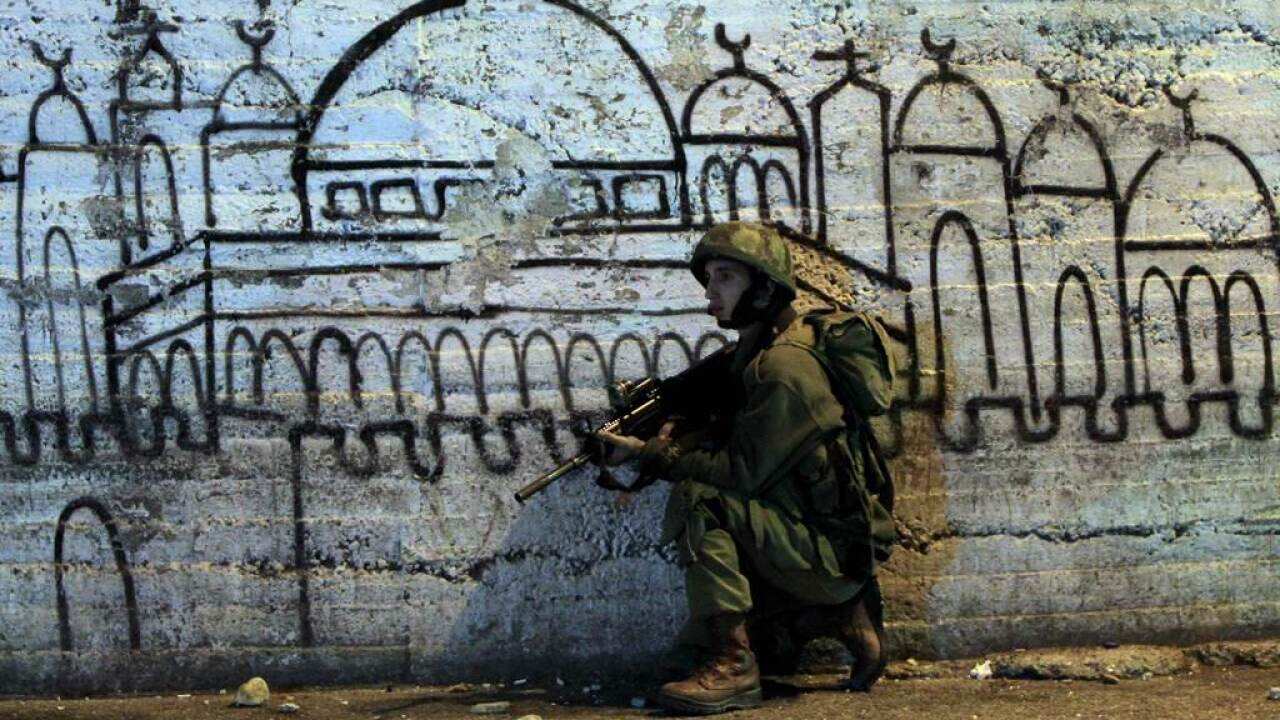
Is it occupied, disputed, or contested? Some are finding it hard to find the right words to describe the West Bank.
In a move widely seen as an effort to demonstrate its pro-Israel bona fides, Australia’s attorney general said on June 5 that the Australian government would stop referring to East Jerusalem – which is part of the West Bank – as “occupied” territory. Attorney General George Brandis explained the change was being made because the term is “freighted with pejorative implications,” relates to “historical events,” and is “neither appropriate nor useful” to “describe areas of negotiations” in the peace process. On Twitter, Israeli Prime Minister Binyamin Netanyahu welcomed Australia’s statement, calling “eastern Jerusalem” an “area in dispute” and condemning “the chorus of hypocrisy and ignorance of history” around the issue.
As a general rule, when an occupying power complains that the term occupation doesn’t apply to its situation, journalists and policymakers should take a deeper look.
Australia’s announcement sparked substantial criticism in its domestic media. Meanwhile, in the United States, mainstream media outlets frequently choose to avoid the “occupied” label, even though the US government officially regards the West Bank as “occupied.” The New York Times, in an unrelated article on June 6, referred to the entire West Bank as “contested” territory, while MSNBC’s Hardball recently aired a graphic about “disputed” territories.
Regardless of whether “occupation” and “occupied” are considered pejorative, they relate to a broadly recognised and specific international legal standard. Whether or not a territory is occupied is a legal question determined by facts on the ground: under laws of war dating back at least a century, territory is occupied when a hostile army has established and exercises authority. It is important to get this right because the international law of occupation, codified in The Hague Regulations of 1907 and the Fourth Geneva Convention of 1949, places certain obligations on the occupying power toward the local population and the territory’s resources. Of particular importance in the case of Israel, the Fourth Geneva Convention, which Israel has ratified, makes it a war crime for an occupying power to transfer parts of its population to occupied territory, as Israel has done in facilitating the growth of its settlements.
The Israeli government’s position is that the Fourth Geneva Convention does not apply to the West Bank, because the territory was not the sovereign territory of a state party to the Geneva Conventions (Jordan) at the time Israel occupied it. However, not only has Israel’s interpretation of the convention been universally rejected, it is also at odds with the convention’s purpose of protecting people under the rule of a hostile military. To our knowledge, every court, foreign government, agency, and international body that has addressed the issue – from the UN Security Council to the International Committee of the Red Cross – refers to the West Bank as occupied territory. In fact, in scores of judgments, Israel’s own Supreme Court has applied the law of occupation to determine the lawfulness of actions by Israeli forces in the West Bank. For decades, it has ducked review of the legality of Israel’s current settlements policy.
So when the Israeli government or others assert that the West Bank is “contested” or “disputed” territory, it’s worth remembering that these terms have no recognised legal meaning, and are nothing more than an attempt to avoid the laws that govern Israel’s military rule there. As a general rule, when an occupying power complains that the term occupation doesn’t apply to its situation, journalists and policymakers should take a deeper look.
Bill Van Esveld is an Israel and Palestine Researcher for Human Rights Watch, Middle East and North Africa Division. He holds a J.D. from NYU Law, where he was a fellow at the Institute for International Law and Justice.
Share


