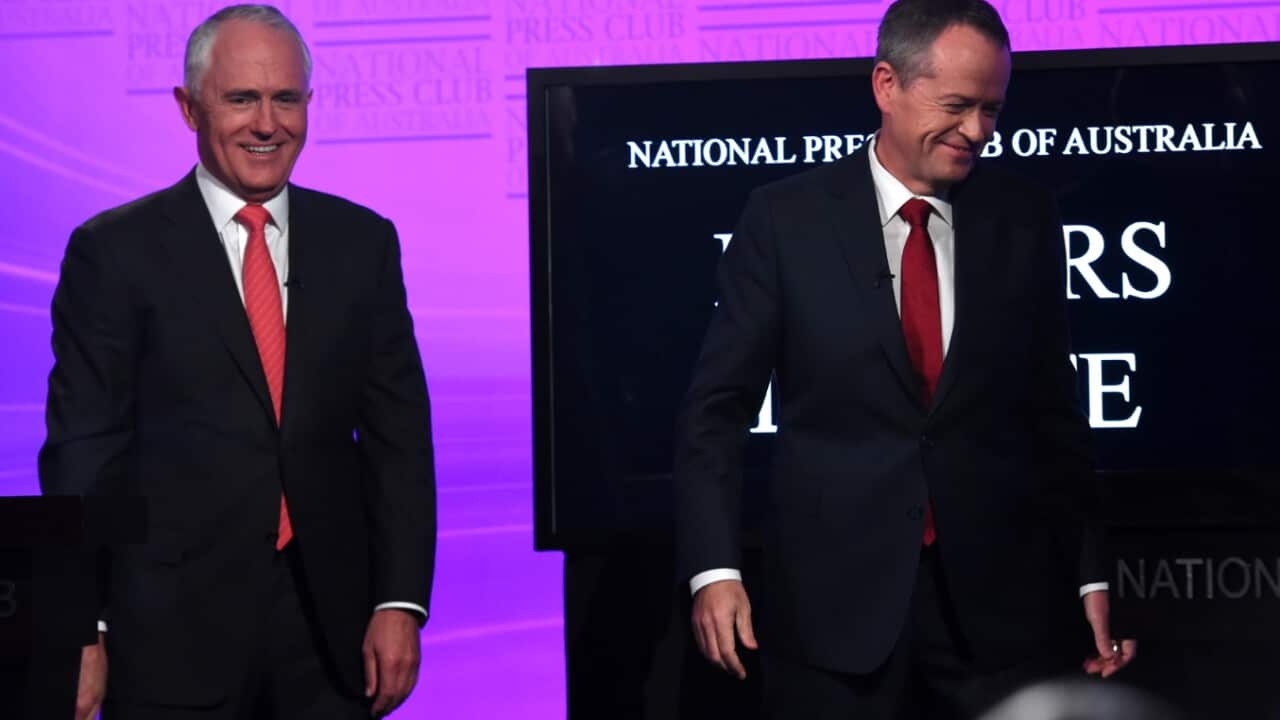
Earlier this week, I watched ABC’s Q&A, featuring Greens leader Richard Di Natale, Labor’s Terri Butler, Liberal MP Steven Ciobo and Independents Jacqui Lambie and Nick Xenophon. And, like 100,000 other Australians, on Sunday night, I tuned into the first formal debate in the election campaign between both party’s major leaders.
Unlike others, I didn’t expect to tune into an entertaining hour of television to rival the likes of 'MasterChef' but I was left with a question - Where is the discussion on global issues this election? Is it too much to expect our future prime minister to be asked questions about global issues and for them to explain their vision for Australia’s role in the world?
Increasingly, our world is a global village and we are citizens of the world. Technology, travel, trade: human advancement has brought us closer together than ever, minimising barriers and borders.
Yet on global issues such as our changing climate, people seeking asylum, global poverty and global inequality, we erect borders, real and imagined, that defy the interconnected nature of these issues and their broad impact.
News that makes sense
Your trusted source for staying up-to-date with the world around you. Get free daily news updates and analysis, straight to your inbox.
Instead of talking about budget black holes, we should be discussing the $11.3 billion black hole in the aid budget due to four consecutive cuts. We should be asking why the Australian government is turning its back on people living in the poorest parts of the world enduring the worst human misery in places like Syria and South Sudan, or the overflowing refugee camps in Kenya.
So why should we be asking these difficult questions about global issues as we head into the election?
As it stands, Australia’s aid budget has been slashed, making it more difficult to respond to natural disasters such as the Nepal earthquake, humanitarian crises like the situation in Syria and in general, to help improve the lives of people in the poorest parts of the world.
The aid budget, at $3.8 billion per year, is less than 1 per cent of the federal budget even though a recent national survey of 1500 people shows Australians mistakenly believe the Federal Government gives 13 per cent of the budget to overseas aid, a percentage about 14 times higher than reality.
Forget about numbers and statistics, this is about people.People everywhere have much to offer, regardless of whether they were born in Australia or in one of the poorest parts of the world. Consider Nona – she’s an 80-year-old energetic woman living in Sri Lanka who had been suffering with failing vision that grew worse as time passed.
Believing nothing could be done, she remained silent and as a result, couldn’t fully enjoy family activities and being involved in her local community. A simple pair of glasses helped to correct her vision, meaning Nona could enjoy all of the things she loved again. This would not have been possible without aid being available to fund the important work of Brien Holden Vision Institute.
Instead of taking away from people like Nona, our gaze should be set squarely on the billionaire corporate companies who don’t pay their fair share of taxes. By failing to pay their share of taxes in Australia or even in poorer countries, these companies are effectively robbing people living in the poorest communities of the revenue that belongs to them. They are taking essential funds away from people who have very little. These corporate companies are generating billions of dollars and are still trying to evade their tax responsibilities.
Why take away help from battlers the world over, when governments are failing to address the rort being carried out by big corporations who are stealing money that would mean older people everywhere can live a better life? In early April, revelations of the Panama Papers exposed the murky underbelly of a system that turns a blind eye towards big businesses and the excessively rich hiding billions of dollars that should be paid in tax.
Alarmingly, it took the endless work of 300 dedicated journalists who trawled through millions of leaked records to break this news to the world. Each year, people living in the poorest parts of the world lose $170 billion due to tax dodging, while 400 million people don’t have access to basic healthcare.
Enabling people living in the poorest parts of the world to keep more of the revenue generated is a vital tool in ending extreme inequality. This can only be done by ensuring global companies are paying their fair share in tax.
We are not just a global economy: we are a global community. Australians are working alongside people all over the world to ensure a fairer world. Global cooperation has helped to almost eliminate polio from the world, as there are only a small number of polio cases left. Ending malaria in the Asia-Pacific region by 2030 is now within our grasp.
We’re living in an age in which the eradication of poverty by 2030 is an ambitious but achievable target made and agreed to as part of the United Nations Global Goals for Sustainable Development. The Millennium Development Goals that were agreed to in 2000 led to a number of incredible achievements. As a result, today we live in a world where global poverty has been halved and more children will live to see their fifth birthday with 16,000 children under five dying from poverty-related causes each day compared to 27,000 just 15 years ago.
But if we are to continue to make progress, Australia must play its role in helping to build a fairer and more equal world and the public must demand that these global issues are debated and given priority by our political leaders.
The consequences of failing to do so are too high for people like Joseph, who contracted polio as a child and has transformed his life with the help of Australia’s aid contribution.
This election is about the future, not just of people here in Australia, but the future of people who live in some of the poorest parts of the world. This July 2, remember that your vote impacts people all over the world.
Tony Milne is the Campaign Director for Campaign for Australian Aid







