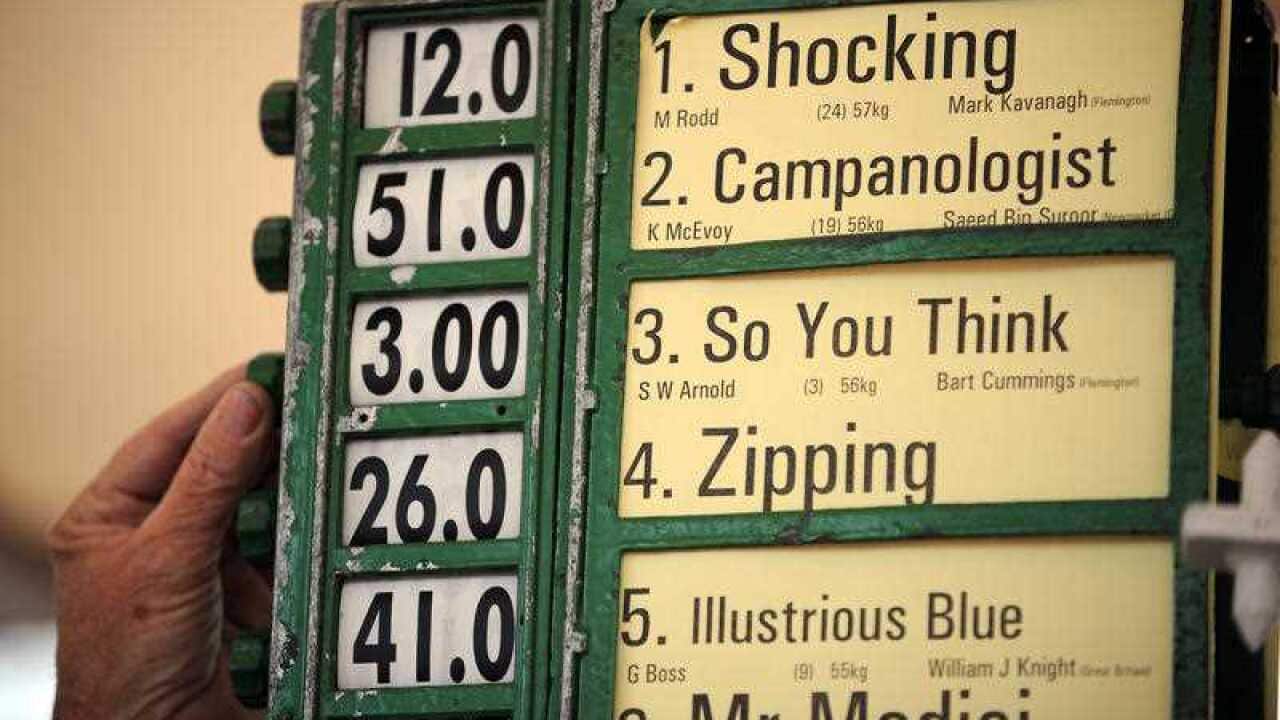
October 21, 2015 has come and gone and there have been no reported sightings of DeLorean sports cars dropping in from 1985, grabbing a booklet of horse racing results and taking them back to the past.
But it’s been a good week to consider what the fiction writers got right and wrong in the popular 'Back To The Future' movie series of the 1980s.
The flying cars of their imagination don’t exist - yet. The urban wastelands do, but in a different form to that confronted by Marty McFly and Emmett 'Doc' Brown.
And betting, well it’s bigger than any of us could possibly have imagined.
News that makes sense
Your trusted source for staying up-to-date with the world around you. Get free daily news updates and analysis, straight to your inbox.
Just how big, and undesirable, sports betting has become was made evident during the thrill of this year’s football finals which seemed to exist on TV, really, as supporting material for the sports betting agencies finding new and inventive ways for Australians to lose their money.
Anyone arriving unexpectedly in 2015 - even from 2005 - would be shocked at the wall-to-wall enticements to bet served up through big sporting events.
Indeed, while the politicians have got exercised about digital technology and its impact on the taxi industry, they seem to have largely stayed impervious to the impact of digital technology on the betting industry.
That now offers anyone holding a mobile phone the ability to bet on anything, anytime, until their heart’s content and their credit card reaches its limit.
The constant enticements have numbed our resistance to gambling and have normalised the idea that spectator sports are now the same as horse and dog racing.
This is what kids are learning and it means nothing but good news for the betting companies as those kids become, phone-toting, credit card carrying teenagers and adults.
I’m no wowser and am happy to put some money through the pokies or on a horse at the Melbourne Cup. I’ve got nothing against licensed clubs or casinos as places built to gamble – so long as their licences depend on encouraging responsible gambling and they push some of their profits into social infrastructure.
But, aside from the constant pressure to bet, there are a myriad of other unresolved issues with sports betting, starting with regulation of the games.
While it’s hard to see the result of a team sport being rigged to the detriment of punters acting in good faith, it’s possible to see individual components being contrived.
For instance, what happens if a group of players agree who will score next to support a large bet? Or what if a match official makes a contentious call, again to the detriment or benefit of punters?
The beauty of sport is its element of surprise and you can be assured that more and more of the surprises we love in sport will become the matter of speculation as more and more money is lost from the unexpected.
What a shame. Because the fact of it is that the football codes are not set up to monitor performance in the same way the racing codes are – and even there, we get plenty of tales of shonkery.
The football codes are able to command bigger and bigger prices for their content from TV stations looking for audiences in a more competitive media world.
The TV stations are selling those audiences to advertisers – increasingly the betting agencies who need to take some responsibility for what their businesses are doing to the games Australians love.
It only follows that more of the TV revenue needs to find its way to better match regulation so Australians can remain confident in the integrity of their games.
It may be that the horse has bolted (so to speak) on the saturation of betting into every aspect of life.
But will we look back on this in the same way we look back cringingly at the TV advertising that glamorised cigarettes in the 70s and 80s?
My guess is that we don’t need a crystal ball – or a DeLorean to take us into the future. The answer is yes.
Madonna King is a senior journalist, and has worked at News Corporation Australia, Fairfax and the ABC. She is the author of six books.







