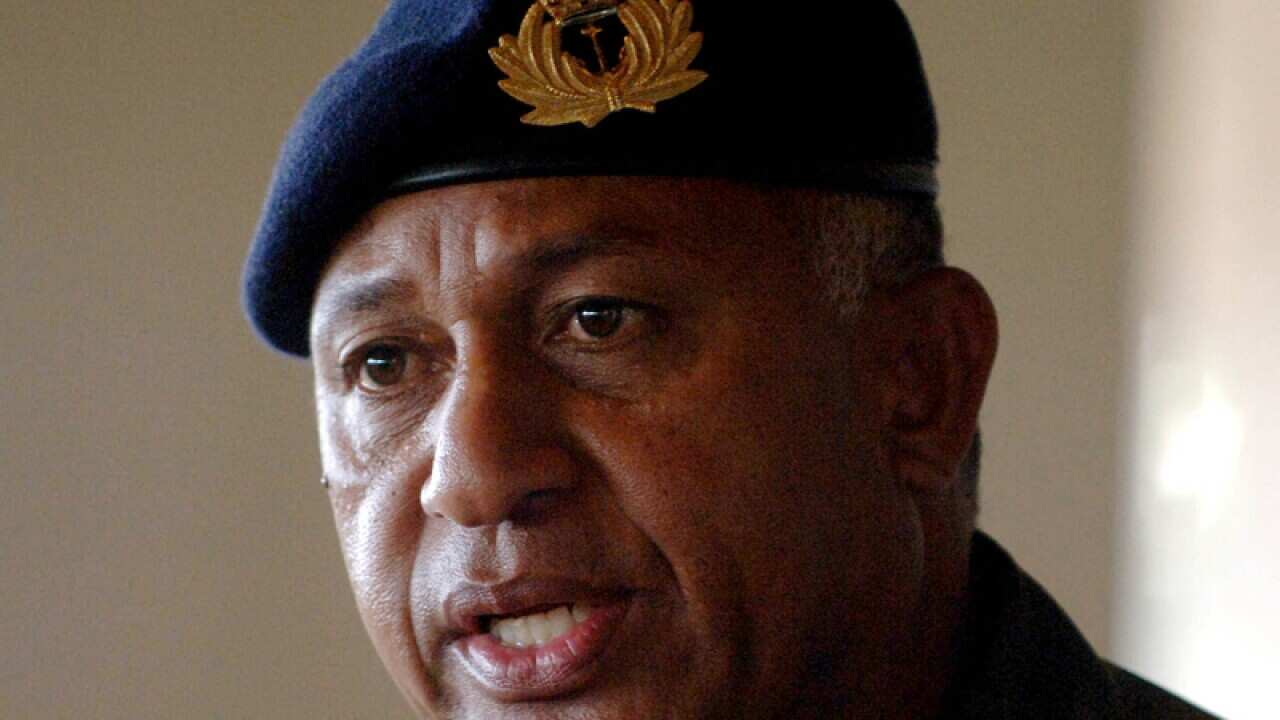
After he used the army to seize power in late 2006, Fiji has been beset by a lack of freedom of speech, transparent media, and basic human rights.
In order to be eligible to contest the 17 September election, Bainimarama has stepped down as Commander of the Fiji Defence Force. This is to avoid a Fijian law that disqualifies members of the country’s military force from engaging in political activity.
The latest poll shows support for his FijiFirst Party is sitting at 45 per cent, with the mainly indigenous i-Taukei SODELPA party in second place at 21 per cent.
If the polls prove accurate, Bainimarama would be forced into forming a coalition government with another party to form a majority. However, Professor Brij Lal from the ANU College of Asia and the Pacific believes this is not an option Bainimarama would be happy to consider.
“Frank Bainimarama has said over and over again that he intends to win all 50 seats,” says Professor Lal, despite this being "impossible".
“You don’t have a majority party winning all of the seats. Or a majority of the seats." Professor Lal explains the system is designed for multi-party coalition government.
“Often, his modus operandi is ‘my way or the highway,’” he says.
The history of Fiji's constitution
History has shown that Bainimarama doesn’t like working in an environment where negotiation, discussion, consensus and compromise is necessary.
Professor Lal was a member of the Fiji Constitution Review Commission which formed the basis of the 1997 Constitution. The document was later torn up.
Currently, the military plays a guardian role over the 2013 Constitution which Bainimarama oversaw the drafting of.
Any attempts by political parties who want to change it will be difficult, Professor Lal warns.
“A number of political parties have said that they would like to review the constitution because they are unhappy with some aspects of it," he says.
“What the military will simply say is that ‘under this Constitution, we are now constitutionally obliged to act because we want to protect this Constitution’,” says Professor Lal.
It would be a "ready-made situation" for military intervention, “under the cloak of legitimacy”. In such a scenario the military would be acting on what the Constitution required it to do.
“This government will be in charge throughout the election. There will be no caretaker government of the type you normally have," says Professor Lal. He is concerned there has not been a level playing field for all contesting the election.
If Bainimarama loses
If Bainimarama lost the election outright, Professor Lal does not believe he would observe the verdict of the ballot box and depart with grace.
“I think that is unlikely. What he will likely say is…all that we have done over these years…these things are now in jeopardy."
It is more likely Bainimarama would think his mission is not complete, and choose to stay on.
In any case, Lal remains hopeful 17 September would mark the beginning of the long journy back to parliamentary democracy for Fiji.
Share


