- US tried and failed to rescue hostages, says Pentagon
- 'Shocking, depraved': Hunt to identify ISIS executioner who beheaded James Foley
- Why are Australians being drawn to the conflicts in Iraq and Syria?
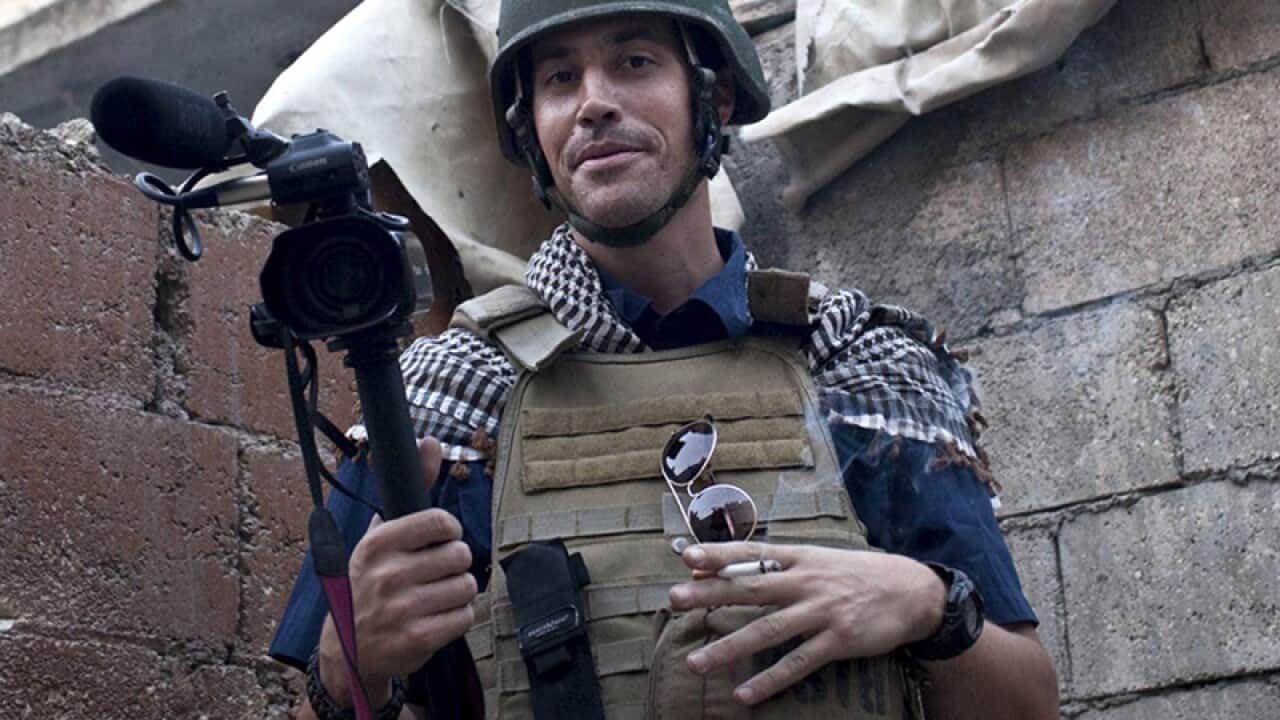
The bloodthirsty jihadists of the Islamic State (IS) have murdered James Foley, an American journalist who was kidnapped in Syria in November 2012. They also have threatened the life of Steven Sotloff, another American freelancer, who was seized last August, and has written for Foreign Policy on three occasions. The executioner in the video warned President Barack Obama that Sotloff would die if the White House continues its bombing campaign in Iraq. I assume that the president has asked intelligence and Special Forces operatives whether Sotloff could be freed in a raid. I hope he determines that he can be; but it's very unlikely. The record of rescue attempts has not been good since American helicopters came to grief in the Iranian desert in 1980. And IS could be shuttling Sotloff anywhere in their vast "caliphate."
It is a gut-wrenching moment. And it's impossible not to think about how it could have been otherwise.
Sotloff had been seized a few weeks before I arrived on the Turkish-Syria border to write a piece for FP about the rampant kidnapping of journalists by IS (at the time, still ISIS) and other Islamist extremists. I never met him, but he was a good friend of Barak Barfi, an Arab scholar and fellow at the New America Foundation who served as my guide and mentor on this article. I talked to many of the people who had advised Sotloff on when and where and how to cross into Syria that last time. (Little of that made its way into my dispatch, since I went to great lengths to protect the identity of journalists then being held.) Some of them thought he had not taken proper precautions; but the situation had deteriorated so rapidly over the summer of 2013 that even a few of the world's most experienced war correspondents had escaped being seized only by a stroke of luck. Sotloff was one of the unlucky.
News that makes sense
Your trusted source for staying up-to-date with the world around you. Get free daily news updates and analysis, straight to your inbox.
Being kidnapped is not usually a death sentence, whether for diplomats or businessmen or tourists or journalists. Most kidnappers in war zones view their prey as a commodity. The Taliban who kidnapped New York Times correspondent David Rohde in Afghanistan at first sought to trade him for money. In Syria, the nationalist rebels who seized journalists in the first years of the war usually held them briefly and then sold them off. ISIS, however, was different. They asked nothing, and divulged nothing. Their victims simply disappeared. And yet, it seemed, they had not been killed. No one knew what, if anything, they wanted. Perhaps they weren't sure either.
And then, earlier this year, some disappeared journalists began to emerge. Two Spanish journalists were released in March. The following month, four French journalists emerged from captivity. It was widely assumed that ISIS had demanded ransom, and that the European governments had agreed to pay. European governments generally agree to make, or facilitate, ransom payments, which are believed to have run as high as $10 million.
Neither the United States nor Britain makes payments of this sort, and sharply criticize European governments for doing so. But perhaps that's why no American or British journalists have been freed during this period. In August, of course, the United States began bombing IS positions in Iraq, further complicating any official attempts -- if they were made at all -- to free Foley and Sotloff. They were thus available to serve as punishment, and as blackmail.
"This raises an agonizing question: Should states pay ransom to kidnappers?"
This raises an agonizing question: Should states pay ransom to kidnappers? If you are a friend or loved one of the victim, the answer is obviously yes. But even a more remote observer could cite the moral argument that the obligation to treat people as ends rather than means -- what Kant calls the "categorical imperative" -- forbids one to place the life of the abductee in a balance with abstract goods, like "sending a message" that kidnapping doesn't pay. In any case, the consequences of capitulation are remote and hypothetical; the life is terribly real. Israel, the most hard-nosed of democracies, has been prepared to pay a terrible price to retrieve its captured soldiers; in 2011, the state handed over 1027 prisoners, a quarter of them serving life terms, in exchange for Gilad Shalit. Israelis understand that by doing so they may encourage further kidnapping, and thus further endanger their own security; it is a price they are prepared to pay.
Journalists are not soldiers, and Americans are not Israelis. And U.S. presidents are clearly not moral philosophers. The president has an obligation to consider the consequences of his decisions, and act accordingly. The consequences of capitulating to terrorist kidnappers are ruinous. As a recent New York Times investigation revealed, "Kidnapping Europeans for ransom has become a global business for Al Qaeda, bankrolling its operations across the globe." That's why no European government will admit to making payments. The thought of Steven Sotloff jammed into a pit, awaiting death, when he might have been freed for nothing more than money, is unbearable. But the thought of rewarding the Islamic State for its savagery is also unbearable. A humane response to a monstrous act engenders more monstrousness.
At the end of the video apparently showing Foley's execution, Sotloff is shown kneeling; the IS executioner says, "The life of this American citizen, Obama, depends on your next decision." The plain implication is that President Obama could save Sotloff's life by calling off the American bombing campaign in northern Iraq. One might say that this represents another stage of the moral dilemma; but here the calculus is unambiguous. To call off the bombing is to endanger thousands of Iraqi civilians now menaced by the jihadists' advance; and there is no guarantee that IS would even a modicum of compunction to spare their captive's life -- even if they got what they wanted. Nevertheless, you would not want to be in Obama's shoes right now.
"The liberal state is awestruck, and often paralyzed, in the face of evil."
The liberal state is awestruck, and often paralyzed, in the face of evil. We shiver when we hear a Taliban or al Qaeda warrior boast, "We worship death and you worship life." To seek death over life is to gain mastery over those who love life. That's why the suicide bomber is such a fearsome weapon. In fact, peace-loving people are prepared to fight, and risk death, to preserve everything that makes life worth living. Yet there is a terrible insight in that death-swagger. When our cherishing of each life leads us to surrender to blackmail, we fortify the death-cult; we abet evil.
One wishes, of course, for some sort of Gotterdammerung out of Inglourious Basterds, in which the former victims rise up to give the monsters a taste of their terrible medicine. That's what the movies are for. In real life, Obama has done what he can do by sending American warplanes to hammer IS positions in Iraq. For the moment, at least, he has saved Kurdistan from being overrun, and driven the jihadists away from the Mosul Dam. That's a very good start. There may be nothing Obama can do to save Steven Sotloff. But there is a great deal he can do to show the criminals of the Islamic State that the West is prepared to defend the values it professes.
James Traub is Fellow of the Center on International Cooperation.
© Foreign Policy 2014







