(Transcript from World News Australia Radio)
An Elders group in Sydney's Bankstown is connecting - and creating - community.
When she moved to the city from country New South Wales more than 40 years ago, Aboriginal Elder Lola Simmons lost contact with many Aboriginal people.
News that makes sense
Your trusted source for staying up-to-date with the world around you. Get free daily news updates and analysis, straight to your inbox.
It wasn't until years later when she was approached in the street and asked to join a local Elders group that she got to really know her local community.
Lola Simmons is just one of a number of Aboriginal people who make up part of the Elders group run by the local arts centre.
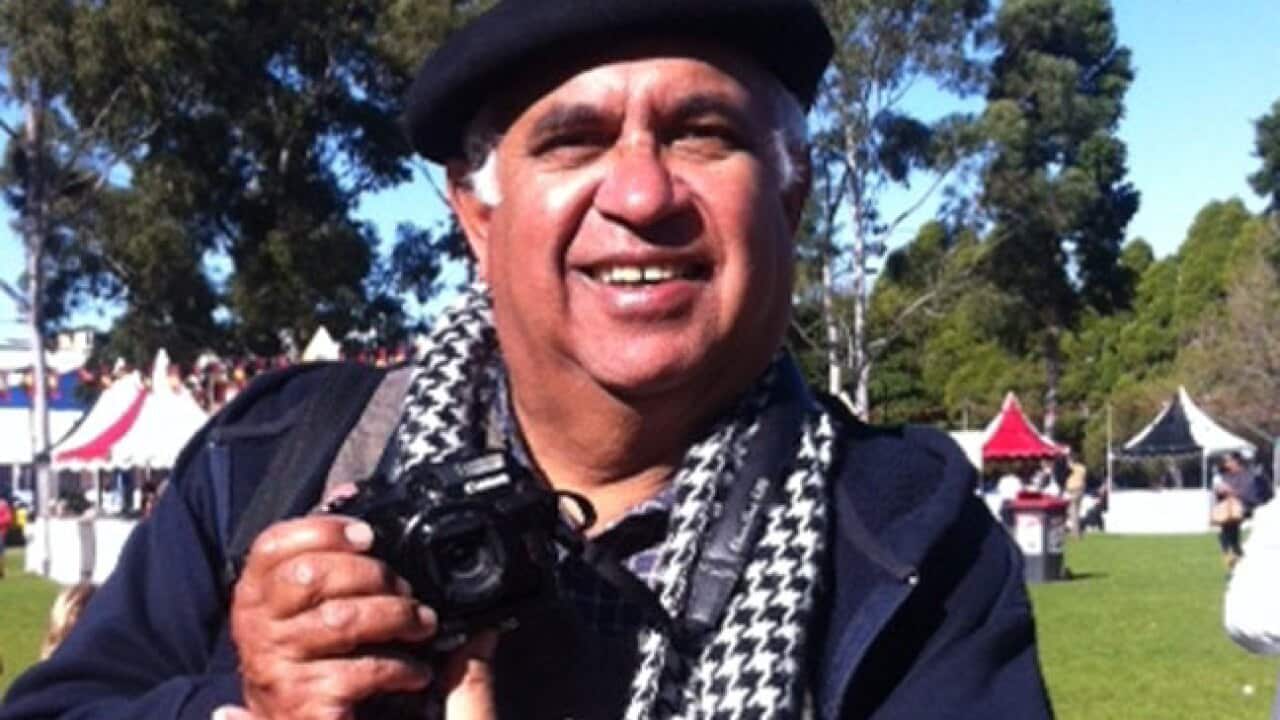
The members of the group have also been photographed by Aboriginal photographer Mervyn Bishop for a series of portraits that make up part of an oral history project put together by the group.
The Bankstown train line cuts runs through the centre of multicultural Sydney.
On the way there the train stops at Belmore, home to a large Greek community while further along the track Lakemba emerges, home to a large Lebanese-Australian population.
At Bankstown the train station sits smack in the middle of the shopping centre which houses mainly Vietnamese and Lebanese grocery shops and restaurants.
It's a short walk through the shopping centre to the Bankstown Arts Centre where SBS is meeting with Vandana Ram, the Director of the Centre.
She's talking about the Centre's Aboriginal Elders group.
"Every Friday Afternoon, I've got an elders group and it's sorted of an open space for them it's really there kind of hang out and what I found is that they're really open and interested in doing anything new. And to some extent they have been meeting in the community in different ways. But the Arts Centre it's a new centre and it's really something where I want to open it up to everybody. And say there's a place for you here. So it's really an elders connecting and creating kind of program. And interestingly when I talk to them about what they would like to do, they said, we would really like to learn how to send text messages to our grandchildren. So they might actually learn some of those really basic sort of social media things. They might end up making a little short film. So we're going to just see where it goes but it is really a space just for them."
In a guide on the usage of indigenous terms, the New South Wales government says an Aboriginal Elder can be one of two things.
The traditional meaning is of someone who has gained recognition in their community as a keeper of cultural knowledge and beliefs.
An Elder can also be an Aboriginal people above a certain age but who may not necessarily be formally recognised as an Elder.
Mervyn Bishop describes himself a an Aboriginal Elder.
He's also a photographer and his portraits of the Bankstown Elders hang in the foyer of the Arts Centre.
"I come from a little town called Brewarrina in north-western New South Wales and I started taking pictures when I was about 8 or 9. I've always been interested in photography, my dear mother was a keen photographer. We always had pictures of friends and family in the house. I used to borrow her camera every now and then and take pictures with it. I loved going in when friends had a darkroom and I loved working in the darkroom and from that point on I was kind of hooked."
Mervyn Bishop was one of the first Aboriginal photographers to make it in the mainstream.
He was the creator of the iconic image of Gough Whitlam pouring sand into the hand of Vincent Lingiarri in 1975.
The photo captured the moment when the Wave Hill cattle station in the Northern Territory was handed back to its traditional owners, the Gurindji people who were on a nine-year strike over working conditions.
This was a turning point in the land rights movement for Indigenous Australia and also a turning point in Mervyn Bishop's career.
Mervyn Bishop has spent about 60 years working professionally in a job that's taken him from the outback, to the suburbs of Sydney.
His portraits of Bankstown elders are of Aboriginal people from many parts of the country.
But they all had one thing in common - they made the City of Bankstown their home.
"I'm Harry Allie. I'm a Bankstown elder. I've lived in the area for 30 odd years but country for me is Kudjula country which encompasses the Charters Towers area in North Queensland."
Harry Allie's grandfather came from the Malaca Straits while his great grandfather was brought over from Vanuatu by so-called Blackbirders, who brought Pacific Islanders to Australia to work.
He was in the Royal Australian Air Force when he was posted to the Bankstown area in 1980 and has lived here since.
Known as Uncle Harry, he's had a long involvement in Aboriginal and Torres Strait Islander issues and policies and was the former chairperson of the Aboriginal and Torres Strait Islander Advisory Committee for Bankstown City Council.
Bureau of Statistics figures show just over 63 per cent of Bankstown residents have both parents born overseas, compared to the Australian average of just over 34 per cent.
The Aboriginal community is small, numbering just over 1300.
Uncle Harry says apart from organising get-togethers and other events, part of the Elders group role is to educate new migrants in the area about Australia's Aboriginal and Torres Strait Islander history.
"Bankstown LGA has got something like 164 different sort of cultures with us being the first people, it's something that we've been chipping away at. We get surprised sometimes when people say I did not realise that about Aboriginal and Torres Strait Islander people. So it's very important that we with our culture and certainly as time goes by there's been a long history a proud history of involvement by the residents here at Bankstown to be proud of that I live in Bankstown."
Reasons for moving away from their small communities vary amongst the Elders.
For some it was to find work, for others challenging personal circumstances pushed them to leave.
"I'm Lola Simmons. I come from a little place called Gulargambone. My family's Wilwan, my dad. My mum is Wiradjuri woman. And I've been a member of the Bankstown Community since 1968 when I came from the country. We've got a child who is physically handicapped. So we come to treatment for her, so that's what we done. That's why we ended up here. We always think about what could've been, but this is our life down here. But we love to go down to the country."
Lola Simmons describes the town of Gular where she grew up as a very racist place and her marriage to a white man in the 1960s was difficult.
She says in Bankstown her mixed marriage was never really an issue, but she had very limited contact with other Aboriginal people until she was approached by a stranger in the street.
Since then her social life has never been busier.
"I'm 72 now. I never sort of seen any Aboriginal people. And then I was here one day and a lady was walking down the street and she said are you an elder Aunty? And I said not really and by then I was already in my 60s. And I said we're starting an Aboriginal group and that's how we got to meet the Aboriginal people that's sad that isn't it. Like since I joined the elders group I can't believe how busy we are. Some days we have five days a week of going to different places, but already booked out for two days next week and then we meet on Wednesday and Thursday and Friday generally we do ceramic classes at that arts centre."







