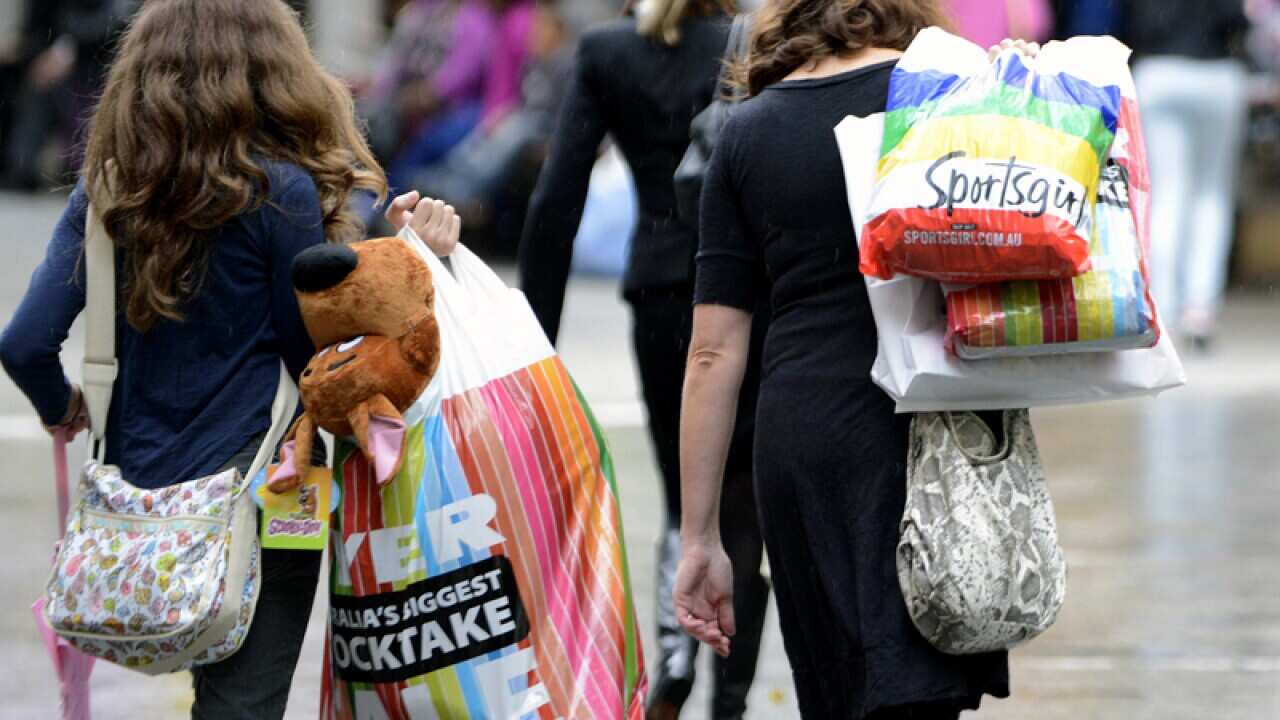
Australians are feeling frugal when it comes to shopping - they're happy to spend on eating out but are steering clear of those shopping centre tills.
Retail spending rose just 0.1 per cent in August, weaker than the 0.4 per cent rise economists were expecting, according to figures from the Australian Bureau of Statistics on Wednesday.
Consumers spent $23.3 billion in the month, but if you exclude spending on food, retail sales actually shrank in August, driven by a sharp drop in department store spending, Citi economists said.
That's surprised economists, given consumer confidence bounced in August and housing market activity was expected to lift home-related purchases.
Online retail spending growth also slowed in August, according to the latest figures from National Australia Bank.
Russell Zimmerman, executive director of the Australian Retailers Association, said the figures were disappointing, but not surprising.
"August is a very difficult trading month," he said.
"You're out of winter, you're not into summer, your sales are almost completed, and although you've got the beginning of your summer stock coming in, August was a pretty cold month.
"Clothing, footwear and accessories are very weather driven, so I think you'll see some good figures come through in September, October - it's all going to be ok."
Mr Zimmerman said it was encouraging that cafe, restaurant and takeaway food sales were going from strength to strength, up 10.1 per cent for the past 12 months.
"When people start to feel a little more comfortable with where things are going, they will give themselves small treats like eating out, so this could be the beginning of a trend," he said.
The drive toward eating out was part of a cultural shift in Australia, as our lives get busier and we are more influenced by foreign cultures, Mr Zimmerman said.
We've also got more money to spend on eating out, since the high Australian dollar has driven the price of clothing and footwear down, he added.
But Citi economists said anecdotal evidence pointed to soft retail sales continuing through September.
They said consumer spending was unlikely to pick up while unemployment fears remain high, meaning the Reserve Bank needs to maintain low interest rates.
They warned investors against putting consumers off by discussing possible rate rises amid the debate over Australia's hot property market.
"This data should remind investors not to over-extend the current debate on what to do about segments of the housing market by talking about interest rate rises," Citi economists said.
"The economic rebalancing remains delicate and still requires accommodative policy, ie, no change in stance from the RBA in the policy language next week."
RETAIL SPENDING BREAKDOWN FOR AUGUST
* Department stores, fell 2.9 pct
* Household goods, fell 0.8 pct
* Cafes, restaurants, takeaway food, rose 0.2 pct
* Food, rose 0.3 pct
* Clothing, footwear, personal accessories, rose 0.3 pct
* Other retailing, rose 1.6 pct
Source: ABS (seasonally adjusted)
Share


