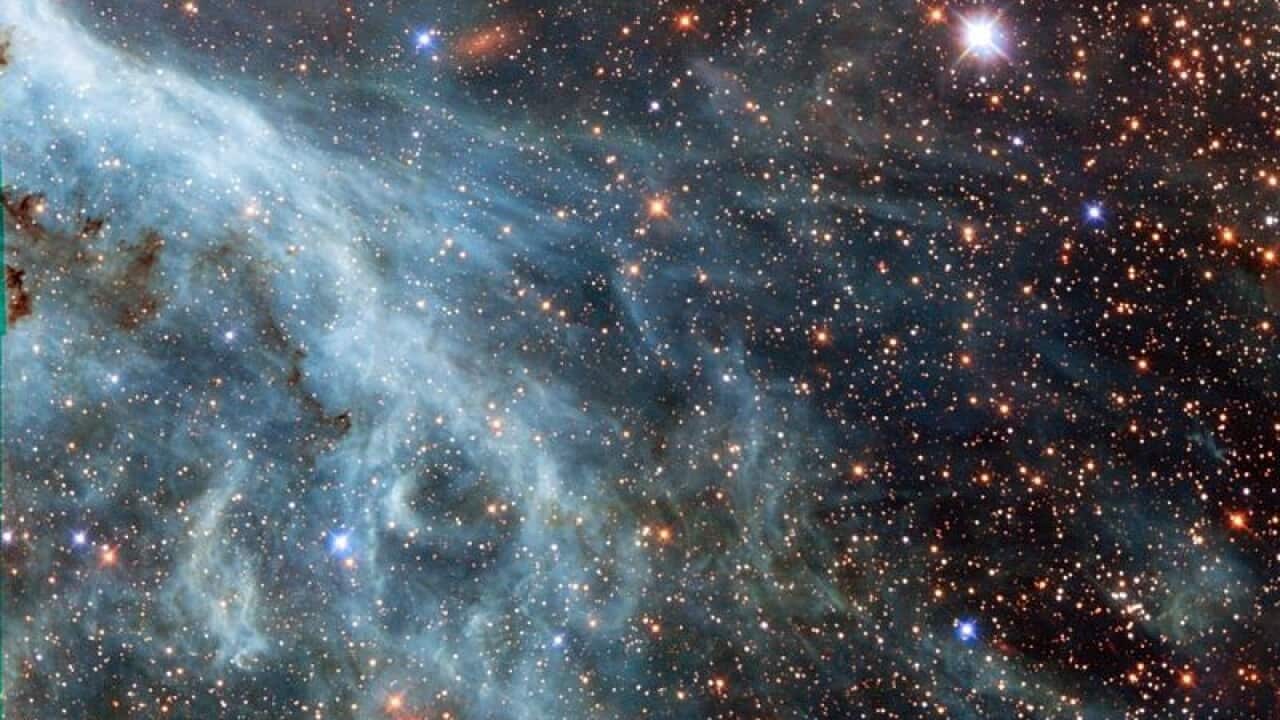
Cosmic rays reaching earth come from other galaxies far outside the Milky Way, new research has revealed.
Ending a 50-year debate over the origin of the rays, a global collaboration of scientists has found there is only a one in million chance they could have come from a single source, within our own galaxy.
The research, which has involved scientists from the University of Adelaide, was published on Friday in the journal Science.
"This clearly indicates an origin of particles outside of the Milky Way and is a very exciting outcome, the result of years of careful work with a highly tuned giant detector," Bruce Dawson, from the university's energy astrophysics group, said.
"This is the first conclusive evidence that real atomic material, not just star-light, arrives at earth from distant galaxies."
News that makes sense
Your trusted source for staying up-to-date with the world around you. Get free daily news updates and analysis, straight to your inbox.
Cosmic rays travel through space at speeds just less than the speed of light, but are extremely rare, arriving at a rate of only one per square kilometre per year.
As one enters the earth's atmosphere, it collides with an air molecule and creates a giant cascade of subatomic particles which sweeps down through the atmosphere almost at the speed of light, in a disc-like swarm several kilometres in diameter.
It's this cascade that can be detected by the Pierre Auger Observatory in Argentina.
The new research has determined that they arrive from multiple directions, although the actual sources are yet to be pinned down.
"The sources of these particles may be extreme cosmic environments associated with supermassive black-holes at the centres of galaxies, or perhaps in massive shocks in colliding galaxies," senior research associate Jose Bellido said.
The observatory is currently undergoing an upgrade to narrow down the origin of the rays.







