
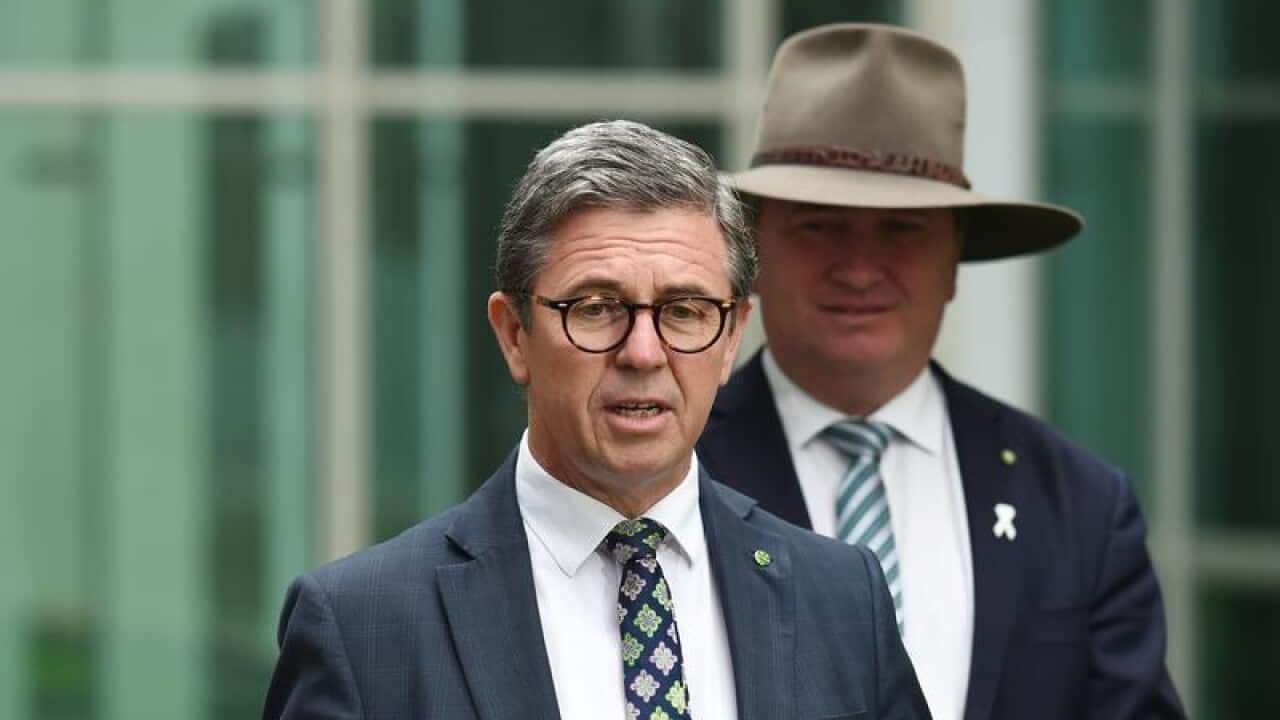
Assistant health minister David Gillespie faces an anxious wait as the High Court considers whether to hear a case against him over his eligibility to remain in parliament.
The decision could set an important precedent in crashing through a political impasse over the handling of a slew of suspected dual citizens.
If the case is struck out, it will be a significant win for the Turnbull government, which holds onto power by a paper-thin margin in the lower house.
Dr Gillespie, a Nationals MP, is facing questions over his eligibility due to a shopping centre he owns on the NSW mid north coast.
One of the shops is an outlet of Australia Post, a government-owned corporation.
Failed Labor candidate Peter Alley is challenging Dr Gillespie's eligibility to sit in parliament, arguing the assistant minister may hold a financial interest in the commonwealth.
But before these claims can be tested, the court must determine whether it can investigate without a direction from parliament.
During a day-long preliminary hearing in Canberra on Tuesday, Solicitor General Stephen Donaghue said it was up to the relevant house of parliament to refer one of its members to the court.
Allowing instead a challenge by a private citizen, under the Common Informers Act, would undermine the "exclusive cognisance" of parliament to dob in its members.
Dr Donaghue suggested a legal challenge could be mounted - but not decided - without such a referral.
But Bret Walker, acting for Mr Alley, said the High Court had the jurisdiction to rule on the case and did not need to wait for a referral.
He argued the legislation at play was designed to counteract the "identified mischief" of partisan politics influencing the actions or inactions of parliament.
He raised the "politically potent" possibility where eligibility issues were raised but parliament refused or neglected to act, allowing the sitting member to remain in office for a full term.
Mr Walker said if the court did not have the power to investigate such matters without parliament's say so, it would be reduced to the "absurdly trivial" role of simply calculating financial penalties afterwards.
However, Guy Reynolds, representing Dr Gillespie, insisted it was the privilege of parliament to decide whether a politician should be referred.
Only "clear and unmistakable" language in subsequent laws could topple this, and the legislation being leveraged in this case was "completely silent" on the matter.
The High Court has reserved its decision.





