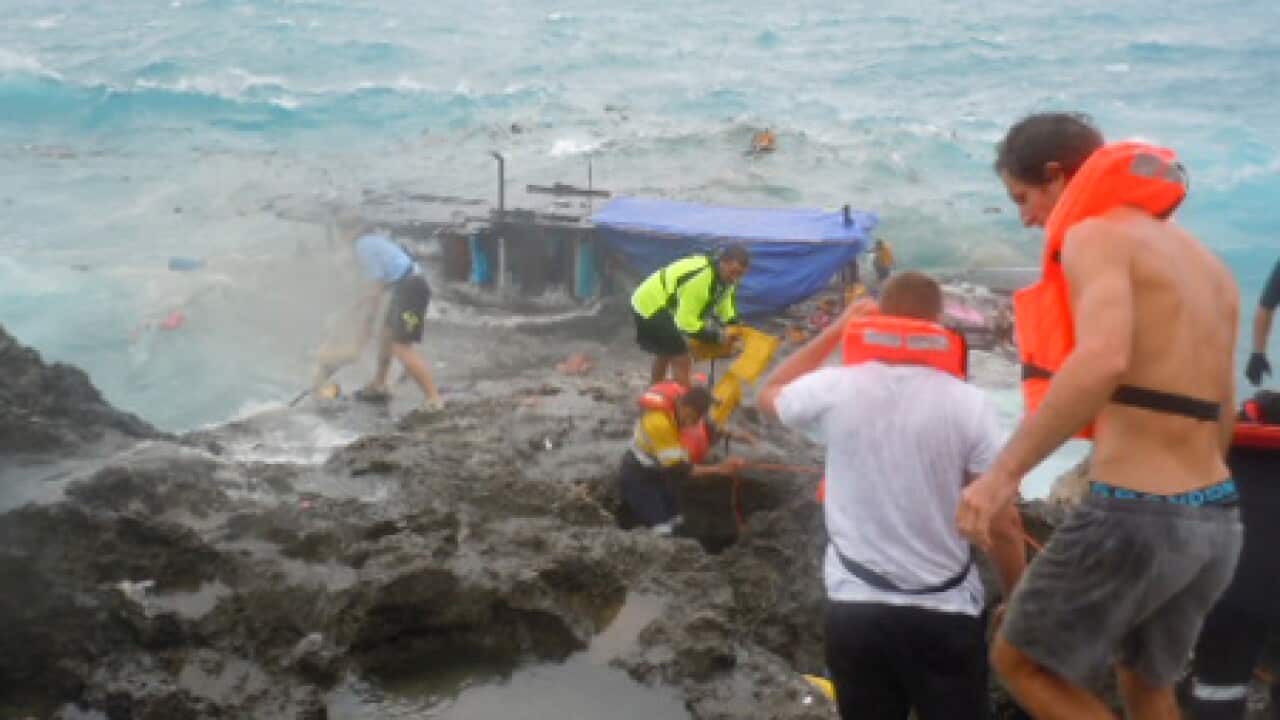
Customs and Border Protection personnel responded appropriately to the Christmas Island boat disaster in December, an internal review has found.
At least 30 people died when the asylum seeker boat known as SIEV 221 crashed on rocks and broke apart off Christmas Island on December 15.
Forty-two people survived but others were never found.
A Customs and Border Protection Command internal review, released on Monday, found the organisation had no intelligence to indicate when the boat departed Indonesia or was likely to arrive at Christmas Island.
The review also found the organisation's personnel responded appropriately to the disaster.
News that makes sense
Your trusted source for staying up-to-date with the world around you. Get free daily news updates and analysis, straight to your inbox.
The organisation's CEO Michael Carmody said his personnel deserved recognition.
"In putting their own lives at risk in extremely dangerous circumstances to rescue 41 people from the sea, the crews of HMAS Pirie and ACV Triton deserve our highest praise," he said.
"I am pleased that the internal review recognises the brave efforts of those personnel involved in the difficult rescue."
Mr Carmody said he had accepted all eight of the review's recommendations.
The recommendations would be acted upon by June 30 this year, he added.
Recommendations include a trial of a land-based radar surveillance system and additional safety and rescue equipment at strategic locations.
Mr Carmody said he found no evidence that any of his personnel had committed criminal or disciplinary offences.
"I have come across nothing in the course of this review that would lead me to form such a view," he said.
"To the contrary, the material available to me has indicated that all persons involved have acted in accordance with policies, processes and procedures relevant to the exercise of their duties and, where there was not a specific policy, process or procedure in place due to the unprecedented nature of this tragic event, have acted appropriately and exercised good judgment.
Prime Minister Julia Gillard said she wholeheartedly commended the actions of Border Protection Command and thanked them for their service.
Attorney-General Robert McClelland said the review was no substitute for a more thorough inquiry being conducted by the West Australian coroner, and investigations by the Australian Federal Police and WA police.
Conditions on the day were "treacherous", with four metre waves, 40 knot winds and rain reducing visibility to 150 metres.
"Those forces of nature were essentially behind SEIV 221 driving it onto the rocks of Christmas Island," Mr McClelland told reporters in Canberra.
"The bravery and professionalism and actions above and beyond the call of duty resulted in some 41 persons being rescued in those treacherous conditions."
Mr Carmody said there was no "firm intelligence" indicating that the boat was headed towards Christmas Island.
It was first seen at about 5.40am (WST) on December 15 by a Customs and Border Protection officer on the island.
"At that time the vessel was some 600 metres offshore and travelling under its own power," Mr Carmody said.
Two customs vessels were in the vicinity at the time of the crash, based to the east of the island, Mr Carmody said.
He noted that the weather conditions had been so poor that neither vessel, carrying 11 and 108 asylum seekers, had been able to transfer their passengers to the island.
One had been trying unsuccessfully for two days.
A land-based ship detection radar, already commissioned when the tragedy happened, will be trialled over the next five months.
Life jackets which can be launched toward people a distance away will be added to the collection of life rings on Christmas Island.
Radio equipment pre-programmed to the same bandwidth will be installed around the island so people can easily communicate with each other in emergencies.
The Department of Regional Australia and the Australian Federal Police also will upgrade the ships they have based at Christmas Island.
"But I should indicate, in the sea state that was available there are significant questions as to whether even those vessels would have been able to cope with those treacherous conditions," Mr McClelland said.
The federal government also will set up a joint parliamentary committee to respond to the crash.
Mr McClelland defended the government's inability to track the vessel's journey to Australia.
"Intelligence is an imprecise science," he said.
"All I can say is our agencies do their best.
"They are well resourced to do it, but given the clandestine nature of these criminal activities, it is necessarily the case that not each and every voyage will be identified."
Mr Carmody said the vast bulk of boats were not tracked, noting most were small-hold, wooden vessels, usually without any modern navigating equipment.
"We don't have anything that would enable us to pinpoint every vessel and know exactly where it is, that's just not capable (sic)"
Mr Carmody said the search-and-rescue operation had been complicated by the fact that WA police were receiving and passing on calls about another possible disaster unfolding, which did not eventuate.
"The first time the (Navy and Customs) vessels became aware that the situation was changing from just another arrival, the people receiving those communications at operations centre also received communications coming from triple-zero calls that had been made to WA police," he said.
"At the time of first communication of the changing nature of this event we were also dealing with potentially a second emerging tragedy because the communication that came in talked about (a boat) being somewhere between Ashmore and Christmas (islands) near a beach and on fire.
"That did not accord with the information that was available to us on the boat that was arriving at Christmas Island, so throughout this our people were dealing potentially with two tragedies."
Mr McClelland said criminal action initiated by Australia in relation to the tragedy was on the horizon.
The boat's crew and operators were being investigated, he added.
"There is certainly a high likelihood of prosecutions happening and happening relatively quickly," Mr McClelland said.
Mr McClelland said criminal action initiated by Australia in relation to the tragedy was on the horizon.
The boat's crew and operators were being investigated, he added.
"There is certainly a high likelihood of prosecutions happening and happening relatively quickly," Mr McClelland said.
Commander of the Border Protection Command, Rear Admiral Tim Barrett, praised the rescue effort, noting that both vessels were operating at full capacity.
"They were at the edge of their limit, the review did indicate that they were close to if not exceeding their limits," he said.







