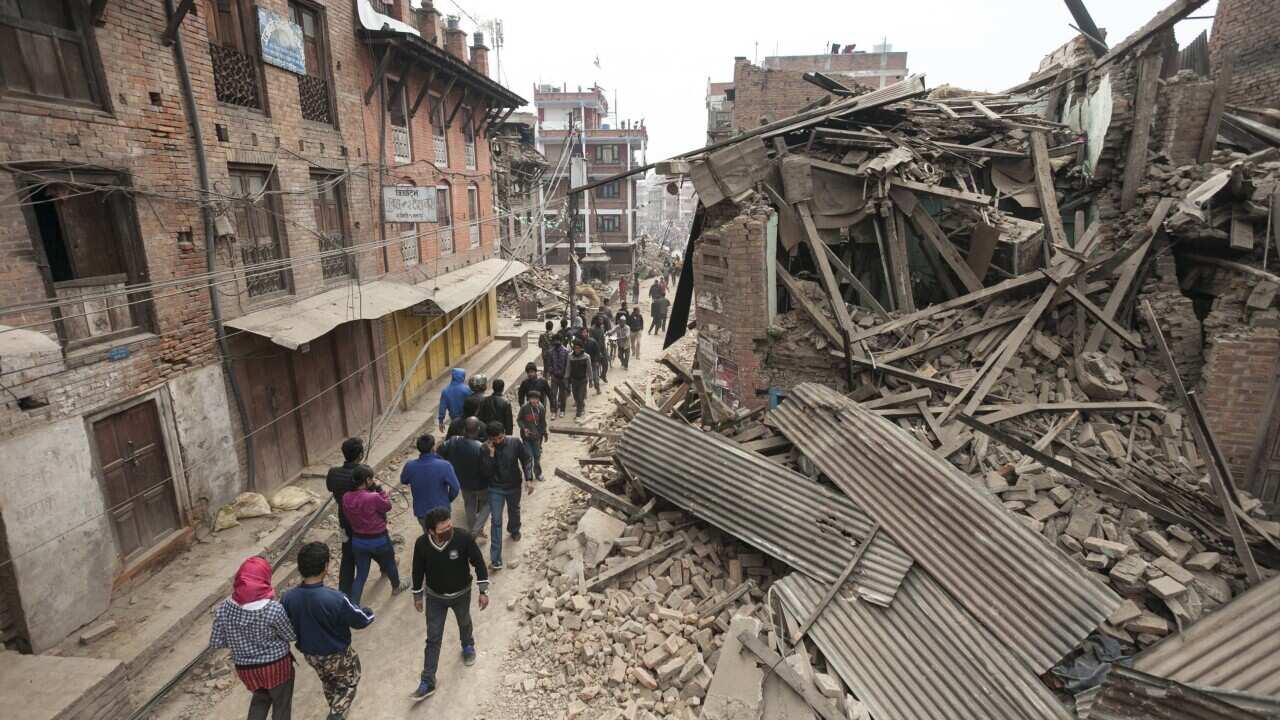
A pair of studies examining the physics of the temblor help reveal how so many small buildings and homes managed to survive the earthquake, while also indicating that another, more damaging quake could be in the stricken country’s future.
The findings, described in the journals Science and Nature Geoscience, could help scientists and engineers better understand future seismic risk and the potential for structural damage in the mountainous region as well as in similar quake zones.
“I was prepared for a death toll of maybe 300,000 or 400,000 people”
Caltech geophysicist Jean-Philippe Avouac said that when he first learned of the devastating temblor from a US Geological Survey email alert, he actually expected the damage to be much higher.
“I was prepared for a death toll of maybe 300,000 or 400,000 people,” Avouac said. The actual number of deaths, he added, “is certainly a tragedy, but it’s a small, small number of casualties compared to what we might have expected.”
Many smaller buildings, often brick homes built with little concrete or iron, are known to be poorly constructed and should have been easily flattened during the quake. But somehow, many seemed to have survived. On the other hand, taller buildings, such as the historic Dharahara (or Bhimsen) tower, collapsed — even though the structure survived a much stronger earthquake in 1934.
Avouac and colleagues took data from 15 GPS monitors placed around the region as well as an accelerometer placed near Kathmandu, Nepal’s capital. They found that the ground shaking had a very low frequency with a long period — around five seconds. Faster, more frenetic shaking (for example, with a one-second period) tends to take out the shorter buildings, but these longer-period waves allowed those weaker-but-smaller structures to remain intact, the researchers said.
The longer-period waves, however, were especially damaging to taller buildings because those slower waves were close to the structures’ resonance points — the point at which they vibrate with their natural frequency.
“If you have a really tall building like the Bhimsen tower, that’s another story because the top of the building is having a hard time catching up with the displacement of the base, so it’s being sheared back and forth,” Avouac said. “And in the end, the building collapsed.”
The nature of the shaking (and its effect on buildings) was likely due in part to the characteristics of the sediment in the region as well as the shape of the Kathmandu basin, the researchers said.
“It could be, we don’t know if and when, that at some point we will call the Gorkha earthquake a foreshock of a larger event”
“Los Angeles is also a place where the seismic waves might be trapped and there might be some resonance as well,” Avouac said. “This is something that earthquake engineers are well aware of for the L.A. basin — but for (Kathmandu), I’m not sure that this effect had been taken into account very well.”
The scientists also measured how much the ground slipped during the quake, in order to examine how much stress the earthquake released in the locked-up fault zone. The researchers found that the quake only “unzipped” a tiny portion of the area under stress — and it may have even transferred stress to neighboring, still-locked regions. This could mean that another earthquake — perhaps even a bigger one — could be on the horizon, the scientists said.
“This was not the ‘big one,’” said Roland Burgmann, a University of California, Berkeley geophysicist who was not involved in the research. “It could be — we don’t know if and when — that at some point we will call the Gorkha earthquake a foreshock of a larger event.”
Share


