
in brief
- Rising intergenerational wealth transfers are widening Australia's economic divide by rewarding inherited capital over earned wages.
- Experts argue that unaddressed untaxed wealth threatens retirement security and demands urgent structural tax reform.
Australia faces a "tsunami" of retirees unable to support themselves if it doesn't address the growing issue of untaxed intergenerational wealth transfer, advocates warn.
A new report from the Australian Institute of Family Studies (AIFS) released on Wednesday shows that intergenerational financial support — flowing from older, wealthy family members to younger ones — is increasingly driving inequality.
The report, citing data from the Household, Income and Labour Dynamics in Australia (HILDA) study, among other sources, shows that Australians receiving inheritance grew from 4.8 per cent to 7.2 per cent between 2001 and 2018 while the proportion receiving financial gifts grew from 10.5 per cent to 15. 8 per cent over the same period.
The timing of such financial aid has a major impact, the report emphasises, with earlier assistance shaping opportunities at critical life stages. Inheritance, while typically larger, often comes after decisions around housing have been made.
"Not all families have the same capacity to provide assistance," Dr Jody Hughes, head of families and society at the AIFS said.
News that makes sense
Your trusted source for staying up-to-date with the world around you. Get free daily news updates and analysis, straight to your inbox.
"Understanding who can access these forms of support, and who misses out, is important for understanding broader patterns of wellbeing, financial security and inequality both between and within generations."
The new data comes as comparison site Finder revealed that 30 per cent of homeowners in Australia received financial support from family to buy their homes. Home loans expert Richard Witten noted that the "bank of mum and dad has become a major player" in the property market.
Christian charitable community services network Anglicare has been campaigning on tax reform to address inequality, with its own data finding the baby boomer generation is set to pass on roughly $5.4 trillion to their families — much of it untaxed.
Kasy Chambers, executive director of Anglicare, told SBS News that Australia's unusual lack of inheritance tax and its generous superannuation concessions allows wealth to "build and build".
"We're about to see the biggest wealth transfer ever in human history," she said. "That will concentrate wealth, which doesn't really do anybody any good because it takes it out of tax systems, it puts it in the hands of a very small amount, and it makes running any kind of government services ... very, very difficult."
Chambers noted Anglicare is seeing a rise in people using its services as precarity climbs the income ladder, driving more people to food banks.
"Normal is not enough," she notes, explaining that families on median incomes are increasingly struggling to afford the basics.
Is a death tax the answer?
In May, the government came under fire as its reforms to trusts were branded a "death tax" by the Opposition.
Treasurer Jim Chalmers introduced changes in the budget to discretionary trusts, imposing a minimum 30 per cent tax rate from 2028 and making their use by families to distribute income to beneficiaries less attractive, and denied the proposal was a death tax.
Australia abolished its inheritance tax in 1979, making it an outlier in developed nations, most of which have some form of duty owed on capital and assets transferred to family members.
Chambers supported the government's reforms to superannuation and capital gains tax but said Labor should go further.
"It's unpopular, but when you model what happens when people that have wealth simply pass all of it on, it very quickly ends up very, very concentrated," she said.
Other experts aren't so sure, with Tax and Transfer Policy Institute Director, Professor Robert Breunig, telling SBS News that such taxes could sound good in theory but fail in practice.
Upper-middle class individuals who die unexpectedly tend to shoulder the greatest burden of inheritance taxes, as "really wealthy" individuals frequently make adjustments to avoid paying them, he said.
Labor's tax reforms primarily affect income tax while largely avoiding wealth accumulation, such as the value of property and inheritance, which the AIFS report notes is the primary driver of growing inequality.
Breunig notes that such inequality is not intergenerational — ie, between baby boomers and millennials — but a growing class one between those with wealthy families and those without.
The housing safety net
Parental support is not only helping young people buy homes, it is also widening the wealth gap, as financial support is more likely to go to those who are already homeowners, the report highlights.
Miriam and her partner, both in their 30s, told SBS News that they have been saving for a house deposit since before they got married over a decade ago. Currently, the couple is in the final stages of closing on their first home in Sydney's Baulkham Hills — a $1.4 million townhouse.
"We've been making sacrifices across the board," Miriam said. "We tried to not live closer to the city, so that we wouldn't be paying so much in rent just to make sure that we kept putting into our savings".
Even so, the couple said they would have been unable to afford the deposit or secure a loan without borrowing around 40 per cent of the value of the home from her partner's family.
"It means we'll be using most of our savings," she said. "We will be paying it back; it's just instead of paying a mortgage and interest, you're paying your family. That means sacrificing for the next few years, on a lot of things."
Without similar support, Miriam said many of her friends assume they will "have to rent" for the rest of their lives.
Chambers notes that "the whole aged care system is really built on an assumption that people will have their own home" by the time they retire.
Renting in retirement is "actually pretty grim," Anglicare modelling shows, with more people expected to enter aged care earlier as they simply run out of money.
"It actually is a bit of a tsunami that's going to hit the country if we don't address it in some way," she said.
Breunig, however, argues that while homeownership is down "a little bit" among younger Australians, people are still buying homes later in life. That demographic will also have benefited from having had superannuation for longer, so are likely to be better off in retirement, he said.
'Something' must be done
The bigger driver of wealth inequality is a tax system that doesn't account for the vast rise in property prices over the last 20 years, Breunig argued.
"[Growing inequality is a result of] our failure to tax the major vehicle in which people hold their wealth," he said.
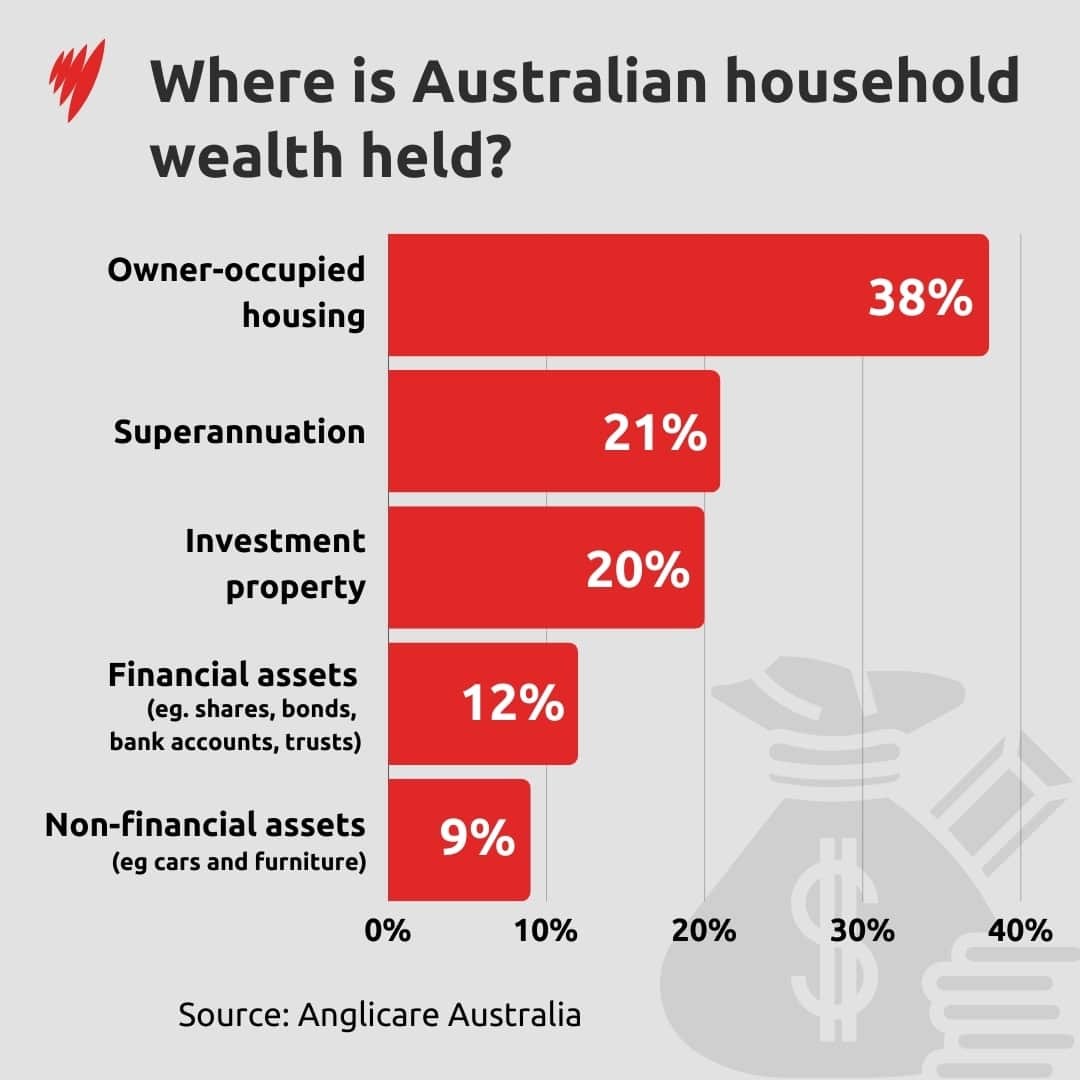
Data varies, but around 40 per cent of total wealth in Australia is in owner-occupied housing. Breunig argues that, at some point, something will need to be done about it.
While he said a "death tax" is likely politically too toxic, he advocates for a broad-based land tax to "really tax the wealth people are holding in property".
The ACT is halfway through its 20-year plan to transition the territory toward this arrangement, although the federal government has repeatedly rejected calls for a national land tax.
Making the economic changes necessary to avoid runaway inequality is deeply unpopular, Chambers said, arguing a "loss of trust in governments and institutions" means people want more of their income.
"If we don't do something ... we're going to end up in a place that's not really very great for anyone," she said. "And it's not that far away; it'll be in a couple of generations."
Clarification: This story has been updated to include information about data sources used in the AIFS report.
For the latest from SBS News, download our app and subscribe to our newsletter.







