
Middle-class Australian households are in decline as the enormous growth in property prices since the COVID-19 pandemic has boosted the wealth of the country's richest families.
New analysis from KPMG indicates the net wealth of Australia's most asset-rich households has increased significantly, while the value of assets held by the country's middle class has stagnated over the past five years.
KPMG urban economist Terry Rawnsley estimates Australia's average household wealth in 2024/25 surged by 24 per cent, from $1.26 million in 2019/20 to $1.56 million.
This includes the value of assets such as property, superannuation, savings, businesses and vehicles, minus any debts.
While this figure appears to suggest that Australians' overall wealth has increased — with the "average" household now worth around $1.56 million — the median figure tells a different story.
News that makes sense
Your trusted source for staying up-to-date with the world around you. Get free daily news updates and analysis, straight to your inbox.
Rawnsley estimates the value of the median household barely shifted from $701,000 in 2019/20 and, in fact, dropped slightly to $700,000.
The median figure — the middle value in a dataset — is a useful indicator of what a typical household looks like, because half of all households have more wealth, and half have less.
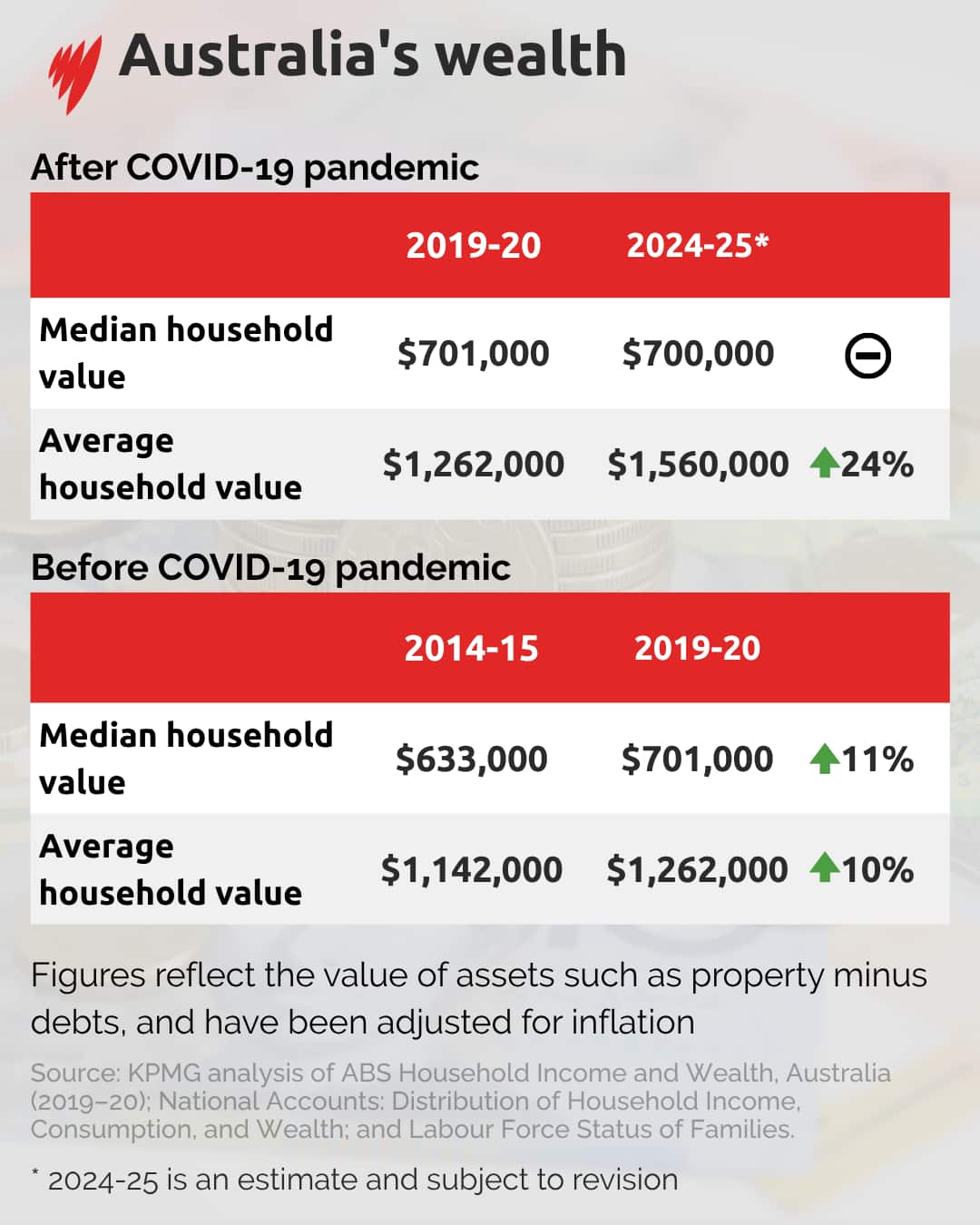
Rawnsley says the stronger growth in average household income indicates the assets of Australia's wealthiest families are increasing in value more quickly than those of typical Australians, whose net worth has remained flat. This can have a skewing effect on the overall average.
I think these numbers speak to the frustration among [many in] the population ... about a lack of progress in their lives economically.
"Whereas ... that higher income household [has been] racing away in terms of their wealth."
Before the pandemic, wealth increases were more evenly distributed.
The median household was worth around $633,000 in 2014/15 and increased in value by 11 per cent across five years. Average wealth increased by 10 per cent, up from $1.1 million.
Property prices supercharging wealth for Australia's richest households
Households with a net wealth of $1.6 million and above now make up 22 per cent of all households, up from just 15 per cent a decade ago.
The number of households in this group has grown significantly — by 7 per cent every year over five years — compared to overall growth in households, which has lifted by 2.1 per cent annually.
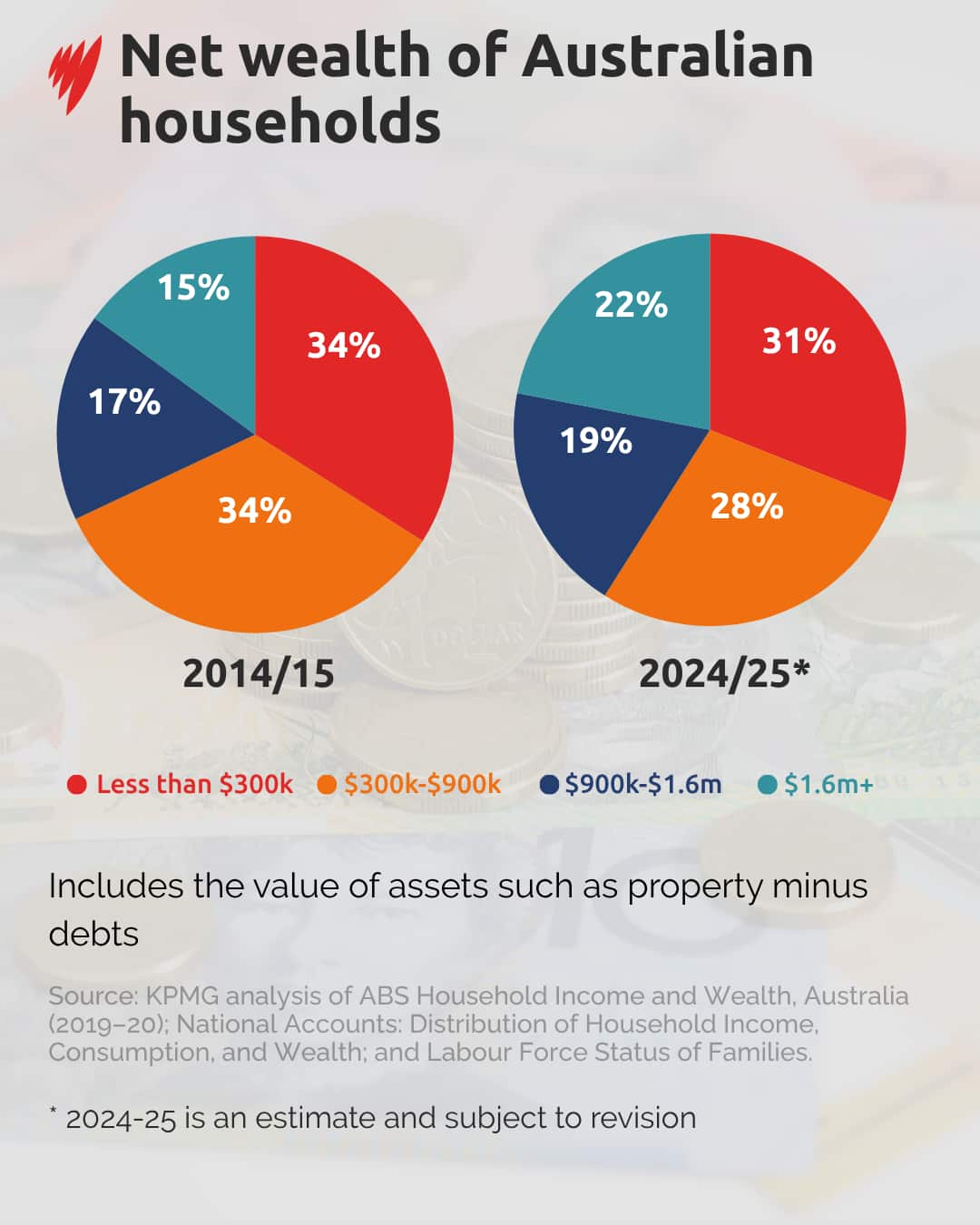
Australians with net wealth of more than $900,000 are now estimated to make up more than 40 per cent of households.
Ten years ago, they comprised just 32 per cent.
Rawnsley says the growth in property prices is behind much of the increase in their wealth.
During the pandemic, interest rates sat at near zero which fuelled a sharp increase in asset values, particularly property.
"Households that already had property or were able to get on the ladder during that time are now reaping the rewards and seeing their wealth grow much faster than those that missed out."
The latest Domain house price report for March shows the median house price in Sydney — home to Australia's most expensive housing market — is now $1.8 million, and the median unit price is $848,227. In December 2020, the median house price was $1.2 million, and the median unit price was $755,699.
Data supplied to SBS News from Domain shows house prices grew in the harbour city by 46 per cent in the five years from December 2020 to December 2025.
But growth in other capital cities was even stronger, with house prices increasing by 91 per cent in Perth, and strong growth in Adelaide (91 per cent) and Brisbane (86 per cent).
Unit prices also grew by 87 per cent in Adelaide, and showed strong growth in Brisbane (84 per cent) and Perth (73 per cent).
The shrinking middle
The data shows the typical household in Australia now has $700,000 in net assets, meaning the middle class appears to be in decline.
The number of households with net wealth of between $300,000 and $900,000 now represents less than 28 per cent of households, compared to 34 per cent 10 years ago.
Rawnsley says this middle-wealth bracket was traditionally topped up by a steady stream of first home buyers purchasing a property with a deposit of around $200,000.
But as housing affordability worsens, they have not been able to get into the market, and he believes this is leading to a decline in the number of people in this bracket.
"We've had this situation where if you were in the market five years ago, you benefited greatly from home ownership [and moved up the wealth brackets]," Rawnsley says.
"Then you've had this other group who haven't been able to access it, and hence that lower wealth bracket hasn't really grown."
Rawnsley says the cohort most people would previously identify as "average" is in decline as more wealth is funnelled to those with property or sizeable asset portfolios.
"We are at risk of becoming a country where the wealth of your parents is becoming a more significant factor in someone's ability to generate wealth."
Some young people now believe they may only be able to buy a property once they receive their inheritance.
Calls for reform
The analysis comes as Australia's wealth gap is under renewed scrutiny on the eve of the federal budget.
Oxfam has called on the Australian government to introduce a wealth tax, among other measures, to reduce inequality and help fund essential services.
A report released by the charity group in January found Australia had 48 billionaires whose wealth was greater than the bottom 40 per cent of Australians.
A working paper from the Australian National University's (ANU) Tax and Transfer Policy Institute last year found generous tax arrangements had also allowed older Australians to accumulate significant wealth and income linked to their real estate and superannuation assets.
"Current settings increasingly favour older Australians at the expense of younger Australians," the report notes.
The Australian Bureau of Statistics General Social Survey, released last week, reveals Australians experienced greater financial stress in 2025 than they did five years ago.
Around 21 per cent reported having at least one cashflow problem in the preceding 12 months (up from 19 per cent in 2020); and 25 per cent said they were unable to raise $2,000 within a week for something important (compared to 19 per cent previously).
Treasurer Jim Chalmers has flagged that "intergenerational fairness" will be a key theme of the budget being handed down tomorrow night.
Changes to the capital gains tax discount and negative gearing are widely expected to be included.
For the latest from SBS News, download our app and subscribe to our newsletter







