
Gen X households hold more wealth in property and shares than other generations, but baby boomers still have the highest net worth overall, according to a new analysis.
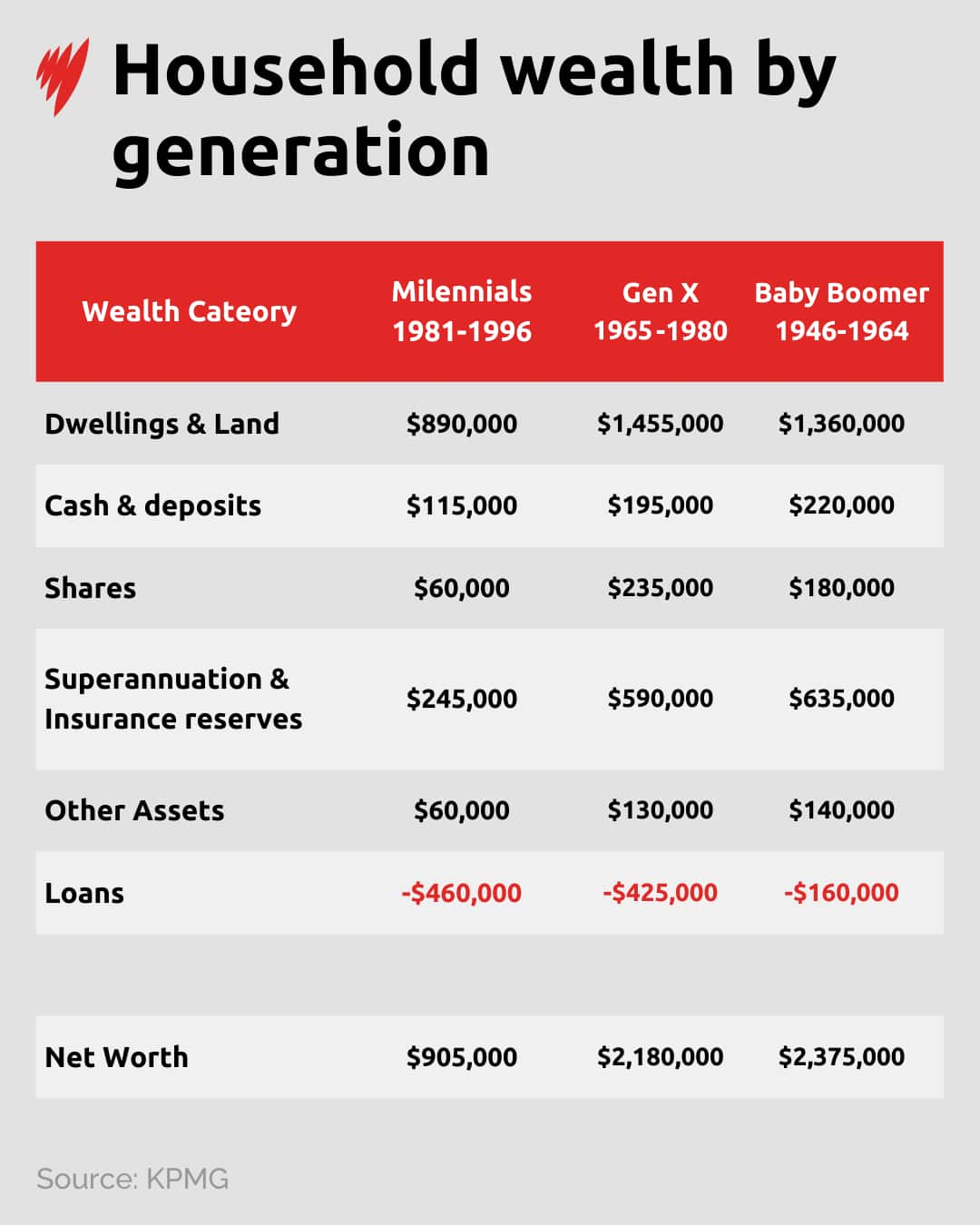
Baby boomers (born 1946-1964) had the highest average net worth at $2.375 million, with gen X (born 1965-1980) close behind at nearly $2.2 million, according to the report by consultancy firm KPMG, which analysed Australian Bureau of Statistics income and wealth data.
The net worth gap between these generations has kept narrowing, according to KPMG, which a year ago said gen X had overtaken boomers for the first time on property wealth and shares.
Both cohorts were significantly wealthier than millennials (born 1981 to 1996), whose average net worth was $905,000, according to the latest analysis.
Young homeowners who could get a foothold during the years of ultra-low interest rates have seen their wealth surge, while those who couldn't are at risk of being permanently priced out of the market.
News that makes sense
Your trusted source for staying up-to-date with the world around you. Get free daily news updates and analysis, straight to your inbox.
The average household wealth for Australians aged 25 to 34 rose from $340,000 in 2019–20 to $550,000 in 2024–25 — an increase of 63 per cent.
KPMG urban economist Terry Rawnsley said the increased wealth of younger Australians was largely driven by those who purchased property when interest rates were "ultra-low" in 2020 and 2021.
"For young Australians able to get into the market they are starting to see strong growth, but for those aged under 30, many of whom have been locked out of housing, wealth accumulation will be a much tougher task," Rawnsley said.
"With interest rates now at much higher levels, that home ownership window is now firmly closed."
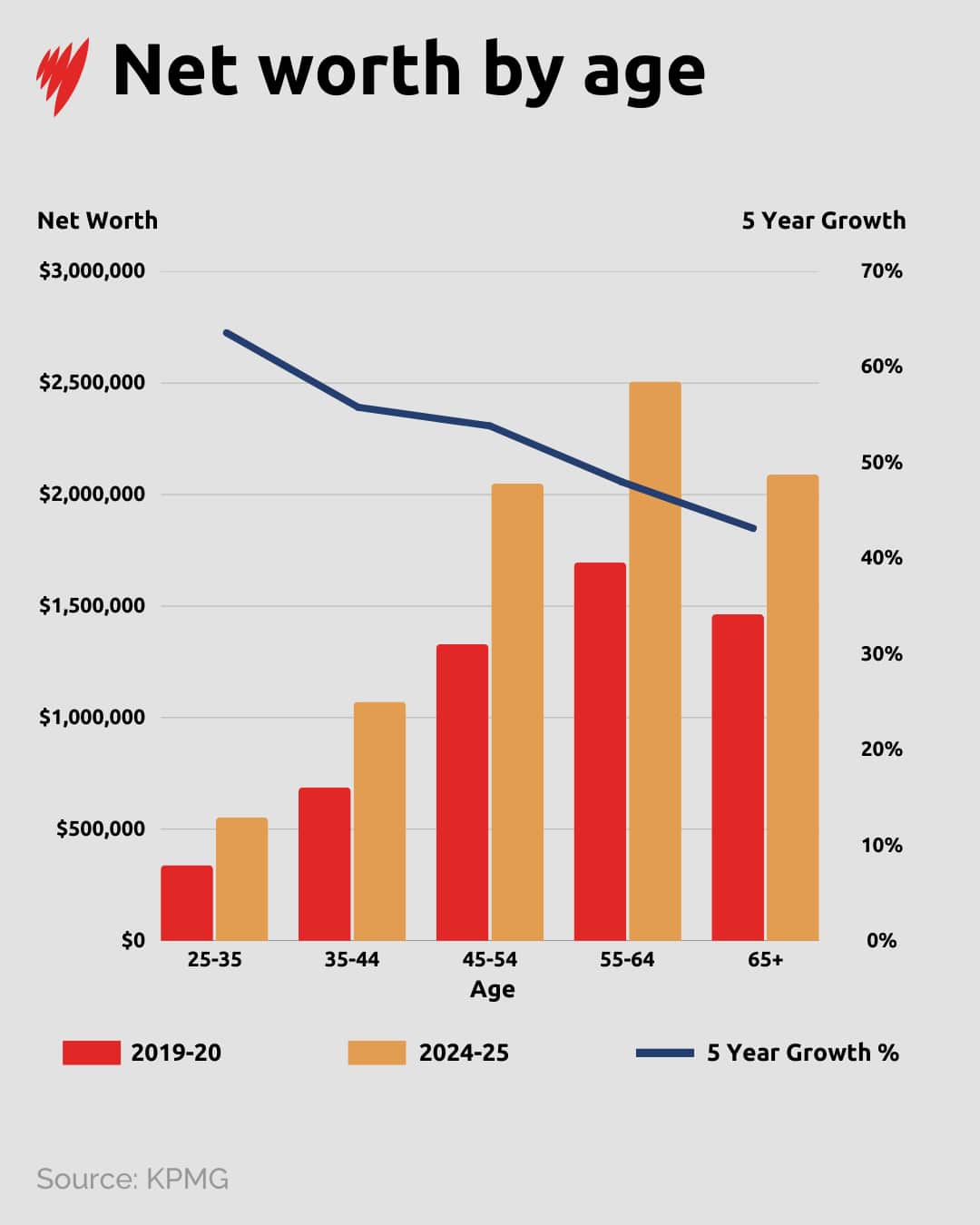
However, younger Australians will likely retire with far more superannuation than those exiting the workforce today, according to the analysis.
The 55 to 64 age group had super balances averaging $756,000, compared to $151,000 for 25 to 34-year-olds and $289,000 for 35 to 44-year-olds.
With decades left of their working lives, younger generations will benefit from higher mandatory employer contributions, which will be invested for longer.
"Their superannuation will be coming off a far higher base than their parents. This means the wealth they will eventually accumulate from super will be far higher than today’s retirees," Rawnsley said.
The amount you need for a comfortable retirement can vary widely, however, depending on whether you own your home, according to some models.
'The great wealth transfer is in full swing'
The report — which also analysed household wealth by generation — found baby boomers had the highest net worth overall, while gen X had the most property wealth.
Gen X households had an average property wealth of $1.445 million, compared to $1.360 million for baby boomers.
Rawnsley attributed the shift to an inter-generational wealth transfer.
In 2024, analysts estimated Australia's over-60s are expected to transfer $3.5 trillion to younger generations in the next 20 years, dubbing this the 'great wealth transfer'.
"The great wealth transfer is in full swing, as baby boomers start downsizing properties and moving that wealth into cash. They are also beefing up their super accounts as they begin to spend in retirement or hand down wealth to their children," he said.
"This has meant gen X is atop the mantel as the wealthiest property owners."
Millenials had larger debts than other generations, likely owing to property loans.
"For the average millennial household, the property they own is still largely a liability, which explains why their net worth is less than the average value of their property," Rawnsley said.
Lucas Walsh, professor of youth studies at Monash University, told SBS News the wealth transfer came at the expense of Australians who did not expect an inheritance.
"More goes to wealthier families and less goes to others," he said.
"This divide is striking ... and I think will present problems to social cohesion, as people become less happy with their lives under these conditions."
Walsh said the wealth transfer would continue, but he expected it to narrow.
"We can expect the wealth accumulated by previous generations to have less and less relative value if property prices keep going up and the cost of living keeps increasing," he said.
Property remains primary driver of wealth
The report shows home ownership remains the cornerstone of wealth accumulation, which includes property, superannuation, shares and other assets minus debts.
Households aged 55 to 64 had the highest average property wealth at $1.529 million, while those aged 25 to 34 averaged $575,000.
"This wealth profile is reflecting a lifetime of super contributions and exposure to the share market and purchasing homes when they were more affordable," the report states.
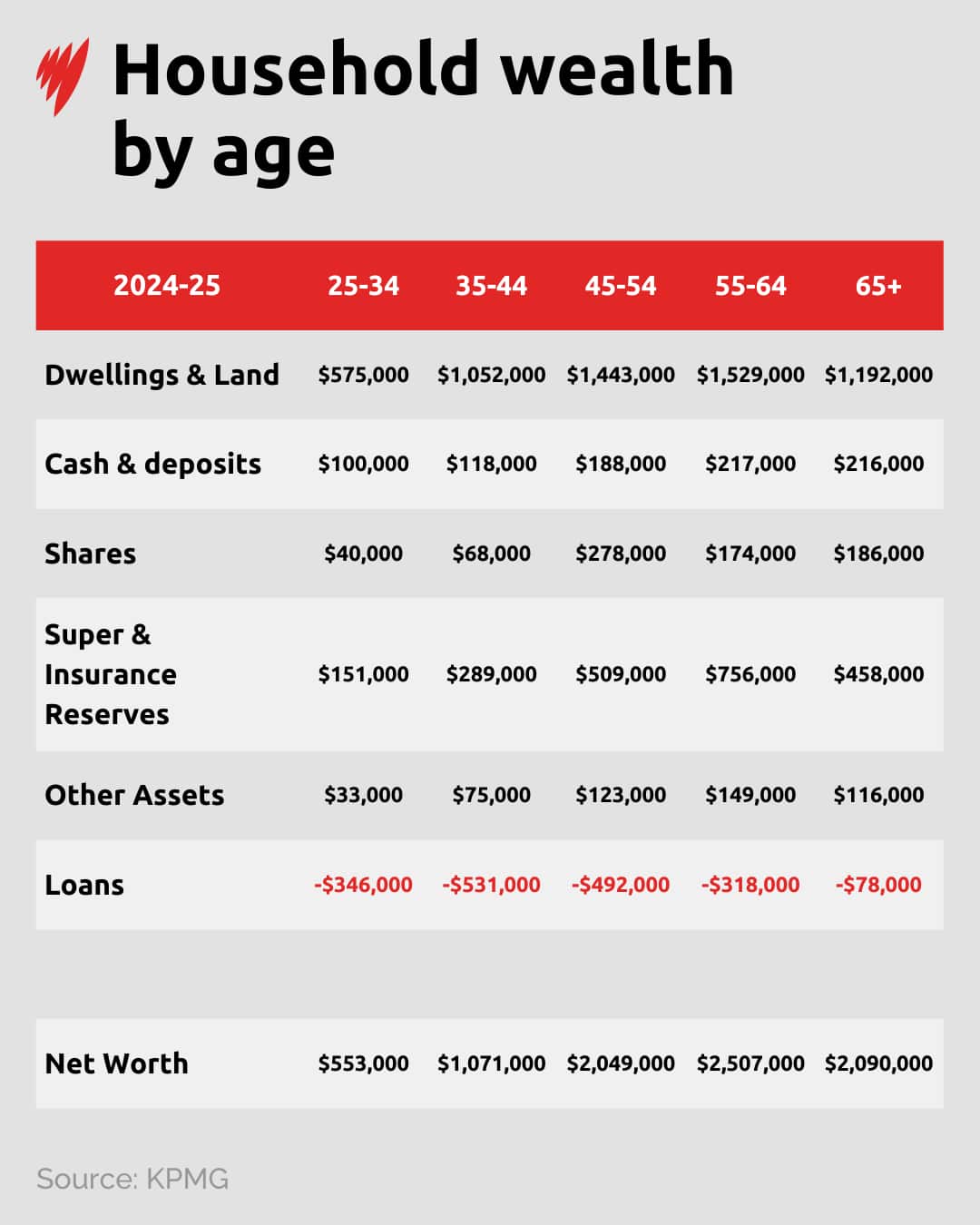
"Many young people in this group are just entering the housing market, which leaves them with large mortgages," Rawnsley said.
"Combined with HECS debts, this makes them the most leveraged generation with an average loan size of $346,000, offsetting total assets of $899,000."
With many young people priced out of the housing market, Rawnsley said he expected many would focus on building their share portfolios as a way of accumulating wealth.
For the latest from SBS News, download our app and subscribe to our newsletter.







