
in brief
- Australia is seeing a varied capital city property market with rises and falls projected for 2026.
- As buyers borrow more money in increasingly tight markets, experts say there are more risks for homeowners.
Global conflicts and uncertainty have largely slowed growth in the housing market so far this year, with prices going backwards in two of the biggest markets. However, one capital city is defying the trend.
Properties in Perth are selling in a matter of days and at record prices, with one property expert saying the market is as tight as it gets.
A house in Perth is spending an average of just nine days on the market before being sold, according to Cotality's latest property report, much faster than the 30-day average.
Limited supply is also driving up prices, as Perth property values surged ahead of other capital cities by over 20 per cent in the year to March.
Experts say prices could continue to rise in much of the country, where demand outstrips supply, increasing risks for borrowers.
News that makes sense
Your trusted source for staying up-to-date with the world around you. Get free daily news updates and analysis, straight to your inbox.
However, two cities are bucking the housing trend, already posting losses for 2026, and are expected to decline further over the course of the year.
Perth and regional WA see the strongest growth
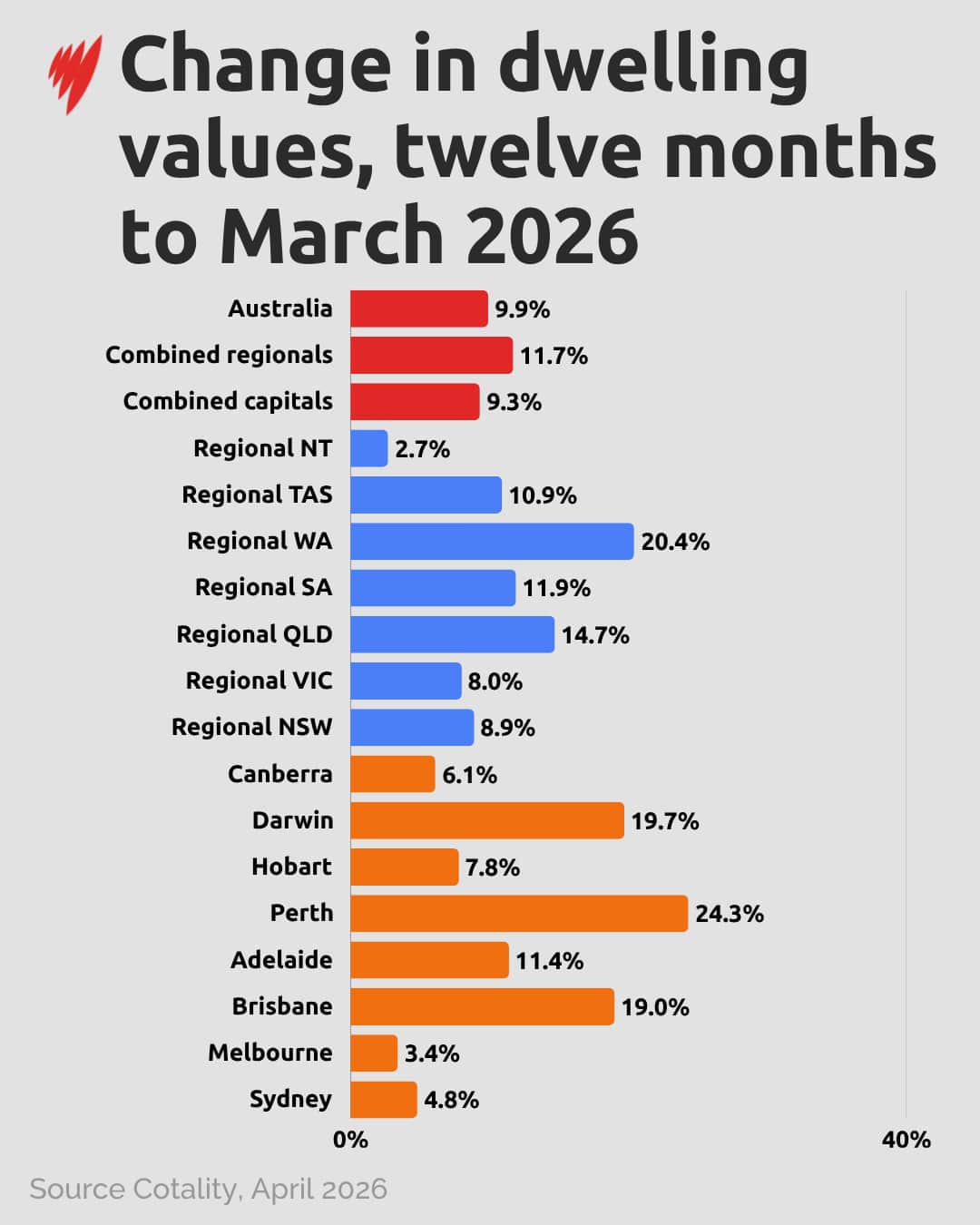
Perth saw the biggest growth in dwelling values, with Brisbane, Adelaide and Darwin also increasing over the year to March.
The western capital saw dwelling values increase by 24.3 per cent in the 12 months to March, surging ahead of other markets.
Jarrod Mahon, managing director of Perth-based Investors Edge Real Estate, told SBS News that buyers in the city have a narrow window to secure a property.
"I don't think it could actually get any tighter because when a property goes online on a Monday [or] Tuesday, it's often gone by the end of the week," he said.
"Over the previous six to nine months to the March quarter, I virtually didn't have to adjust prices on any single property."
The industry veteran said the amount of demand is unheard of.
"My average price above asking was $99,000 for that quarter, which is crazy."
He said that buyers in the state are having to compromise on size or location more than in previous decades to secure a property.
"Before it was like, for $600,000, you could get a house, but now the options are a decent, well-located unit or apartment. So that trend has emerged and that's what people are now preferring instead of going and living too far out," he said.
He attributed the nation-leading growth to two main factors: a lack of existing housing stock and soaring construction industry costs, leaving people reluctant to build a property from scratch.
"There's been four consecutive quarters of decreasing construction starts and completions and the recent inflation is also starting to cause increases to the cost of building," he said.
The Urban Development Institute of Australia released its annual State of the Land report in March, examining residential development activity across Australia.
It forecasts a shortfall of 380,000 new dwellings by 2030 and an 11 per cent drop in production in 2026 alone, due to rising costs, labour shortages and volatility in the construction industry.
Other markets are hitting their limits
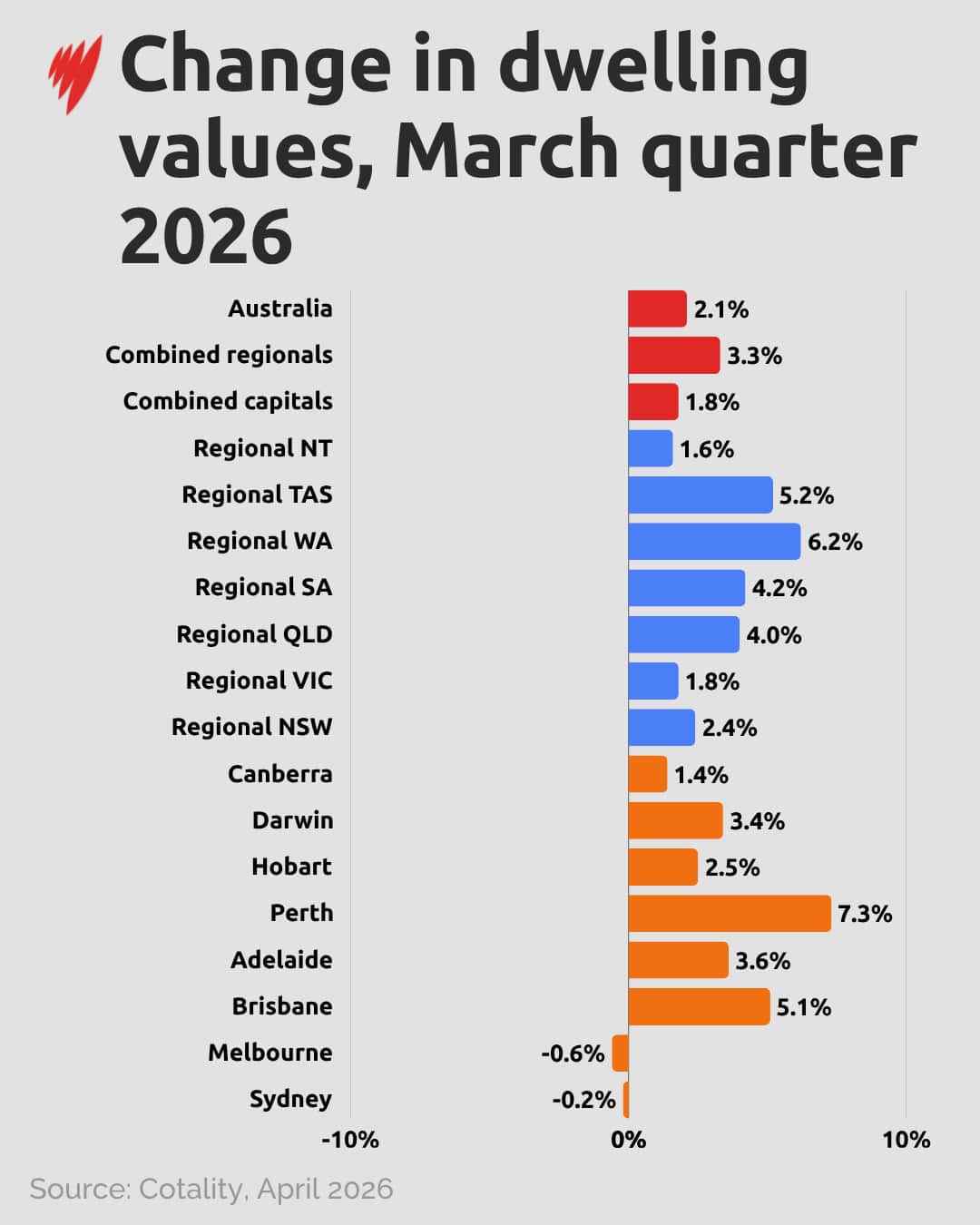
While Perth saw the most growth at the start of this year — at 7.3 per cent, more than three times the national average — other cities saw mixed results.
Brisbane saw a 5.1 per cent increase, followed by Adelaide at 3.6 per cent and Darwin at 3.4 per cent.
Sydney and Melbourne saw values drop in the three months to April, falling 0.2 per cent and 0.6 per cent respectively.
Gerard Burg, Cotality's head of research, told SBS News that every capital city is "starting to lose some momentum".
"We've had back-to-back rate hikes from the RBA. There's still some uncertainty around how much higher rates might go… and we've got the uncertainty around energy markets as well," he said.
"And I think all of that combined is starting to really impact the demand for potential home buyers."
Meanwhile, the war in the Middle East has led to increased costs in fuel-reliant industries, including construction.
The global oil benchmark price has dropped amid the US-Iran ceasefire to US$95 ($134.9) per barrel, above pre-war averages of around US$70 ($99.4) per barrel.
The Master Builders Association says rising fuel costs have contributed to a 10 per cent increase in building material delivery costs.
The Reserve Bank of Australia's Monetary Policy Board raised the official cash rate from 3.85 per cent to 4.10 per cent in March.
Burg said the fall in prices in Melbourne and Sydney showed buyers have reached their purchasing capacity, leading to a slight fall in demand.
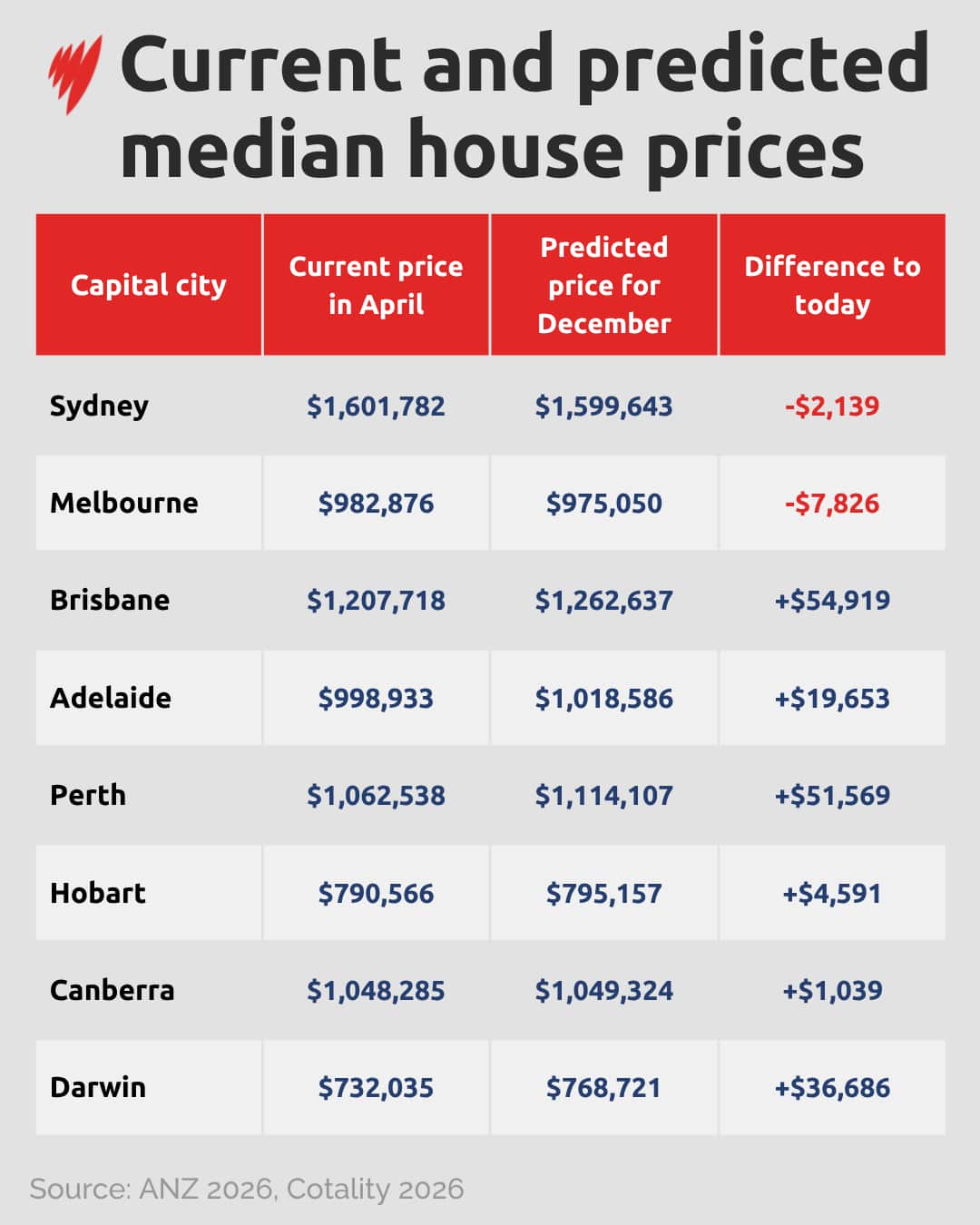
The median house price in Sydney was $1.6 million in April, according to ANZ, while in Melbourne it was $980,000.
"The reality is a large proportion of buyers probably can't get into that sort of property value without significant assistance, ie the Bank of Mum and Dad," he said.
"That's going to increasingly become the case in markets like Brisbane and Perth now that they have pushed above the million-dollar mark."A house in Brisbane costs an average of $1.2 million, while in Perth, the median house price is $1.06 million.
Risks of borrowing at capacity
ANZ predicted that median house prices will increase in most capital cities, putting further pressure on borrowers.
The cost of houses in Perth, Darwin, Brisbane, Adelaide and Hobart is expected to outpace annualised wage growth — 3.4 per cent last year — by the end of 2026.
Properties in Perth are expected to increase by a further 12.3 per cent, or $51,569, by January.
Meanwhile, properties in Sydney and Melbourne are projected to fall by 0.7 and 1.7 per cent, respectively.
Sally Tindall, data insights director for price comparison site Canstar, told SBS News that Australian budgets are tight in the shadow of two RBA rate cuts.
"For home buyers still in the hunt, news of property price drops will be welcome, but they’re nowhere close to a solution," she said.
"Already, people’s home buying budgets have dropped by far more than the fall in the median house price in cities such as Sydney and Melbourne."
She said that Australian property markets are increasingly risky for buyers as mortgage holders borrow up to their financial capacity.
"Some borrowers feel like they're in between a rock and a hard place because prices are so high in places like Sydney that they feel like they've got no choice but to borrow at capacity or not buy at all," she said.
"But it's really important to not just borrow blindly how much the banks will lend you but understand exactly how much you can live with after your repayments."
She said that some people may consider buying a less desirable property to avoid altering their lifestyle or risking their savings.
"The danger is, people will borrow to the limit, banking on prices continuing to climb. If circumstances change — whether that’s interest rates, job security or the economy — it could leave some households overexposed," she said.
Regional gains, rental pains
While capital cities are growing in price overall, regional areas saw the largest price rises in the March quarter of this year and in the 12 months leading to April, according to Cotality.
Burg said that this is largely being driven by affordability constraints in capital cities.
He said there's been migration from the major capitals to regional areas since around the midpoint of 2023.
"It really comes down to a lot of people, including first home buyers, but possibly also people looking for the tree change opportunity, seeking out these kinds of markets where their dollars just simply go a lot further," he said.
"In this most recent wave of migration, increasingly, people choosing inland regional locations rather than the coastal markets. And these are the markets that really have the greatest affordability on offer."
Another push point for moving regionally is the lack of available rentals in cities, which are well below the decade-average.
The national vacancy rate sat at 1.6 per cent in March, below the decade average of 2.5 per cent, pushing up prices as demand exceeds supply.
For the latest from SBS News, download our app and subscribe to our newsletter.







