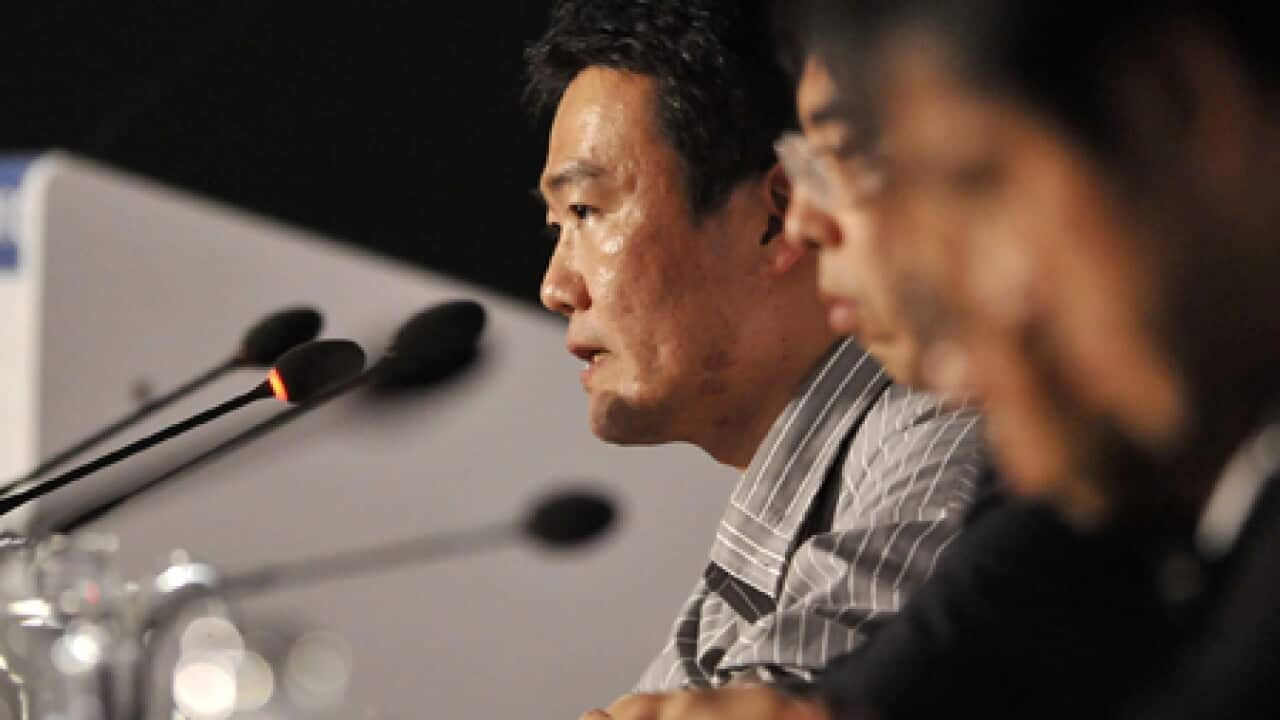
The world's climate negotiators on Friday considered "deep cuts" in emissions to hold back climate change as part of a package that would pave the way for billions of dollars in aid to poor countries.
Sleep-deprived envoys from more than 190 countries were presented a hard-fought draft agreement by host Mexico that also leaves open an extension of the landmark Kyoto Protocol whose commitments run out at the end of 2012.
Faced with scientists' warnings that global warming is already taking a toll, the draft proposal calls for "urgent action" to cap temperature rises at no more than 2 degrees Celsius (3.6 Fahrenheit) above pre-industrial levels.
News that makes sense
Your trusted source for staying up-to-date with the world around you. Get free daily news updates and analysis, straight to your inbox.
The proposal, to be considered late Friday by a full session, "recognizes that deep cuts in global greenhouse gas emissions are required according to science." Scientists blame the mostly industrial emissions for global warming.
The accord at last year's chaotic summit in Copenhagen included similar language, but it was never approved by the full UN-led talks.
Negotiators have met for two weeks in the beach resort of Cancun, hoping to set up the building blocks for a new comprehensive deal on climate change, perhaps at the next major talks at the end of 2011 in Durban, South Africa.
After spending a sleepless night, the negotiators called off public events and met throughout the final scheduled day on Friday to iron out remaining disputes -- chief among them, on the future of the Kyoto Protocol.
Faced with the growing prospect that a new climate treaty is distant, the European Union has led calls to extend the Kyoto Protocol.
Japan has adamantly opposed a new Kyoto round, pointing out that the treaty named after its ancient capital covers only 30 percent of global emissions because China and the United States are not part of it.
Russia, a major exporter of carbon-intense fossil fuels, has backed Japan's position, while Canada was also seen as a quiet supporter.
In a compromise, the proposed Cancun agreement would call for talks to set up a second period of the Kyoto Protocol but not oblige members of the treaty -- such as Japan and Russia -- to be part of the new round.
Japan and Russia "accept this language, while before they didn't accept it," Brazilian negotiator Luiz Alberto Figueiredo told reporters.
"This is positive language which clearly states a second period of commitments" under the Kyoto Protocol, said Figueiredo, a supporter of the treaty.
Japan faced intense pressure at the talks to compromise, with British Prime Minister David Cameron early Friday telephoning his counterpart Naoto Kan, diplomats said.
The Kyoto Protocol makes no demands on emerging economies such as China and India to curb emissions. China has refused to be subjected to a treaty, although India in a surprise shift in Cancun said it would at least consider binding action in the future.
The United States is the sole rich nation to reject the Kyoto Protocol. US President Barack Obama has pledged action but is hobbled after his rivals in the Republican Party swept mid-term elections.
Haunted by the Copenhagen summit, host Mexico tried to focus on areas of agreement instead of seeking an ambitious full treaty. It also insisted on transparency rather than closed-door talks among major powers.
In one area of agreement, the conference looked set to chart out the future of a global fund to distribute aid.
"There is agreement and convergence, I would say, on what the foundation would be," Bangladesh's Environment Minister Hasan Mahmud said.
The European Union, Japan and the United States have led pledges of 100 billion dollars a year for poor nations, which many experts say are already suffering a rise in floods and drought as temperatures steadily mount.
A broader issue is just how wealthy nations would raise the money, with some negotiators advocating levies on airplane and shipping fuel.
The talks also look likely to make headway on spelling out ways in which wealthy nations can help developing states preserve tropical forests -- a crucial way to combat climate change as lush vegetation counteracts pollution.







