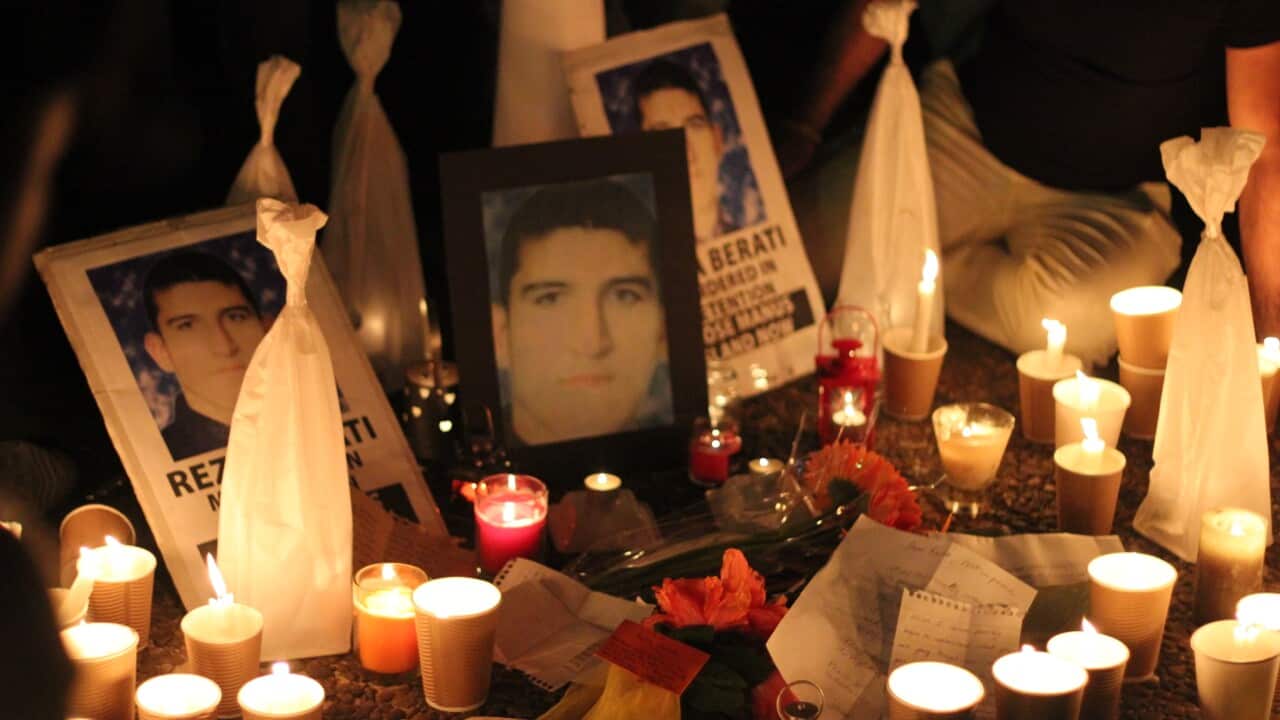
A detailed timeline of the fatal Manus Island detention centre riot has been presented to a Senate committee by federal immigration department boss Martin Bowles.
A 23-year-old Iranian man, Reza Berati, died after the February 17 riot and 62 other asylum seekers were injured.
The unrest unfolded rapidly, Mr Bowles told the estimates hearing in Canberra on Tuesday.
Papua New Guinea's royal constabulary deployed a dog squad outside the detention centre at 7pm local time, he said.
At 9.45pm asylum seekers pushed down fences.
"The incident escalated quite quickly and a greater number of transferees were involved," Mr Bowles said.
Asylum seekers not involved in the riots were evacuated to the playing fields outside the centre to ensure their safety.
Asylum seekers were throwing rocks and sticks, the hearing was told.
Mr Bowles said at midnight all staff were evacuated and the health clinic was relocated.
After this, G4S guards drew back to protect internal perimeters.
"At this point, that's when (police) discharged a gas canister and warning shots were fired."
Unrest continued for an hour or two.
Robert Cornall, a former secretary of the attorney-general's department, is reviewing the incident and will be going to Manus Island soon.
Mr Bowles was first told about the events escalating about 1am (AEDT) on the Tuesday.
"There was unrest late in the afternoon, early evening - I was aware of that but it seemed to be consistent with what had happened on previous days," he said.
After the 1am call from one of his Canberra-based deputies, Mr Bowles rang Immigration Minister Scott Morrison to give him "a precis of what was a very fluid situation".
Mr Bowles and departmental staff had teleconference with service providers on Manus Island through the night and during the day on Tuesday, before and after Mr Morrison gave an initial press conference in Darwin.
Ministerial staff were not involved in these calls.
Mr Bowles briefed Mr Morrison before his second press conference on Tuesday evening.
He said that at no point in the early stages were there suggestions security contractor G4S staff were involved in the clashes.
"There were many and varied reports happening during that period of time where this information bounced around," Mr Bowles said
"Probably not until around the Saturday ... was there some of that information out there that had some credible form that I was made aware of."
He said a lot of issues were still unclear and were matters for the independent review.
Greens senator Sarah Hanson-Young was skeptical that it took until Saturday to find out what had been reported widely in the media.
"There were teleconference on the Tuesday between your department, G4S, other service providers on the island, and no one raised in those teleconference that it was suspected that G4S staff participated in the incident?" she asked.
"Not to my recollection, senator, at that point," Mr Bowles replied.
He confirmed electricity did go out in the centre but said it was still not clear when or how many times.
Mr Bowles is not aware of local residents being let into the detention centre as "extra man power" for the guards but those claims would be examined in the review.
He defended the integrity of advice provided to the minister and said it should be viewed in the context of a fast moving event.
Operation Sovereign Borders commander Angus Campbell, who was sent to Manus Island to assess security, told the hearing he met with the Royal PNG constabulary chief, provincial police commander, senior G4S staff, new service providers Transfield Services, Wilson Security and the health care provider.
Mr Bowles said G4S lost the security contract at Manus Island late last year because the department wanted one service provider to cover that detention centre and the one on Nauru and not because of performance issues.
G4S's contract expires on March 28, the hearing was told.
He dismissed calls for the Australian Federal Police to be sent to Manus Island to investigate, saying PNG was a sovereign nation and had its own structures and processes.





