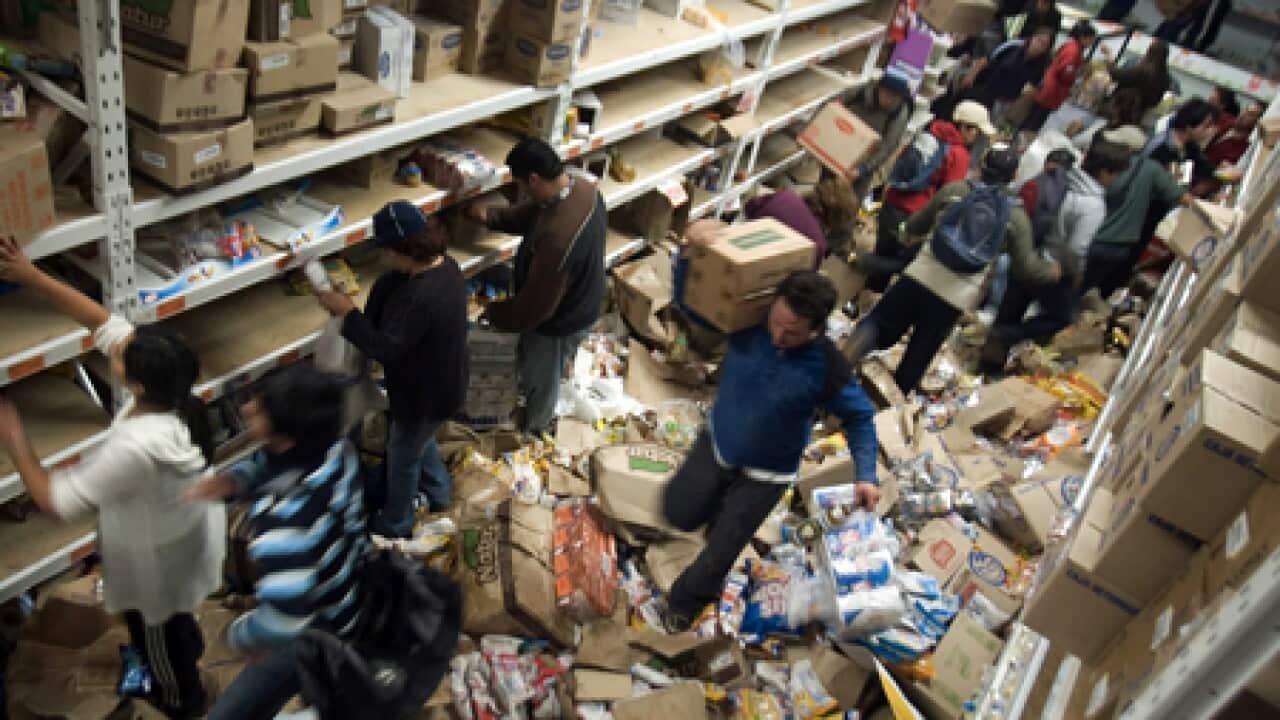
Chilean citizens gathered outside supermarkets, desperate to get their hands on basic goods despite the start of an overnight curfew, as 7,000 troops were deployed.
Chile has called for international aid as the anguished calls of trapped quake survivors pierced the rubble and police had to arrest 160 looters for defying overnight curfews.
"It's full, they have water, food, diapers, but the police won't let us go inside," complained one man standing next to the Concepcion supermarket.
The building, its windows shattered, had already been targeted by looters, like many other shops in the city, where a curfew was imposed overnight to try to limit theft and violence.
News that makes sense
Your trusted source for staying up-to-date with the world around you. Get free daily news updates and analysis, straight to your inbox.
"It would be fine if they distributed things, or at least sold them to us," said Carmen Norin, 42, standing nearby as police guarded the shop.
Anger boiled over during the day when a group of looters at the Bigger store set fire to the building when they were blocked from entering by the police who fire tear gas at the crowd.
The building's roof collapsed in the fire, injuring a volunteer firefighter.
Chilean troops were deployed alongside police in the city after President Michelle Bachelet declared a state of emergency Sunday in Maule and Biobio regions, a day after a massive 8.8-magnitude quake that killed over 700 people.
When we take account of the troops already in Biobio and Maule there will be by tomorrow 7,000 troops deployed," said Bachelet as she announced new efforts to clamp down on looting.
Concepcion was placed under curfew from 9:00 pm (0000 GMT) to 6:00 am (0900 GMT) -- the first time such a measure has been imposed in Chile since the end of Augusto Pinochet's dictatorship in 1990.
After touring the disaster zone, President-elect Sebastian Pinera said "the situation is worse than expected" and recounted hearing cries for help when he entered a collapsed building not yet reached by rescue teams.
Rescuers with heat sensors and sniffer dogs picked through the debris of shattered buildings in Concepcion and specially designed cameras showed three survivors trapped in the twisted ruins of a 15-story apartment block.
Eight bodies were pulled Sunday from the giant building, knocked onto its back by the force of the quake, but rescuers said they were hopeful that survivors would be found.
"We'll have to work with the precision of watchmakers," said fire chief Juan Carlos Subercaseaux. "May God help us."
Aftershocks rattled shell-shocked citizens -- 127 since the quake at last count -- and Pinera said he had seen sick people sleeping out in the open under the open sky.
Deputy Interior Minister Patricio Rosende said one person was shot and killed in Concepcion as police and the army clamped down on rampant looting overnight, making 160 arrests.
The circumstances of the death were unclear and local media said the shooting was an altercation between looters.
"The public cooperated, it understood the need for a curfew. One has to understand the anguish that many people feel. Because on top of the constant aftershocks, there is the darkness, the uncertainty," Rosende said.
Desperate parents said they were just trying to look after their children as they raked through supermarket ruins despite the start Sunday of an overnight curfew, the first in Chile since the end of Augusto Pinochet's dictatorship.
"Water, I ask only for water," said one young woman as she shook an empty plastic bottle.
Rosende said the government had purchased all the food in the city's big supermarkets so that they could be distributed for free, and a barge and two Chilean air force planes would arrive later in the day with more supplies.
Pinera said the situation in Concepcion was dangerous.
"When we have a catastrophe of this magnitude, when there is no electricity and no water, the population... starts losing the sense of public order."
The scale of the devastation was still being discovered, with seaside towns and villages engulfed by massive waves from a tsunami sparked by the massive quake, which struck at 3:34 am (0634 GMT).
State television reported that more than 300 bodies had been found in the swamped fishing village of Constitucion, where survivors stared in disbelief at the seaweed clinging to the remains of their homes and businesses.
President Michelle Bachelet, due to hand over power to Pinera on March 11, said the air force would begin flying in food and aid to badly-hit areas, including some largely cut off by the quake.
Her government also officially requested international aid, after earlier saying it would wait to assess damage and needs before seeking assistance.
A spokeswoman for the UN's humanitarian coordination office (OCHA) said Chile had "supplied a list of priorities," including field hospitals, mobile bridges, communications equipment and disaster assessment and coordination teams.
US Secretary of State Hillary Clinton, in Montevideo at the beginning of a Latin America tour that will include a brief stop in Chile on Tuesday, said she had spoken with Bachelet to offer help.
"They have asked for communications equipment, some of which I'm bringing on our plane. Other technical equipment will be flown there in addition," she said.
Aid pledges also rolled in from around the world, with the European Union offering four million dollars, Japan three million and China one million.
Chile is one of Latin America's wealthiest nations and better equipped than most to withstand and recover from earthquakes, but the total damage from the quake has been forecast at between 15 billion and 30 billion dollars.







