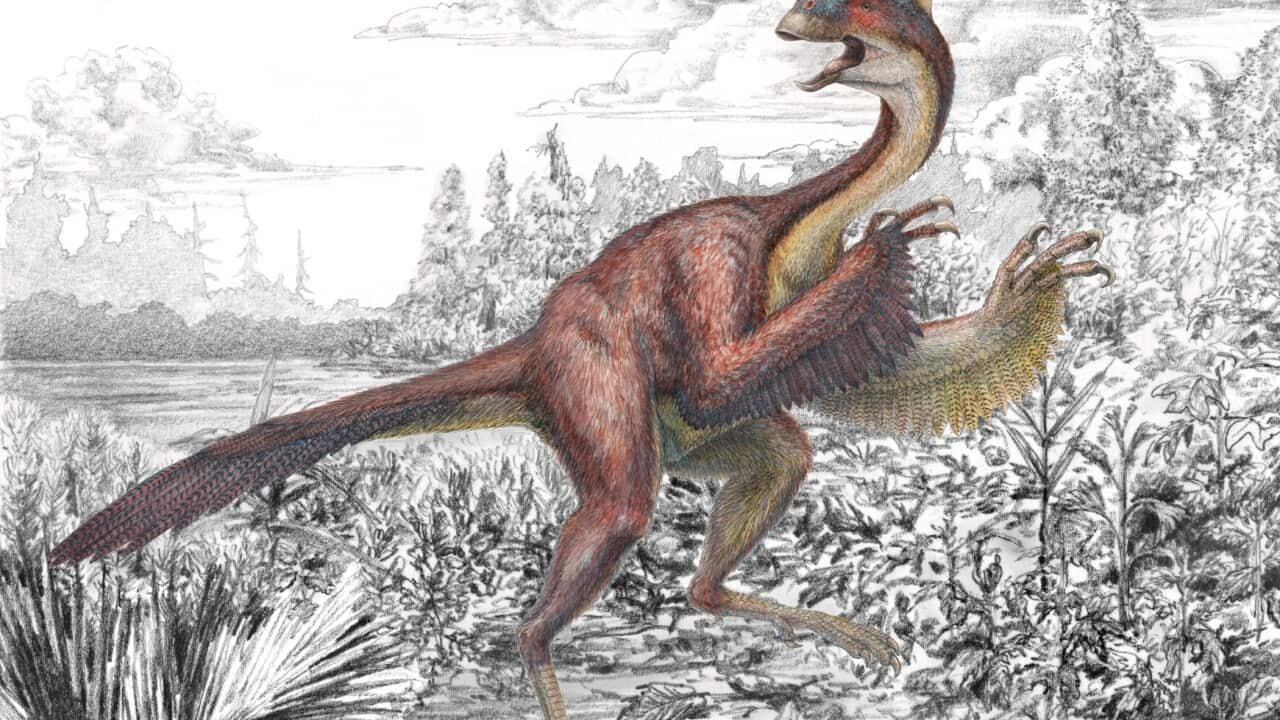
Nicknamed the "chicken from hell", a newly identified species of feathered dinosaur as tall as a human roamed North America at least 66 million years ago, paleontologists have announced.
With a hen-like crest on its head, lanky legs like an ostrich, sharp claws on its forelimbs and jaws built for crushing eggs and prey, the Anzu wyliei weighed between 200-300 kilograms.
The long-tailed creature is the largest known member of the legendary "egg-thief" dinosaurs, known as Oviraptorosaurs, which are closely related to birds, said the study in the journal PLOS ONE published on Wednesday.
"We jokingly call this thing the `chicken from hell' and I think that's pretty appropriate," said lead author Matt Lamanna of the Carnegie Museum of Natural History in Pittsburgh, Pennsylvania.
A collection of fossilised bones from three separate dinosaurs provided the first nearly complete glimpse of the 3.5-metre-long beast that stood 1.5 metres high at the hip.
News that makes sense
Your trusted source for staying up-to-date with the world around you. Get free daily news updates and analysis, straight to your inbox.
"It would be scary, as well as absurd, to encounter," said co-author Emma Schachner, a biology postdoctoral fellow at the University of Utah.
The dinosaur was named after Anzu, a bird-demon from Mesopotamian mythology, and Wylie, the grandson of a museum trustee.
The skeletal pieces were found over a decade ago in the Hell Creek rock formation in North and South Dakota, where many other fossils have been found, including those of T. rex and Triceratops.
The Anzu specimens are dated to between 66 and 68 million years old, very close to the end of the dinosaur era some 65 million years ago when an asteroid is believed to have wiped them out.
The fossils reveal new details about a category of Oviraptorosaurs called caenagnathids, which were first discovered a century ago and came in a variety of sizes, from as small as a turkey to - in the case of Gigantoraptor - as heavy as 1.36 tonnes.







