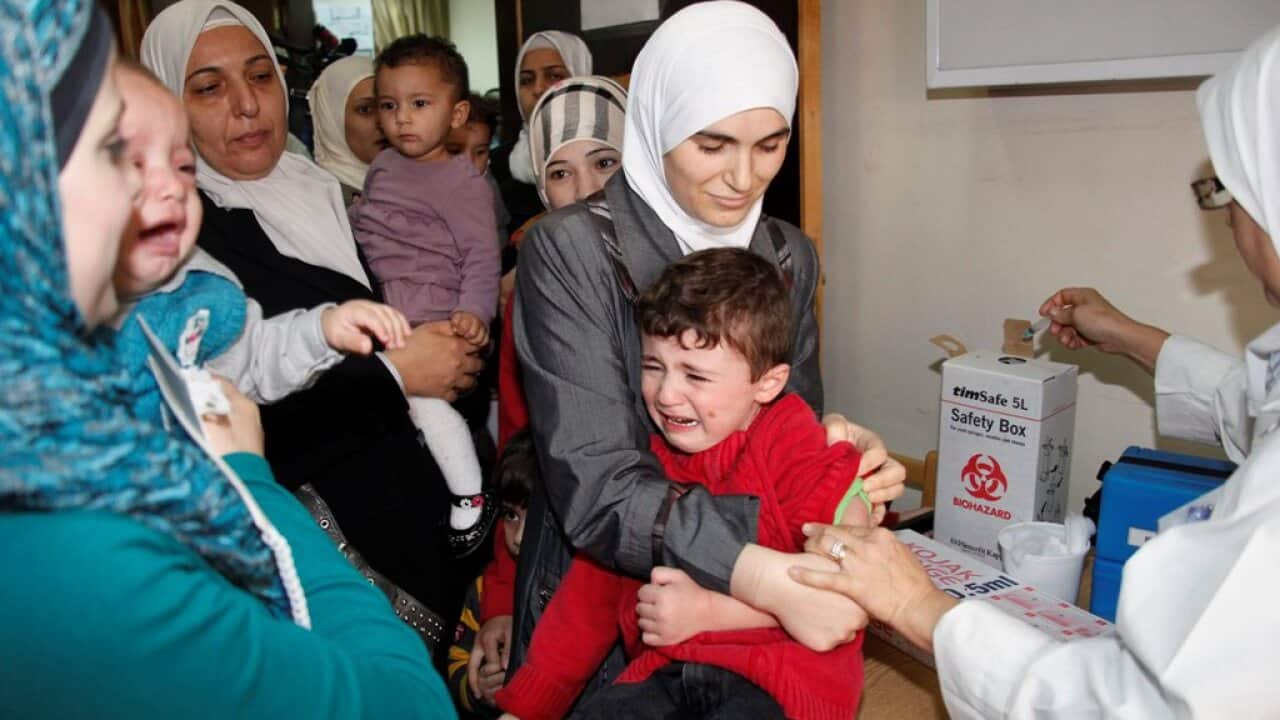
As the United Nations launched a huge vaccination campaign against polio in the Middle East after an outbreak in Syria, some doctors have questioned its potential effectiveness.
The World Health Organisation (WHO) recently confirmed 10 cases of the virus in Syria’s Deir-ez Zor province, found in mid-October mostly among children under two years old, who are believed to never have been vaccinated or who only received one of the four doses essential for full protection.
While the WHO is currently investigating 12 other suspected cases, it believes there is many more amid fears refugees seeking shelter beyond Syria’s borders may have carried the virus to neighbouring countries.
Polio, which is highly contagious and transmitted via contaminated food and water, can cause paralysis and even death.
News that makes sense
Your trusted source for staying up-to-date with the world around you. Get free daily news updates and analysis, straight to your inbox.
Before the war in Syria broke out in 2011, the country had been polio-free for 14 years.
But as a result of the conflict, vaccination rates have plummeted from more than 90 per cent before the war, to current levels of about 68 per cent.
As a result of the outbreak, the United Nations has begun one of the largest immunisation operations ever in the Middle East.
Over six to eight months the immunisation campaign will target more than 20 million children within Syria and Lebanon, Jordan, Iraq, Egypt, the West Bank and Gaza and Turkey.
The outbreak has led to calls for a “vaccination ceasefire” to allow a lull in fighting amongst Syrian rebels and government forces for vaccination efforts to take place.
However, some doctors are doubtful vaccination efforts will be successful under current circumstances.
“Polio is very infectious and if we [put together] crowding, poor hygiene, displacement and lack of vaccination, we have the perfect formula for spreading the epidemic out of control,” Zaher Sahloul, president of the Syrian-American Medical Association.
“The only hope of controlling it (in Syria) is if the UN and international NGOs are allowed unfettered access to all areas in Syria. This will not happen as long as the conflict continues. “The vaccination rate in some areas is only 10-20 per cent. This is a result of the destruction and disintegration of the public health care system in Syria. It also means the failure of the international NGOs and the UN agencies in vaccinating Syrian children in large areas of the country due to the blockade of the Syrian regime and not allowing consistent cross-line humanitarian assistance to these trapped civilians.”
Dr Annie Sparrow, a critical care paediatrician who recently launched a study of the long-term impact of the Syrian war on civilian health, agreed.
“Given that most kids who get it are asymptomatic or get mild symptoms only, I think the situation reflects that it will be extremely hard to control now,” she said.
“This is what happens when the Syrian regime preferences control of the population over population health and control of infectious disease. Infectious diseases don’t respect working hours or borders.”
But despite limited access to those inside Syria, Dr Sparrow added that vaccination and treatment would be difficult because of doctors’ lack of experience.
“Syrian doctors don’t have any experience with early symptoms of polio, nor how you treat polio. You can’t reverse the disease but it is very easy to make it worse through poor knowledge.
“Put all that together with the fact neighbouring countries aren’t going to be keen on more refugees with potential polio coming to infect the children in refugee or urban settlements, that, let alone, poses a risk to their own kids who may not be fully immunised.”
Meanwhile, writing in the Lancet journal last week, two doctors in Germany warned that Europe could be at risk from unsuspecting carriers bringing polio in from Syria.
Professor Martin Eichner of the University of Tubingen in Germany and Stefan Brockmann, of Reutlingen Regional Public Health Office said that because only one in 200 unvaccinated infected individuals would develop paralysis, it could take a year of “silent transmission” before an outbreak is detected.
They warned that countries in Europe with relatively low vaccination coverage, such as Austria and Ukraine, may be at particular risk of “sustained transmission” if the disease was carried into the region.
Polio is still endemic in Pakistan, Nigeria and Afghanistan.
Exit Syria: Diaries from Za'atari - watch the latest video here.







