In Brief
- The government will spend $4 million on a study to see if Australia should build a new oil refinery.
- If the refinery goes ahead, it would be Australia's first since 1960 and the nation's third.
The federal government will spend $4 million on a study to investigate whether a new oil refinery should be built in Western Australia, which would be the country's first such new facility in six decades.
The plan is aimed at buffering the nation to global oil shocks as the United States-Israeli war on Iran continues to impact supply and fuel costs.
Prime Minister Anthony Albanese is due to visit Karratha on Tuesday to announce the jointly funded pre-feasibility study for the potential refinery, which would be Australia's first newly built facility since the 1960s.
The project has been proposed by fertiliser producer Perdaman, which currently has a $6.4 billion fertiliser manufacturing facility being built in Karratha.
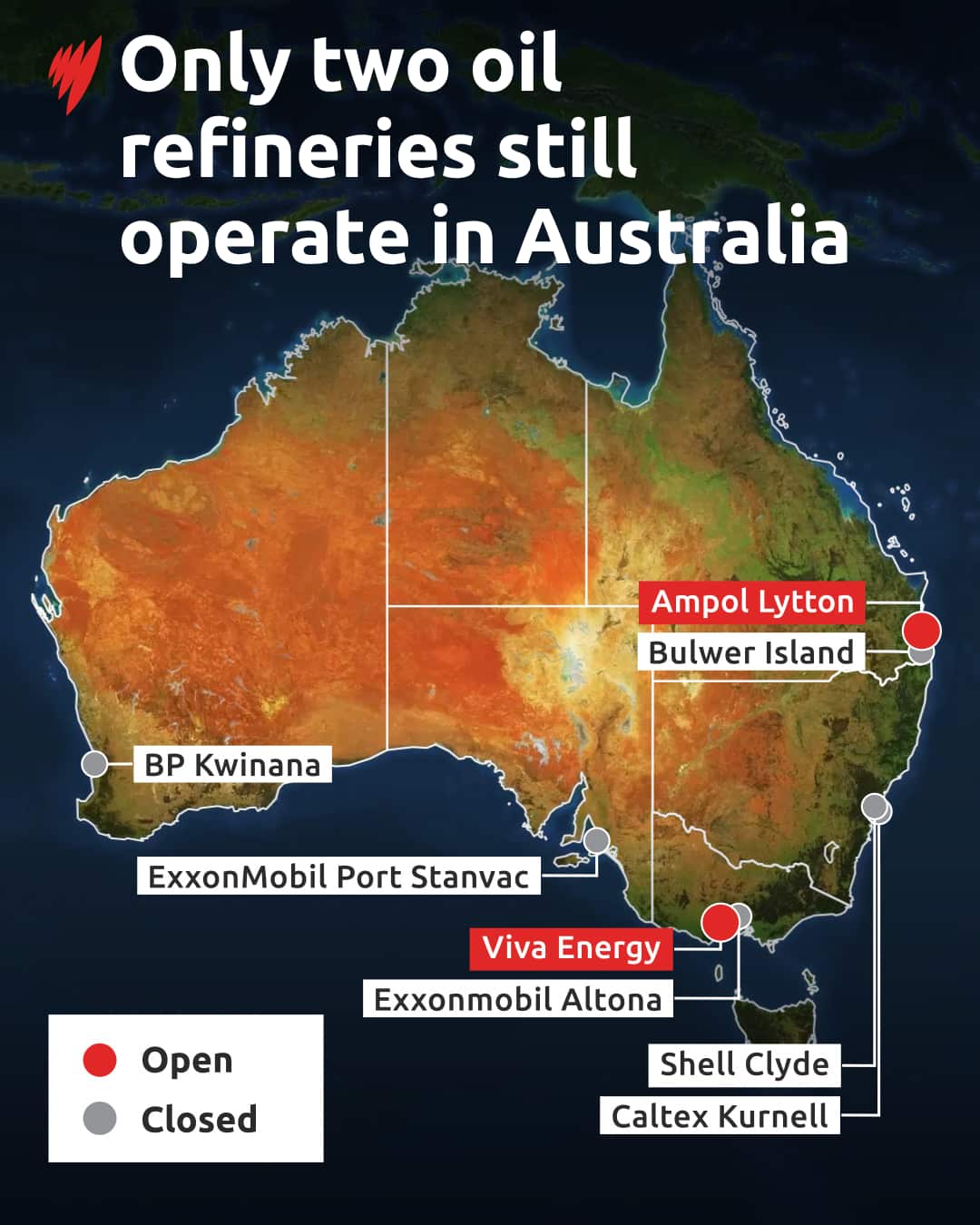
If the refinery goes ahead, it would be the nation's third, along with facilities in Brisbane and Geelong. Those two facilities supply roughly 10 to 20 per cent of the country's fuel.
News that makes sense
Your trusted source for staying up-to-date with the world around you. Get free daily news updates and analysis, straight to your inbox.
Australia relies heavily on imported refined fuels. Almost 90 per cent of Australia's daily fuel consumption is imported, much of it brought in as refined product from South Korea, Japan, Singapore, Malaysia and Taiwan.
The country used to have more domestic oil refineries, but six of eight facilities closed between 2003 and 2021, after newer, more economical mega-refineries were built across Asia in the 1990s.
Earlier this year, a fire at the Geelong facility, which supplies 10 per cent of the nation's fuel, sparked fears of a fuel supply shortage as Australia was reeling from global oil shocks triggered by the US-Israel war on Iran.
That incident highlighted Australia's vulnerability to shocks in both international and domestic supply chains.
Are their drawbacks to a new refinery?
However, a new refinery would only partly shield Australia from international oil-supply shocks, as it would still be reliant on imported crude oil.
Nonetheless, Resources Minister Madeleine King has said that it would still improve Australia's resilience in times of crisis because crude oil can be stored for far longer than refined oil products.
"So you can bring it in and have it sit in a vessel for some amount of time before you need to refine it. And that's a critical difference in times of crisis," she told ABC Radio National.
"This (would) make a great difference ... to sovereign capacity — being able to have capacity on the west coast to refine crude oil into this product."
There is potential for new oil discovery off the Western Australian coast, although it has not yet come to fruition.
Financial analysts estimate a new oil refinery could cost more than $15 billion.
"When it comes to economic viability, there's a reason that Australia has seen six of the eight refineries shut down over the last 20 years, and in particular, the last two, even those requiring government support to keep going," Saul Kavonic, an energy analyst at MST Financial, told ABC radio on Tuesday.
However, Kavonic said a new refinery would help with addressing "acute" risks exposed by the recent crisis — even if it wasn't combined with an increase in domestic crude oil production.
"One thing we have noticed from this crisis is, while there is a shortage of global crude oil, the shortage for refined products has been even worse. And so having refining capacity, even without additional new crude oil supply, is still going to help with our resilience, particularly to getting jet fuel and diesel, which is where we've had the most acute risk for the Australian economy," said Kavonic.

"But realistically ... it would be somewhat self-defeating to go to the effort of building a new refinery unless we're also going to look to produce more of our own oil to go into that refinery.
"And that means that there's two pieces of this puzzle that need to be put together again, highlighting that this isn't a slam dunk thing that's going to happen."
The challenge of shifting demand
Experts say Australia needs to accelerate its shift away from liquid fuels, with electrification of transport offering a pathway to greater energy security.
University of the Sunshine Coast economics expert Sajid Anwar said: "Improving fuel storage capacity, diversifying energy sources, and expanding electrification of transport would strengthen Australia's economic resilience to global energy shocks."
The chief executive of Ampol, which runs the Brisbane refinery, recently told the ABC that petrol production could one day become more expensive in Australia.
"There's a point at which making petrol and refining petrol becomes more challenging, and as soon as you have to try and put that petrol that you're making in Brisbane, for example, on a ship and send it somewhere else, that becomes very, very expensive," Matthew Halliday told the ABC's That's Business podcast.
"And so, how you adjust your production to produce more diesel and jet [fuel] and less petrol over time is an important challenge that needs to be solved because it becomes less profitable."
He said there will be a structural shift over time with the uptake of electric vehicles.
"As you're seeing more and more EVs and hybrids coming to the system, you need to produce less petrol and more diesel and jet fuel," he said.
"That'll be part of what we need to contemplate: is how we produce less petrol and more diesel and jet fuel, but that's expensive."
He said the company was thinking "longer term" to ensure the refinery's future viability, and that it was discussing long-term investments in the Brisbane Lytton refinery with the federal government.
- With additional reporting by the Australian Associated Press
For the latest from SBS News, download our app and subscribe to our newsletter.







