
IN BRIEF
- Just over two decades ago, Australia had eight oil refineries capable of meeting most of the nation's fuel demand.
- So, why have six of them closed since then, and how should Australia respond to ongoing supply challenges?
As a fire raged through one of Australia's two oil refineries in the middle of an energy crisis, it raised a critical question: how did we get here?
A major blaze broke out at the Viva Energy oil refinery in Geelong, Victoria, late on Wednesday evening. It was extinguished on Thursday after it continued to burn into the morning, according to emergency services.
The fire started due to an equipment failure that led to a leak, Fire Rescue Victoria deputy commissioner Michelle Cowling said on ABC Radio Melbourne.
Energy Minister Chris Bowen and Viva CEO Scott Wyatt both said the incident would impact petrol production.
Wyatt said the refinery was still processing fuel but was operating at minimum capacity, with the extent of the damage not yet clear.
News that makes sense
Your trusted source for staying up-to-date with the world around you. Get free daily news updates and analysis, straight to your inbox.
The facility has been operating since 1954, and supplies 10 per cent of the nation's fuel, according to Viva Energy's website. It can process 120,000 barrels of oil daily, generating fuel types including petrol, diesel, LPG and jet fuel.
Australia consumes roughly 1.15 million barrels of oil per day.
The other remaining oil refinery, Ampol's Lytton facility, is located in Brisbane. The two facilities account for roughly 10 to 20 per cent of the country's fuel supply.
Just over two decades ago, Australia had eight oil refineries capable of meeting most of the nation's fuel demand.
So what happened?
From eight refineries to two
Most of Australia's oil refineries were built in the 1950s and 60s, amid surging use of road vehicles and thus demand for fuel.
While the country was not entirely self-sufficient, the majority of supply came from domestically extracted and refined oil.
But from the 1990s, the rise of mega-refineries across Asia — combined with a range of other pressures — eroded the viability of the more costly domestic facilities.
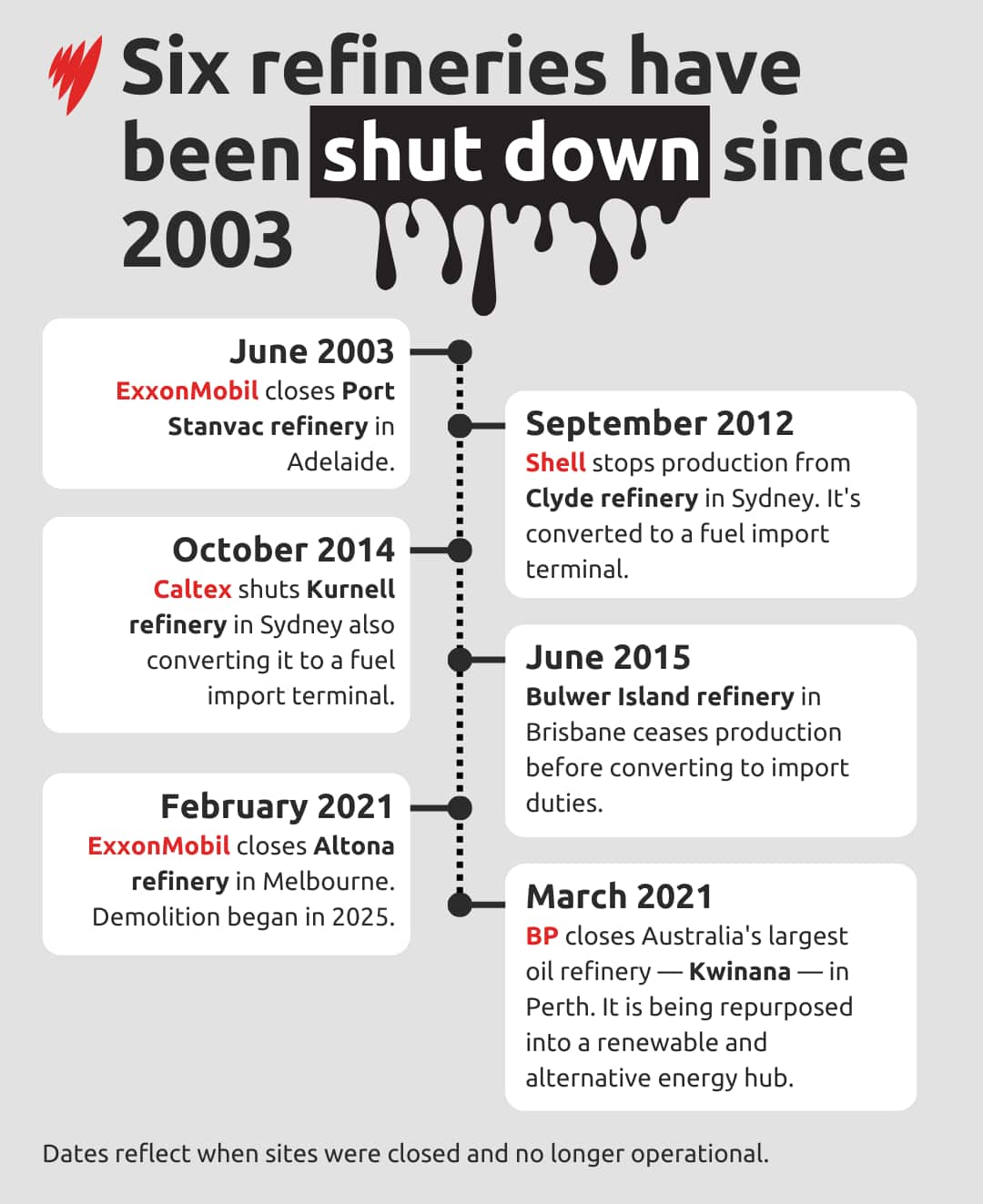
"There's the economics of scale, plus we weren't producing so much oil," Kevin Morrison, energy analyst at the Institute for Energy Economics and Financial Analysis, told SBS News.
"Also, the type of oil product we were consuming was changing. We were becoming much more of a diesel-driving nation than petrol.
"We would have to invest in a lot to change that, so it was just sort of economically unsustainable."
The sector shrank dramatically from 2003, when ExxonMobil closed its Port Stanvac refinery in Adelaide.
That was followed by the closures of five more refineries between 2013 and 2021, when BP shuttered the nation's largest oil refinery, Kwinana, in Perth.
What role do domestic refineries play?
The Geelong refinery supplies more than 50 per cent of Victoria's fuel, according to Viva Energy's website, with Morrison saying that was where the impact of the fire was "going to be felt the most acute".
Peter Anderson, director of APCO, which operates dozens of service stations across Victoria, told ABC Radio Melbourne that Viva Energy provides about 60 per cent of his supplies.
However, he said that, during previous supply disruptions due to maintenance issues, "they've always been able to come through with other suppliers from elsewhere, just bring it in by ship".
Victoria's energy minister, Lily D'Ambrosio, said the fire had not impacted diesel or jet fuel, and noted that petrol is easier to source replacements for than diesel.
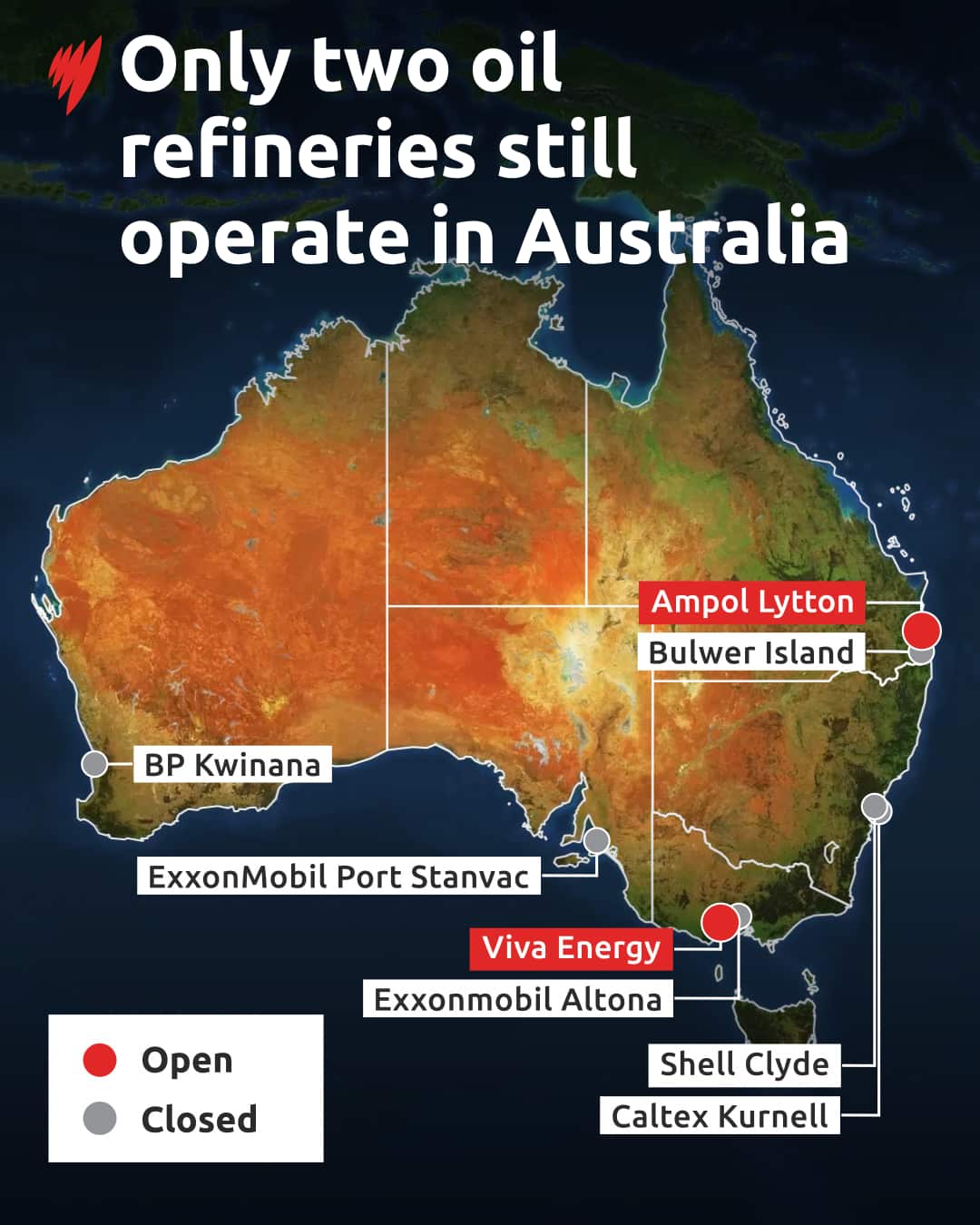
Together with Brisbane's Ampol refinery, the domestic facilities account for roughly a third of Australia's petrol consumption, with the rest imported.
"They're very small by world standards, and they're very old," said Alison Reeve, energy and climate change program director at the Grattan Institute.
"The government has underwritten [the refineries] in order to get them to stay open," she told SBS News.
"Part of that was so that they could produce fuel that can be used in modern cars, because the fuel quality that we use has changed over the years, and part of it was for fuel-security reasons."
Almost 90 per cent of Australia's daily fuel consumption is imported, much of it brought in as refined product from South Korea, Japan, Singapore, Malaysia and Taiwan.
Hussein Dia, professor of future urban mobility at Swinburne University of Technology, said that while supply would continue through international markets, the incident "adds pressure to an already tight and globally exposed fuel system".
"This doesn’t mean people will run out of fuel tomorrow, but it does narrow the buffer we have to absorb shocks."
'A structural issue'
The war in the Middle East has driven unprecedented global oil shocks due to Iran's effective closure of the Strait of Hormuz and the subsequent US blockade of the critical shipping lane.
It's also renewed scrutiny of Australia's dependence on imported fuel and international supply chains.
"From a broader perspective, this highlights a structural issue," Dia said of the fire.
"Australia has significantly reduced its refining capacity over recent decades, increasing reliance on long international supply chains," he added.
"While those systems are generally reliable, events like this show how limited redundancy exists when something goes wrong locally."
Morrison said Australia needs to accelerate its shift away from liquid fuels, with electrification of transport offering a pathway to greater energy security.
However, Reeve noted, much of electric vehicle and solar panel manufacturing also occurs overseas.
"Everyone's energy systems are linked to each other," she said, adding that the key challenge will be how to build stronger buffers into Australia's energy system.
For the latest from SBS News, download our app and subscribe to our newsletter.







