IN BRIEF
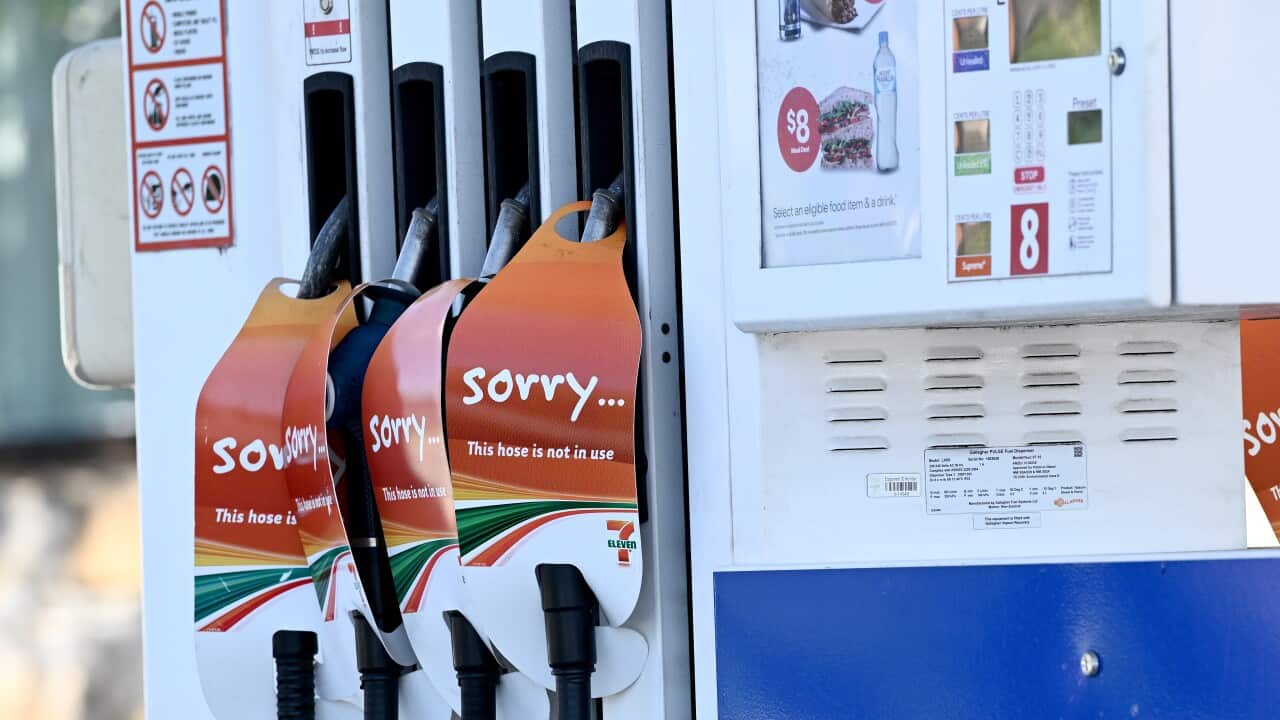
- Fuel prices in Australia have surged amid Iran's effective blockade of the Strait of Hormuz.
- Electric vehicles (EVs) are viewed as a practical solution for Australia to lessen its dependence on imported oil.
As Australia faces a global fuel shortage, experts say it is a "wake-up call" for the nation to rethink how it uses fuel.
About 90 per cent of Australia's liquid fuel is imported, according to the Department of Energy.
According to the Institute for Energy Economics and Financial Analysis (IEAAFA), Australia has the largest trade deficit in refined oil products in the world, naming the country "one of the most exposed worldwide" to current and potential future supply shocks.
With Iran maintaining an effective blockade on Strait of Hormuz — a waterway through which around 20 per cent of the world's oil passes — amid the war in the Middle East, Australia would need to consider how it would meet its fuel needs if supplies were disrupted.
The situation even led to a rare national address by Prime Minister Anthony Albanese, warning, "the months ahead may not be easy" as fuel prices could continue to rise and create further ripple effects in the community.
News that makes sense
Your trusted source for staying up-to-date with the world around you. Get free daily news updates and analysis, straight to your inbox.
Some experts say the answer to a more stable future may lie beyond oil.
"I think this is a really good wake-up call," Hussein Dia, professor of transport technology and sustainability at Swinburne University, told SBS News.
"For a long time, Australia enjoyed a lot of prosperity ... Essentially. If you wanted oil, it would arrive in time. We didn't have these supply shocks, but now we are witnessing it firsthand."
Since the transport sector accounts for up to 75 per cent of the country's liquid fuel demand, experts suggest that significant solutions for reducing oil dependence could arise from changes in this sector.
'Electrification'
Electric vehicles (EVs) are widely seen as a practical way for Australia to reduce its reliance on imported oil.
Dia said that this could be a "medium to long-term" solution for Australia.
"The most straightforward way to actually reduce our reliance on imported oil is to look at vehicle electrification," he explained.
"By turning to electrification, we can reduce our reliance on that imported oil or even on oil altogether. The good thing about electrification is that electric vehicles and trucks are charged using electricity produced locally.
Dia acknowledged that "We do need to burn coal at the moment to generate electricity, but increasingly, we will have solar and wind".
He suggested efforts should be concentrated on accelerating renewables.
The Federal Chamber of Automotive Industries' latest data show that in February, EV sales accounted for 11.8 per cent of the country's car sales, representing a record-high monthly share.
This comes with a huge hike in the EV market globally, with more affordable cars being sold.
"If we were having this conversation, maybe two years ago, you and I would struggle to find an electric car for less than $50,000. Now, you can find them for $30,000 and $40,000," Dia said.
"That's a good story because it means consumers have more choice."
However, compared with many other countries, Australia has fewer EV sales — these vehicles account for over 50 per cent of total sales in several countries, including Norway, China, Nepal, Denmark, and Finland.
"Unfortunately, Australia started from behind," Dia said.
"But still, it is not too late," and consumers would want to see more government policies in support of EVs and chargers, he said.
Currently, there is limited federal assistance available for buying EVs. Eligible zero or low-emissions vehicles are exempt from the fringe benefits tax, but the exemption for plug-in hybrid electric vehicles ended in April 2025.
The scheme is under review, and the government is considering a distance-based national road user charge for EVs.
The government is using the National Electric Vehicle Strategy to increase the supply of affordable EVs, encourage greater demand, and establish the resources needed.
But Dia said there should be "more".
"Sometimes there is this inconsistency in government approaches," he said. "They're encouraging, for example, renewables, but at the same time, they're also still investing in fossil fuel production and so forth ... There needs to be a holistic approach."
'The moment for electric bikes'
There are also additional short-term benefits that electricity can provide to reduce dependence on oil.
According to Jago Dodson, a professor of urban policy at RMIT University, most trips within Australian cities are less than five kilometres, which can be "undertaken relatively easily" by electric bikes.
"This should be the moment for electric bikes for short trips, below five kilometres," he told SBS News.
"Another thing that could start to be considered, although this is perhaps a little longer term than an immediate crisis response, is that we could look at options like electrifying the Hume Highway to provide catenary overwires that electric trucks could then draw charge from as they drive up."
The Hume Highway is a major national highway running for 840 kilometres between Melbourne and Sydney.
Can biofuels be a solution?
Replacing oil may not rely on electricity alone.
Some are also pointing to biofuels as a potential way to replace at least part of the oil currently used in Australia.
"Bioenergy, and the subset of biofuels, are an energy source derived from biological materials. So wood, plant material, animal waste, oils from plants. All can be processed to produce fuels and energy," Mark Brown, the current chair of the International Energy Agency Bioenergy Technology Collaboration Program, told SBS News.
Biofuels, including ethanol, may be combined with conventional fuels like oil to lessen dependence on other fuel sources. E10 is a type of biofuel that consists of a 10 per cent blend of ethanol mixed with regular petrol, available at most service stations.
"Bioenergy, more generally, is globally, as well as in Australia, a key component of the net zero transition," Brown said.
He said "the strongest opportunity" for biofuels would be for diesel aviation fuel and shipping fuel, "that are considered to be challenging for other solutions like electrification to step into."
According to Bioenergy Australia, the country is lagging behind countries such as the US, the UK, Canada, Brazil, Germany, Sweden, and New Zealand.
"We have the capacity in Australia today to produce as much as half a million litres of fuel a year, and we're currently using about 30 per cent of that capacity," Brown said.
"We could scale quite quickly to make some contribution, but to put that half million litres into context, that would roughly, if funded with our current fuel supply, be roughly two or 3 per cent of the total supply.
"The half million litres and some growth on that can be done quite quickly. The technology, infrastructure, supply chains, and networks exist."
However, some warn that the production of biofuels can still depend on fossil fuels, potentially limiting their benefits.
Dodson said that "most agricultural production in Australia is heavily dependent on fossil fuels."
"So yes, we can produce biofuels that then may be used in motor vehicles, but in order to produce those fuels, we've probably used almost as much diesel or petrol, more likely diesel, to actually produce the agricultural products that can then be turned into oil.
"It's actually difficult to get a big gain in additional energy by the time it makes its way into the car.
"At scale, it's not really going to solve many of our challenges and problems."
'Expanding' public transport network
Beyond alternative fuels, experts say reducing oil dependence will also require changes to how Australians move around their cities and to the public transport system as a whole.
With the current fuel shortage, Victoria and Tasmania have offered free public transport for a limited time to encourage people to use their cars less.
"I've tended to be a bit sceptical of free public transport as a solution to transport problems, in part because use of public transport is in part dependent on the quality of the service," Dodson said.
"If it were already providing a good quality service, then people would be using it irrespective of the fairly modest price that it's currently set at."
Instead, he suggests "expanding our public transport networks in our cities".
"That's relatively hard to do if we're thinking about large-scale fixed public transport infrastructure ... But we should be accelerating and expanding our planning for our metropolitan rail networks," he said.
"Comparatively, it is easy to roll out new bus networks. All you really need is some rolling stock, a bit of signage, and a few bus stops to be put out there, and some timetable updates.
"We should be looking at rolling out new electric bus rolling stock to create go-anywhere, anytime public transport networks across the entirety of our metropolitan areas."
For the latest from SBS News, download our app and subscribe to our newsletter.







