
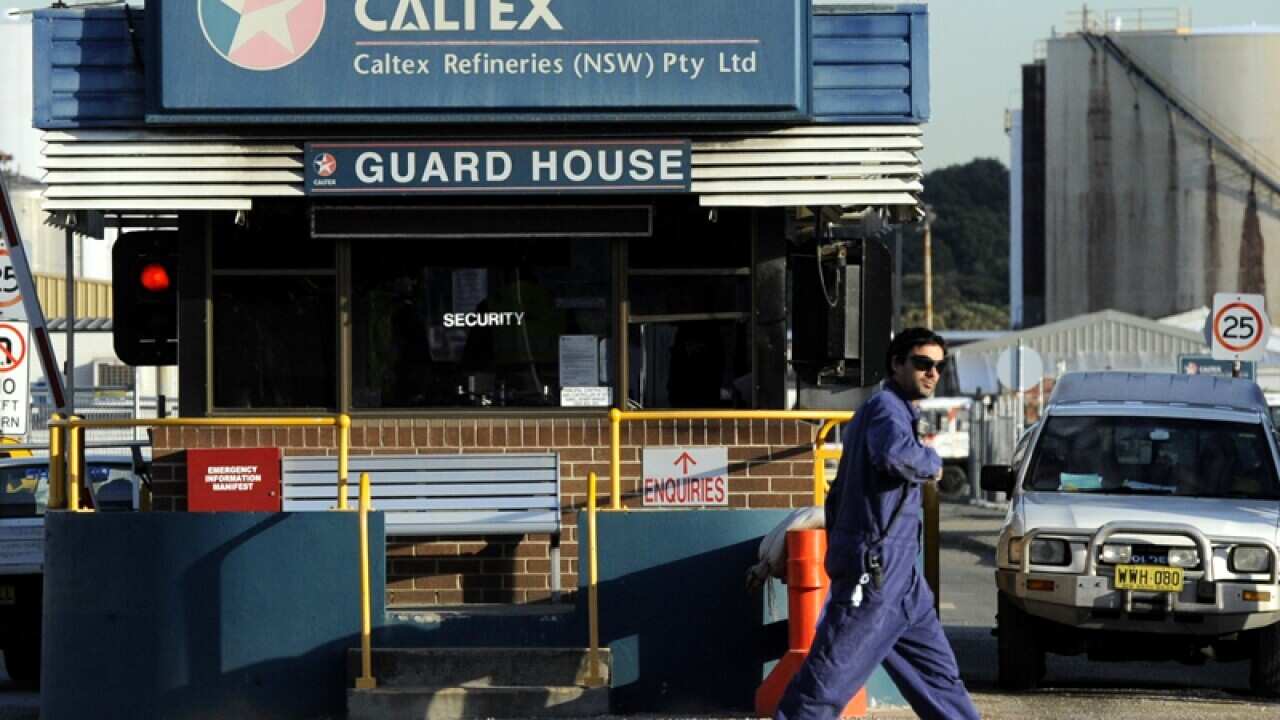
Caltex remains committed to reducing its oil refinery operations despite better margins and a falling dollar throwing the move's economics into question.
Australia's largest transport fuel supplier said it was on track to shut Sydney's Kurnell refinery by the middle of 2014 and convert it into a fuel import terminal, which will cost hundreds of jobs.
Delivering his company's financial results for the first half of 2013, chief executive Julian Segal talked up the company's retail stores and fuel distribution business, saying they would drive growth in the second half of the year.
The company's first half profit dropped 13 per cent to $171 million, due to the lower the Australian dollar and a pipeline outage.
The result was at the higher end of Caltex's guidance range for profit on a replacement cost basis, which excludes the effect of changes in world oil prices and reflects underlying performance.
Caltex's shares opened higher but then fell, closing two cents lower at $18.93.
Analysts attributed that reaction to an uncertain outlook for Caltex, as it winds down refining and possibly faces rising costs on imported oil due to the weaker Australian dollar.
A weaker Australian dollar would make refining more attractive, as the finished product is traded in US dollars.
Mr Segal said growth would continue in the company's marketing and distribution operations - driven by motorists using premium fuels.
A reduced exposure to refining would remove the volatile cashflows of those more competitive markets, he said.
"Caltex is the Australian transport fuel market leader, supplying 30 per cent of these fuels," Mr Segal said.
"But there are opportunities in geographies where we are not as strongly represented, and in products, we have demonstrated we can grow market share in lubricants that are high margin products."
He expects the mining and oil and gas industries to continue to demand higher volumes of diesel fuel, driven by the huge investment of recent years.
IG market strategist Evan Lucas said investors remain concerned that there was still a long way to go for Caltex's costly "consolidation" of its restructure, involving Kurnell's shutdown and conversion.
Analysts predict the company will also wind down its Lytton refinery in Brisbane.
"The refining business is highly volatile, sometimes they get excellent numbers, sometimes they don't and more times than not, the `don't' numbers influence them more than the good numbers," Mr Lucas said.
The refining business made a loss of $43 million in the first half of 2013, down from a $2 million profit last year.
An outage at its Lytton refinery in May and a disruption to supply in Sydney in June delivered a $20 million hit.
The marketing and distribution business delivered a $365 million profit, in line with last year's record $367 million.