The quest for independence
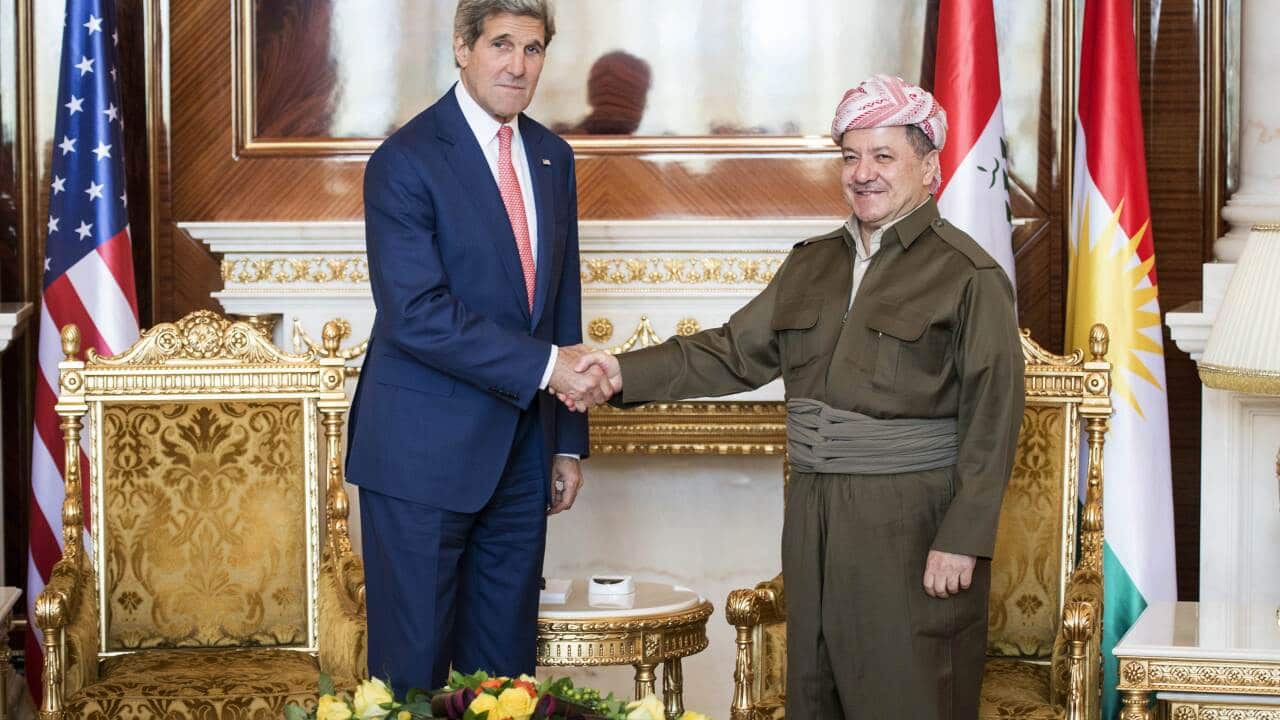
As John Kerry arrives in Baghdad this week, the big news is that the country's western frontier is now entirely outside the control of the Iraqi state. Sunni tribes have taken over the only legal crossing between Iraq and Jordan. The crossings between Iraq and Syria are under control of either the Islamic State of Iraq and the Levant (ISIL) or Kurdish peshmerga forces. Meanwhile, Kurish leader Masoud Barzani is giving strong hints that it may be time for Kurdistan to seek full independence.
Now, Sykes-Picot has been declared dead more times than God, rock 'n' roll, and Kenny from South Park combined, and yet, Middle Eastern borders haven't changed much in decades. So I wouldn't throw out your map of the Middle East quite yet.
Given these developments, it's not surprising that a number of influential foreign-policy writers are now questioning whether the unified Iraqi state has become a not-particularly-useful fiction. "I don't think it is worth American money, or certainly American lives, to keep Iraq a unitary state," argues Jeffrey Goldberg in the Atlantic. Fareed Zakaria, writing in The Washington Post, thinks the U.S. "should recognize that Iraq is turning into a country of enclaves and work to ensure that these regions stay as stable, terrorism-free and open as possible."
Others go further, arguing that the Iraq crisis marks the end of Sykes-Picot, the division of the Middle East by European powers after World War I that set the stage for the region's modern borders.
Now, Sykes-Picot has been declared dead more times than God, rock 'n' roll, and Kenny from South Park combined, and yet, Middle Eastern borders haven't changed much in decades. So I wouldn't throw out your map of the Middle East quite yet.
ISIL as a state
The world has many weak and fragmented states and many places that would like to be states but aren't. International recognition is the difference between the two.
In modern times, foreign powers have, with a few notable exceptions, not looked favorably on dramatic border changes — the U.S. was even wary about the Soviet Union breaking up — and for the moment, U.S. policy seems aimed at pressuring the Iraqi government to become more inclusive rather than allowing it to devolve into parts.
In the Iraq case, there's also the problem that the group that forced the issue onto the table — ISIL — isn't the most popular group around. ISIL may have some characteristics of statehood, and some other Sunni groups have joined it, but it doesn't have a foreign government patron and no one's going to recognize a new Sunni state as long as the group formerly known as al-Qaida in Iraq is running things.
Kurdish independence
The prospects for full, recognized Kurdish independence have increased dramatically in the last few weeks.
Kurdistan may be a different story. The region has enjoyed something close to de facto independence for a while. Even before the events of this month, things were coming to a head between the Kurds and Iraq in a dispute over oil exports, and the Kurdish regional government has even formed an unlikely alliance with traditional foe Turkey. If the ISIL rebellion is eventually defeated, it will be in no small part due to the efforts of Kurdish peshmerga forces, which should put the region in a far stronger bargaining position if and when the conflict ends.
The prospects for full, recognized Kurdish independence have increased dramatically in the last few weeks. But if I had to guess, I'd say that the conflict is most likely to end in something closer to the federalized system envisioned by Joe Biden back in 2007. (Contrary to how it's often remembered today, Biden never actually proposed splitting Iraq into three fully independent countries.) The partition of the country's ethnic groups has been happening anyway.
Even if Kurdistan does become independent, I think we're still a long way off from a total redrawing of the map. I don't mean to say that different borders might not be better for the region. There's no moral imperative in defending lines drawn by colonial powers in their own interests decades ago, including one that Winston Churchill boasted of drawing "with the stroke of a pen, one [possibly intoxicated] Sunday afternoon in Cairo." But my guess is that there are too many local governments with an interest in maintaining power and too many outside powers with an interest in maintaining the admittedly flawed status quo for major changes to take place.
We're not quite done with Sykes-Picot yet, and my guess is that the internationally recognized borders of the Middle East will look largely the same five to 10 years from now. But with a stunningly large and growing refugee population, seemingly intractable civil conflicts, ethnic polarization and the increasing power of armed nonstate groups, the better question may be how relevant those internationally recognized borders actually are to the people who live inside them.
---
Keating is a staff writer at Slate focusing on international news, social science and related topics. He was previously an editor at Foreign Policy magazine.
bc-iraq-slate
Share


