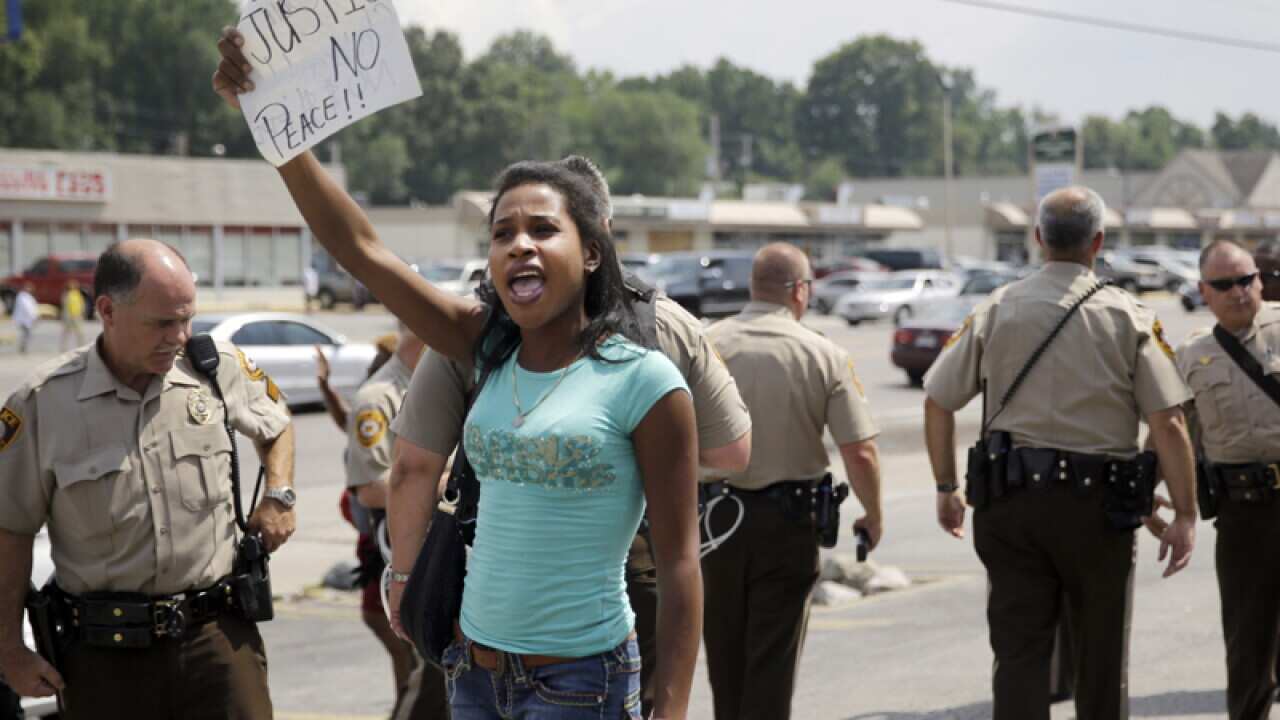
Two people have been shot and dozens arrested in the Missouri town of Ferguson as racially charged unrest continues to roil its streets more than a week after the killing of an unarmed black teen by a white policeman.
Police said a small minority of protesters within a larger demonstration fired guns and tossed rocks and Molotov cocktails at officers, who responded with tear gas.
Two people in the crowd were wounded by the protesters' gunfire and 31 were arrested, said Captain Ron Johnson of the Missouri Highway Patrol, adding that the police did not open fire.
He said four officers were also injured in the fresh bout of violence on Monday night that has shaken the Saint Louis suburb and gripped the US in a new debate over police treatment of minorities.
On August 9, 18-year-old Michael Brown was shot dead in broad daylight on a residential street by a Darren Wilson, a 28-year-old white police officer.
News that makes sense
Your trusted source for staying up-to-date with the world around you. Get free daily news updates and analysis, straight to your inbox.
Monday's demonstration over the killing started peacefully, only hours after President Barack Obama made a national televised appeal for calm.
But Johnson said a group of about 200 then started moving toward the police and a small minority among them attacked.
"There is a dangerous dynamic in the night," Johnson said.
"It allows a small number of violent agitators to hide in the crowd and then attempt to create chaos."
He added: "Our officers came under heavy gunfire."
Johnson stood behind a table on which a gun and a Molotov cocktail he said had been seized from protesters were on display.
Some of those in the crowd were not locals but rather had come from as far away as New York and California, he said.
US National Guard troops rolled into Ferguson earlier in the day, but they kept a low profile as police in riot gear dispersed the demonstrators around 11pm local time.
Obama, the nation's first African-American president, said he was sending Attorney General Eric Holder to Ferguson on Wednesday as Washington pursues a civil rights investigation into the case.
Obama said there was no excuse for local police to employ "excessive force" and urged the state of Missouri to make only "limited" use of the National Guard, which is operating under the supervision of Johnson and the Missouri Highway Patrol.
The reinforcements allowed State Governor Jay Nixon to lift an overnight curfew, but tempers are still running high amid controversy over Brown's death.
"They're supposed to protect the American citizens, but they're fighting a war with unarmed citizens," said demonstrator Ron Henry, who wore a T-shirt with the phrase "stop killing us."
Residents were on edge, after the previous night saw rioters loot stores and throw Molotov cocktails.
A forensic pathologist retained by Brown's family revealed that the student had been shot at least six times - twice in the head.
Different versions of the shooting have emerged, with police sources saying there was a scuffle during which Brown tried to seize the policeman's weapon, while witnesses have alleged that Brown had his hands up and was not resisting when he was shot.
A total of three autopsies have been requested - by local authorities, the family and the Justice Department.
Obama warned of a "gulf of mistrust" between residents and police in many cities and towns across America, particularly in those where racial minorities feel excluded from opportunities for a better life.
Former New York chief medical examiner Michael Baden, who examined Brown's body on behalf of his family, said on Monday he found no evidence of an alleged struggle between Brown and the officer.
The absence of gunpowder on Brown's body indicated that the muzzle of the gun was probably at least a foot or two away - or as much as 10 metres - Baden added.







