The first driverless shuttle allowed to use South Australian public roads will begin a five-year trial this week, as developers hope to raise the profile of autonomous vehicle technology.
The Flinders Express, or FLEX, will initially operate between Flinders University and nearby Clovelly Park train station before expanding its route within a year.
"I'm sure there will be technical learnings from the trial but as importantly, if not more importantly, what we're hoping is for some community acceptance to come out of the trial," Transport Minister Stephan Knoll said following the unveiling of the shuttle on Tuesday.
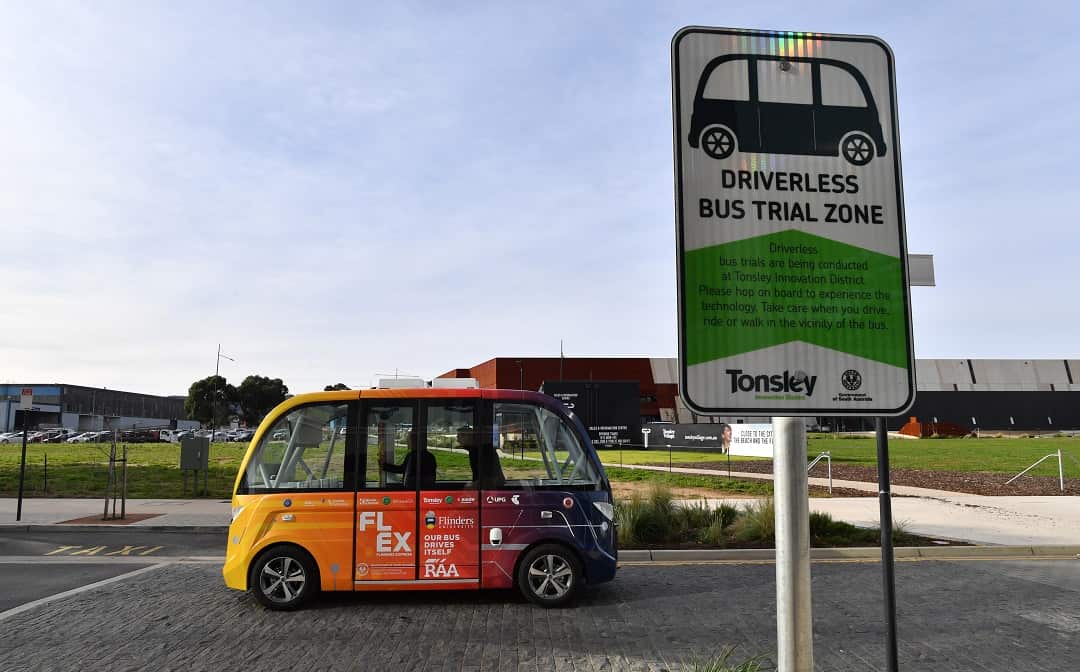
Mr Knoll was one of the first to take a ride on the vehicle, which was controlled at the launch by a chaperone due to connectivity issues.
News that makes sense
Your trusted source for staying up-to-date with the world around you. Get free daily news updates and analysis, straight to your inbox.
The French-designed electric shuttle can carry up to 15 passengers at speeds of up to 40km/h, but will only travel up to 30km/h during the trial.
It will ferry passengers Monday to Friday but its battery life will restrict operation to between the hours of 10am and 2pm
Flinders University Head of Civil Engineering Professor Rocco Zito said driverless technology uses a number of systems and mechanisms to map a particular route.
"My analogy would be (that) it's like railway tracks," he told reporters at the launch.
"The route is programmed and then it just drives along. All the speeds, all the turns, they're all programmed in there."
He said the vehicles do not yet have the capacity to react to changes in the route, necessitating an on-board chaperone at all times.
Before the trial's end, the shuttle will expand its course to the Flinders Medical Centre and the university's Bedford Park campus, and will have the ability to use main arterial roads within the Bedford Park precinct.
Prof Zito said developers hope the public will embrace the opportunity to ride on the shuttle.
"The whole purpose of our trial is to gauge the community's attitudes towards this new technology, to what we think is an enhanced mobility service," he said.
"What do we need to do to get people to be confident about the technology and actually convince them that it is providing a higher level of transport service than they could have at the moment?"
The $4 million project received $1 million from the state government's Future Mobility Lab Fund and used $3 million of industry funds for the five-year, three stage trial.
Members of the public will be able to book a ride on FLEX on the Flinders University website from Wednesday, June 20.