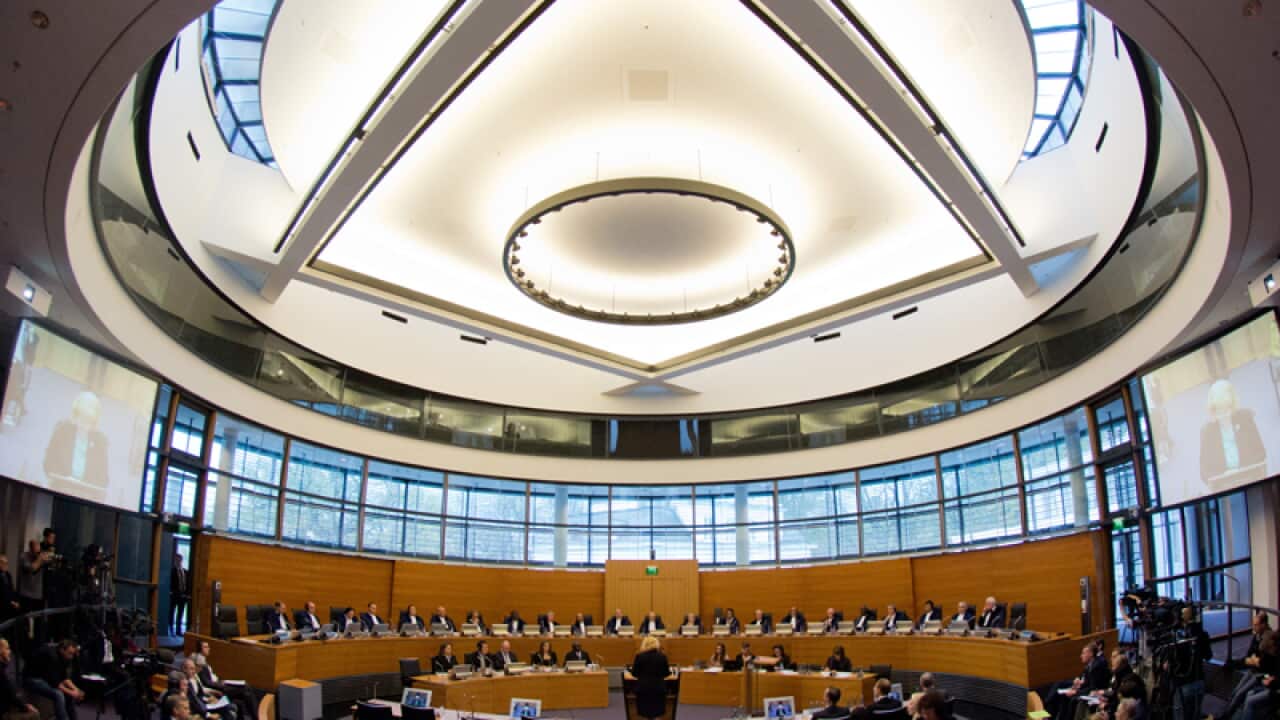
An international maritime court will rule this month whether to order Russia to release 30 crew members of a Greenpeace ship held since mid-September, in a high-profile case brought by The Netherlands.
Russia, as expected, did not attend the near three-hour hearing at the German-based International Tribunal for the Law of the Sea, based in the northern port city of Hamburg.
Its angry response after two Greenpeace activists scaled a state-owned Gazprom oil platform to protest at Russian oil exploration in the Arctic has sparked an international outcry.
Russian coastguards boarded the Dutch-flagged Arctic Sunrise icebreaker on September 19, arresting the 30 crew members, who included activists from 18 countries including Australia, and two journalists, initially charging them with piracy.
The Netherlands urged the tribunal, established by the United Nations to help settle maritime disputes between states, to take provisional measures, including releasing the crew and allowing the ship to sail.
News that makes sense
Your trusted source for staying up-to-date with the world around you. Get free daily news updates and analysis, straight to your inbox.
Liesbeth Lijnzaad, a legal adviser for the Dutch foreign ministry, told the tribunal's judges that Russia had infringed the ship's freedom to sail and violated the crew's human rights.
Expressing regret for the empty Russian seats at the tribunal, she accused Moscow of pursuing legal action for "apparently groundless" reasons.
"The disagreement is worsening and spreading," she said.
The tribunal's president Shunji Yanai said a decision on the Dutch demands would be announced on November 22.
"We're looking forward to that date and we're confident that the decision reflects many of the points that have been made," Lijnzaad said in a statement afterwards.
The crew members have been placed in pre-trial detention in Russia until November 24 and several have complained about their conditions, including being kept in isolation, cold cells and lack of adequate food and clothing.
Russian investigators last month reduced the piracy charge, which carries a maximum 15-year prison term, to hooliganism, the same charge used against the Pussy Riot punk band for a protest performance against Putin.
The Pussy Riot action in a Moscow cathedral in February 2012 landed two band members in prison for two years.
Greenpeace has said the Arctic activists never received official papers formally lifting the piracy charge.
Russian Prime Minister Dmitry Medvedev said after talks last week with his French counterpart that Russia would not condone attempts to "influence technically complicated and unsafe processes" associated with the extraction of natural resources.
Objects such as oil platforms are essentially "like a powder keg", he said.







