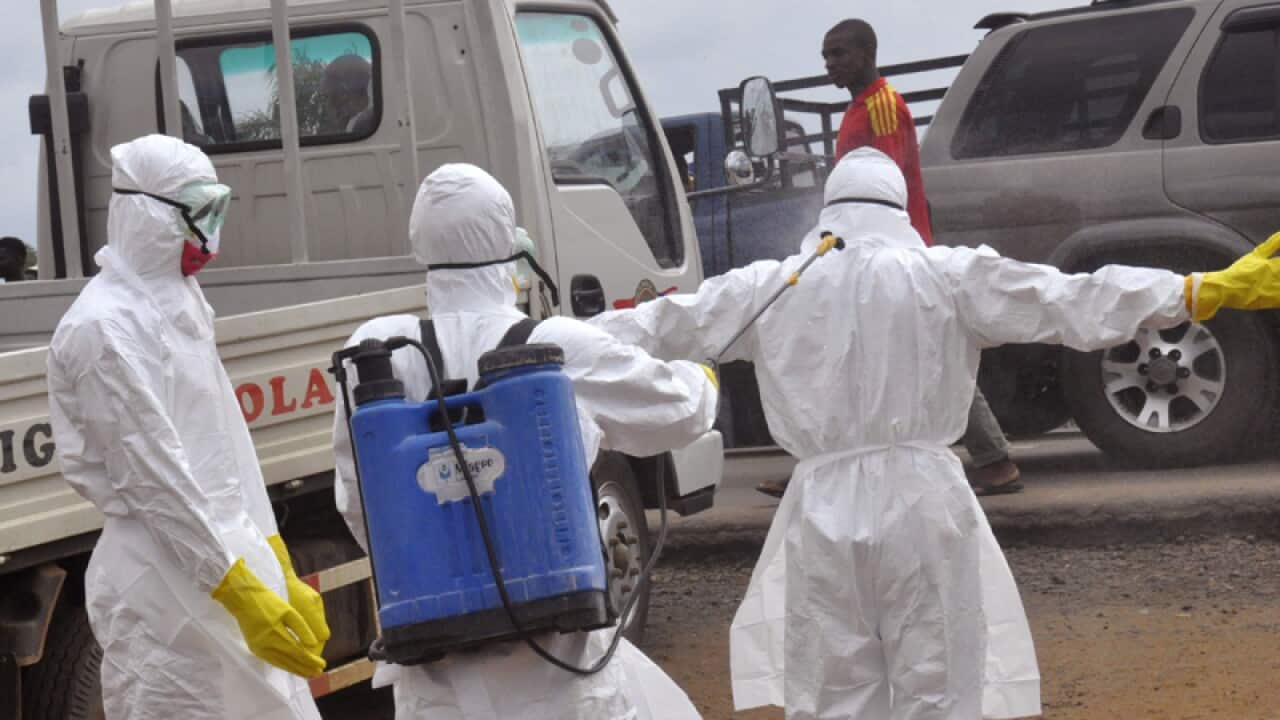
The UN Security Council has declared Ebola to be a threat to world peace and security.
At a meeting in New York, the Security Council called on all states to increase resources to tackle the disease, as UN Secretary-General Ban Ki-Moon announced the establishment of an emergency health mission to deal with it.
"This unprecedented situation requires unprecedented steps to save lives and safeguard peace security. Therefore, I have decided to establish a UN emergency health mission, combining the World Health Organization's strategic perspective with a very strong logistics and operational capability," Mr Ban said.
It's thought that more than 5,000 people have been infected and more than 2,600 have died in the recent outbreak.
The mission will focus on the three worst-affected states, the neighbouring West African nations of Liberia, Guinea and Sierra Leone.
"The outbreak is the largest the world has ever seen. The number of cases is doubling every three weeks. There will soon be more cases in Liberia alone than in the four-decade history of the disease," Mr Ban said.
Senior UN co-ordinator for for Ebola, British doctor David Nabarro, emphasised the resources needed to combat the disease.
"I estimate that to get ahead of the outbreak the level of response needs to be about 20 times greater than it is on the moment. That's a calculation based on the rate at which its extending but also recognizing that any scale up takes between one and two months to put in place."
In Sierra Leone, residents are stocking up on food and supplies as the government has imposed a nationwide lockdown to contain the outbreak.
The World Bank has spoken in stark terms of the economic cost on the disease, which may be felt even more acutely in Africa, already the world's poorest continent.
It believes billions of dollars could be drained from African economies as a result.
President Dr Jim Yong Kim has compared it to the Severe Acute Respiratory Syndrome, or SARS, outbreak in Asia in 2002 and 2003.
"There was over $40 billion dollars in loss of GDP, as a result of the SARs epidemic. And so 80-90 percent, we found, of that impact was due to what we call aversion behaviour, or the fear factor; ports closing down; airlines shutting down; people not going to work. And so we really have two contagions. The first is due to the virus and the second is due to this aversion behaviour or fear factor....we need to get high quality services on the ground that will both prevent new infections and treat the people who are infected."
This is the world's largest-ever outbreak of Ebola, the first having occured in the Democratic Republic of Congo in 1976.
There is presently no specific treatment for the disease, nor is there, despite the recent commencement of trials, a vaccine.
Share


