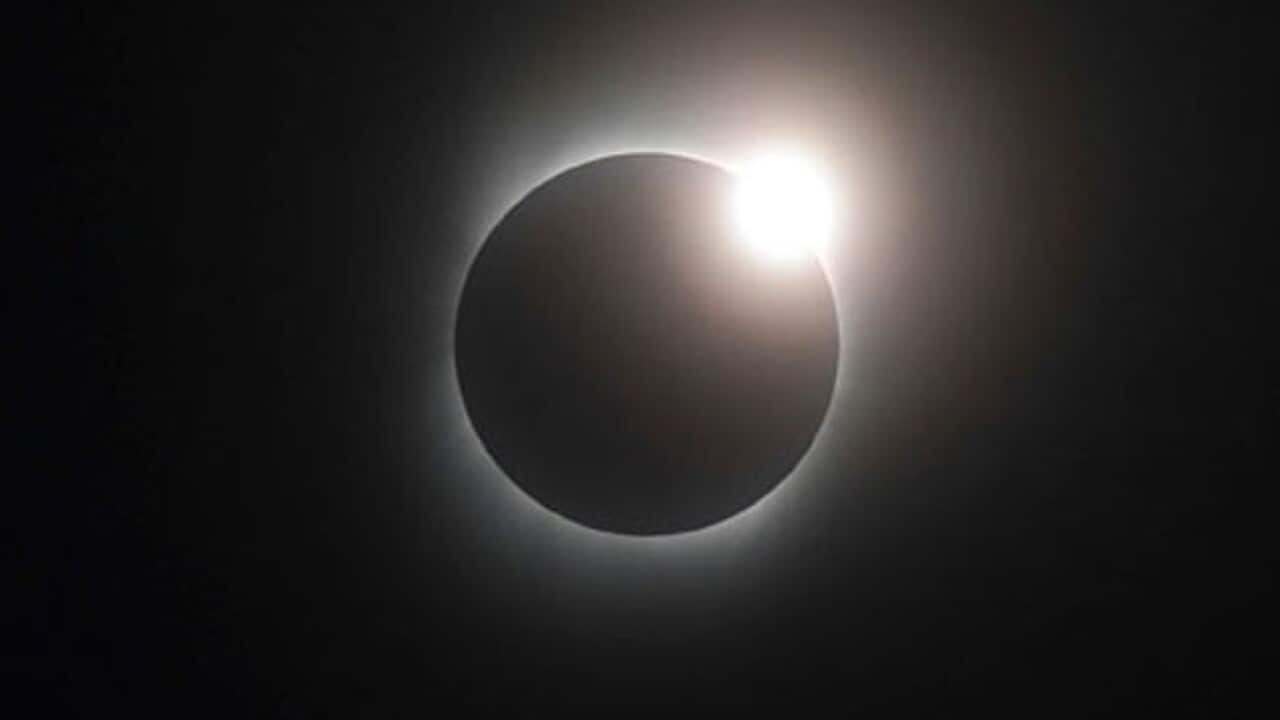
Many travelled thousands of kilometres to see one of nature's great spectacles. And they weren't disappointed.
For two minutes, day turned to night as the sun, moon and the earth aligned.
A significant celestial event, not only for astronomers, but also for Indigenous Australians.
Elverina Johnson travelled to Jardil beach near Yarrabah with a group of female elders to watch the total eclipse.
News that makes sense
Your trusted source for staying up-to-date with the world around you. Get free daily news updates and analysis, straight to your inbox.
"From the stories that my elders told me, this was a once in a lifetime event and also that, you know, a lot of the stories that come out of things that happen with the season, and the sun, the moon, the stars, it was a perfect opportunity where new stories were born" said Ms Johnson.
And stories continue to be born.
The group of female elders, and Ms Johnson, say the eclipse inspired a new dance about the unsual tides in the morning thought to be caused by the eclipse.
Duane Hamacher, an expert on Aboriginal astronomy at the University of NSW, said eclipses were of great importance in Indigenous legends. The moon and sun are often seen as a man and a woman who chase each other across the sky, sometimes fighting, sometimes loving each other. .
"In Euahlayi culture, the sun woman, Yhi, is constantly pursuing the moon man, Bahloo, who has rejected her advances," Mr Humacher writes in his blog.
"Sometimes Yhi eclipsed Bahloo, trying to kill him in a jealous rage. However, the spirits that held up the sky intervened and drove Yhi away from Bahloo.
"The Yolngu people of Elcho Island in Arnhem Land provided a similar, but less malevolent, explanation for a solar eclipse -- it was an act of copulation between the sun woman and moon man."
As in other parts of the world, eclipses in Aboriginal communities were seen as a sign of impending calamity or black magic, a threat that could be addressed by medicine men, or wirreenuns, who chanted a particular set of words or threw sacred stones or a boomerang at the eclipsing sun.
The next full solar eclipse in far north queensland won't be for another 200 years.







