Rescue and recovery efforts are continuing in Ecuador's hard-hit coastal town of Pedernales as the earthquake death toll passed 350.
A 7.8-magnitude quake struck off Ecuador's Pacific coast on Saturday, collapsing buildings and roads, and leaving people trapped under the rubble.
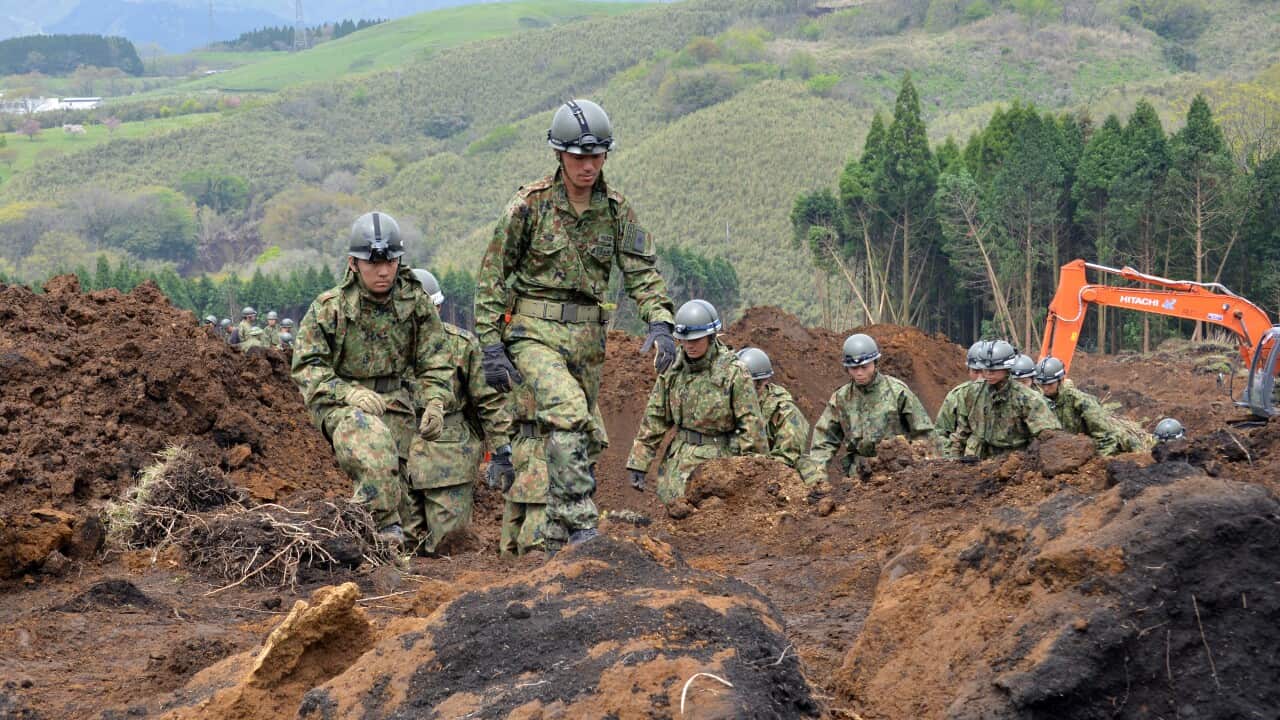
Japan is also recovering after a series of earthquakes struck the country's south, with the strongest measuring up to magnitude 7.3.
A state of emergency is in effect in six provinces in Ecuador, and more than 13,000 security personnel have been deployed.
News that makes sense
Your trusted source for staying up-to-date with the world around you. Get free daily news updates and analysis, straight to your inbox.
Coastal areas nearest the epicentre are worst affected, with reports that some villages have been completely destroyed.
The town of Pedernales is one of the worst-hit, and tents have been pitched in still-intact stadium to store bodies, treat the injured, and distribute water, food, and blankets.
Survivor Betty Reina is desperate for news of missing loved ones.
"No, I didn't sleep last night and I won't be able to sleep today because I am distressed with the desperation to find them, to see them, to know they are OK."
Ecuador's President Rafael Correa says the quake is the worst to hit Ecuador since one in 1949 that killed 5,000 people.
He says the priority now is finding survivors.
Mr Correa says better construction standards were enforced in Ecuador after the devastating quake that hit Haiti in 2010 in which 160,000 people died.
But he concedes that before then, there were poor building practices in place in Ecuador.
"What do you expect after an almost 8-magnitude earthquake? What answers do you want? For building and highways not to get damaged? Now, many buildings collapsed because of bad construction. No one wants to blame anyone now, but that's local government's fault. From this painful experience I hope we can learn. After Haiti's earthquake, we began to learn stronger norms of construction, which were applied in 2014. But before that, there were really precarious constructions, and that's why the damages are bigger."
Ecuador's quake followed two deadly earthquakes that struck Japan late last week close to the city of Kumamoto.
Japan's atomic regulator says there was no need to shut down the country's only operating nuclear station on the south-western Kyushu island, where the quakes killed more than 40 people and damaged in frastructure.
Sensitivity over nuclear power is high in Japan after the Fukushima disaster of 2011 was sparked by an earthquake and tsunami.
Professor of Geophysics at University of Tokyo Robert Geller has cast doubt on the position of Japan's Nuclear Regulation Authority.
"If I were in their position, I would be a little bit more worried. Can we accurately and reliably predict earthquakes? And the answer to that is: No way. It's impossible."
Both Ecuador and Japan are on the so-called "Ring of Fire", the seismically active zone that circles the Pacific.
Earthquake expert and Chair of Geology at the University of Melbourne, Professor Mike Sandiford, says even though both countries lie in the Ring of Fire, the earthquakes are unlikely to be connected.
"The conventional wisdom is no. The earthquakes on either side of the Pacific are on different tectonic plates so far removed from each other that we don't have any physical mechanism that we would think would explain that they are connected. Having said over the last decade we have had a number of similar occurrences where large earthquakes have occurred very close in time, so I think the weekend's earthquakes will cause us to do a bit of rethinking. But my gut feeling is that these occurrences are coincidences."







