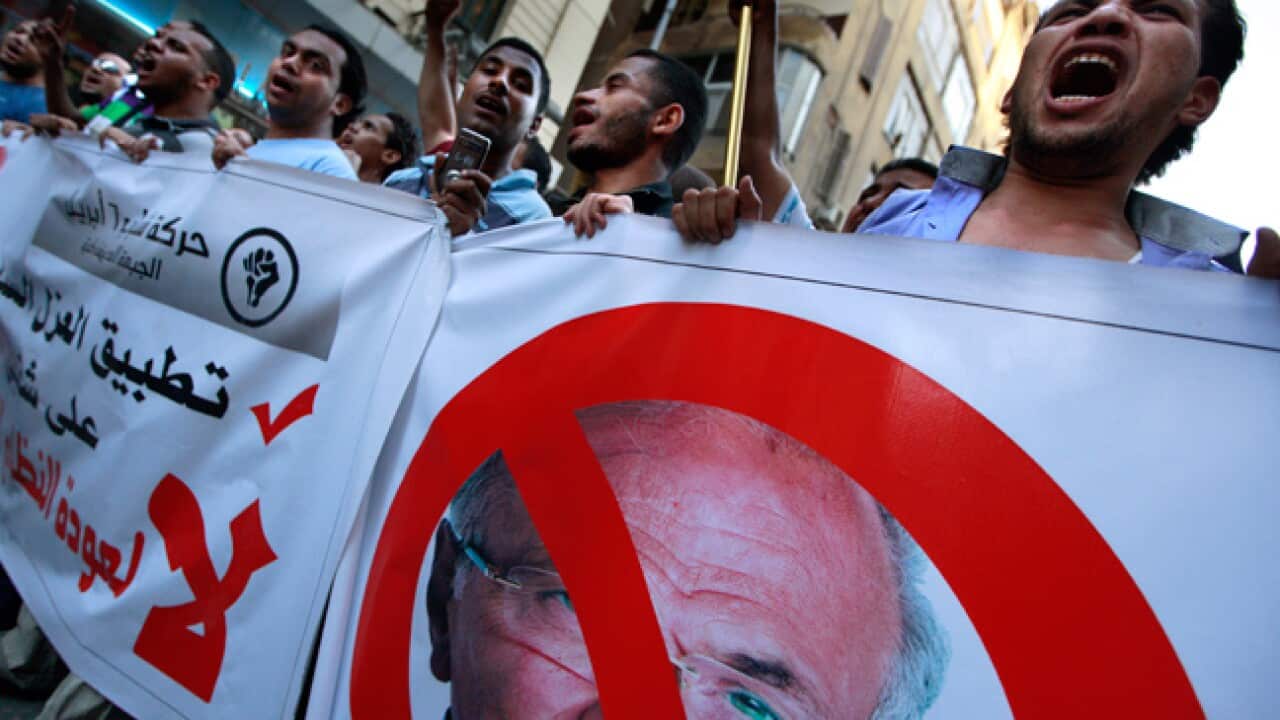
Egypt's top court has paved the way for the ruling military to assume parliament's powers by annulling the Islamist-led house while allowing Hosni Mubarak's last prime minister to stand in this weekend's presidential election.
The rulings, two days ahead of the fiercely contested election between the Muslim Brotherhood's Mohammed Mursi and the ousted Mubarak's last prime minister, Ahmed Shafiq, could throw the country into further political turmoil.
The military council, which took power when Mubarak was ousted, has vowed to cede power to civilian rule after a president is elected.
The uncertain transition has been thrown into further disarray by Thursday's ruling, which annulled parliament.
The new president's powers were to have been defined by a constituent assembly appointed by parliament this week.
News that makes sense
Your trusted source for staying up-to-date with the world around you. Get free daily news updates and analysis, straight to your inbox.
A military source said the court's ruling technically meant the military would assume legislative powers.
"We don't want it (the power) but according to the court decision and that law, it reverts back to us," the source said.
The court based its decision on what it said were illegal articles in the law governing parliamentary elections that reserved a third of seats for directly voted independents, or party members, and the rest for party lists.
Egypt's military decided on a complex electoral system in which voters cast ballots for party lists which made up two thirds of parliament and also for individual candidates for the remaining seats in the lower house.
The individual candidates were meant to be "independents", but members of political parties were subsequently allowed to run, giving the powerful Muslim Brotherhood's Freedom and Justice Party (FJP) an advantage.
The court also ruled that a law drafted by parliament to bar senior former regime officials such as Shafiq from standing in elections was unconstitutional.
The law applies to those who served in the 10 years prior to Mubarak's ouster on February 11, 2011 after an 18-day popular uprising.
Egyptian activists and political figures accused the military of a "coup" after the court decisions.
Mohammed al-Beltagi, a senior member of the FJP which dominates parliament, called the court's decision on parliament part of a "military coup".
"This is in many ways a soft military coup," said activist and academic Ibrahim al-Houdaiby.
"Now we have the parliamentary power going back to the Supreme Council of the Armed Forces, they will have their presidential candidate, they have the arrest laws. So we are going back to square one."
US Secretary of State Hillary Clinton called for a full transfer of power to elected civilians.
"There can be no going back on the democratic transition called for by the Egyptian people," she told a news conference in Washington.







