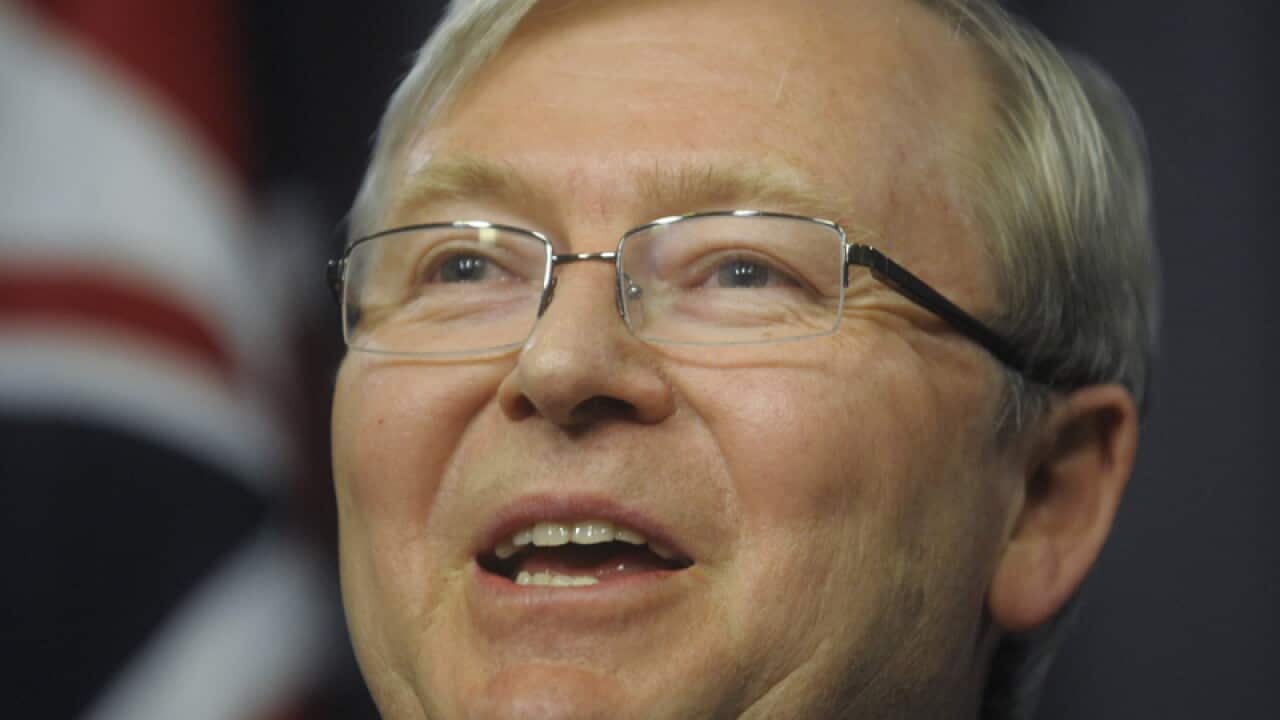
Opinion polls heralded him as the most popular Prime Minister for 30 years.
But plummeting opinion polls, a shelving of the emissions trading scheme and the botched mining tax saw the party replace him with Julia Gillard in 2010.
In the lead up to this year's federal election Mr Rudd turned the tables on Ms Gillard regaining the top job which he says he wants to keep.
News that makes sense
Your trusted source for staying up-to-date with the world around you. Get free daily news updates and analysis, straight to your inbox.
(Transcript from World News Australia Radio)
Kevin Rudd joined the Australian Labor Party in 1972, aged 15.
He'd been a member for nine years when he graduated from university with a Bachelor of Arts with Honours in 1981.
Prior to entering federal Parliament he worked as a diplomat, serving in the Australian embassies in Stockholm and Beijing.
He speaks fluent Mandarin - something which has won him approval in the past from Australia's regional neighbours.
In 2007 Mr Rudd impressed the former Chinese President Hu Jintao by addressing him in Mandarin.
"Mr President, if I might conclude my remarks with some words of personal welcome to yourself as our honoured guest in this country, (speaks in Mandarin)."
Kevin Rudd also worked as a senior official in the Queensland Government, and as a consultant helping Australian firms to establish and build their business links in China.
He first unsuccessfully contested the Federal seat of Griffith for the Australian Labor Party in 1996.
Two years later, he was elected to Parliament in the same seat.
Following the November 2001 election, Mr Rudd was appointed opposition spokesman on foreign affairs, subsequently adding responsibilities for international security and trade.
He first became leader of the parliamentary Labor Party on 4 December 2006, leading it to victory at the 2007 federal election.
Now re-installed as leader, he's hopes to do it again in 2013.
"In 2007 the people elected me to be their Prime Minister. That is a task I resume today with humility, with honour, and with an important sense of energy and purpose. In recent years politics has failed the Australian people. In fact it's been holding our country back. And all this must stop."
During his first term as Prime Minister disgruntled colleagues accused him of micromanaging ministers, or excluding them from decision-making altogether.
He also had a reputation for bursts of anger and brusqueness.
It is a reputation that had stayed with Mr Rudd from his time as chief of staff to then Queensland Premier Wayne Goss and later as Queenland's top bureaucrat, as head of the Department of Premier and Cabinet.
To assuage MPs' concerns he has now promised a decentralised management style and a more conciliatory personal tone.
Mr Rudd says he's learned from past mistakes.
"Everyone in national political life whether it's me, whether it's Mr Howard, whether it's Paul Keating, whether it's Bob Hawke, whether it's Bob Menzies. You speak to any of these folks they'll all readily say there are days where they don't get it right it's just life. And so all of us make mistakes and every government's made mistakes including the one I led as well."
Mr Rudd has moved quickly to turn the Opposition Leader Tony Abbott's own campaigning strengths on the carbon tax, debt and deficit and asylum boat arrivals against him.
One of his first acts was to go to Indonesia for the annual leaders' meeting where he negotiated a summit on a regional solution to people smuggling with Indonesian President Susilo Bambang Yudhoyono.
"I congratulate the president on his new initiative - that is to convene a regional ministerial meeting of key origin transit and destination countries, a conference to explore concrete operational policy responses including new regional responses and actions to enhance boarder security, in addressing the problem of irregular movements of persons."
Mr Rudd has also set about wooing the gay and lesbian vote.
He says he's changed his mind about the issue of gay marriage, even though he voted against same sex marriage just last year.
The P-M says after reflection and many discussions, he now believes it's the right move.
"I believe that surely Australia is grown up enough in the year 2013 for the secular state to have its definition of marriage, religious institutions and the Christian church to have their definition of marriage and for them each to be able to conduct their own ceremonies. That's it in a nutshell."
Climate change is an issue that has played a big part in shaping the Australian political landscape over the past few years
Soon after his re-election as leader, Kevin Rudd moved to weaken Coalition advantage among voters on this issue by switching from the carbon tax to a floating price in 2014 - a year sooner than planned.







