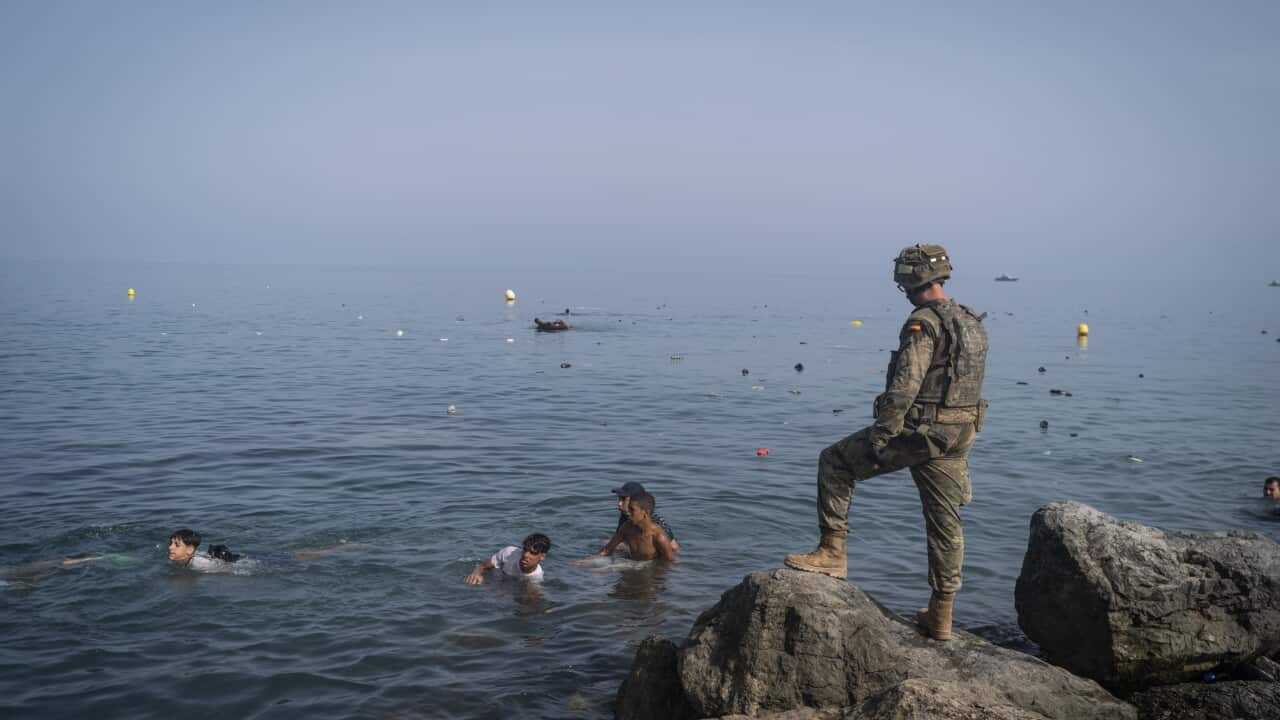
In brief
- More than 50,000 migrants crossed into Ceuta, with most returning to Morocco within 48 hours.
- Spain says a new barrier will help prevent further crossings at a key entry point.
A tiny Spanish territory on the northern tip of Africa has become the focus of international attention — and debate — after more than 50,000 migrants crossed into it in a mass rush that left at least 67 people dead.
The European Union will hold crisis talks after the mass crossing into Ceuta on Thursday. Most of the migrants had returned to Morocco within 48 hours of crossing, but the incident has raised alarm among European leaders about the bloc's shared border security.
Ceuta has steadily fortified its border over the years as it became a key route for migrants trying to reach Europe.
The Spanish exclave already had a border fence with Morocco, but Spanish authorities have since begun installing a 500m-long floating barrier on its sea border with its African neighbour.
It's designed to stand 30 to 70cm above water and extend as much as one metre below the surface, while a channel between the barriers will allow Civil Guard vessels to patrol the area, the government said.
News that makes sense
Your trusted source for staying up-to-date with the world around you. Get free daily news updates and analysis, straight to your inbox.
The arrivals were equivalent to nearly two-thirds of Ceuta's permanent population of about 83,000.
How and why did the migrants enter?
Ceuta and Melilla, another Spanish exclave on the North African coast, are the only two land borders between the European Union and Africa.
Many arrivals swam to Ceuta around the Tarajal breakwater — a sea wall extending out from the Spain-Morocco border into the Mediterranean — to come ashore at Tarajal beach.
"Spain gives you the chance to make your future, not like Morocco," Buji, a 21-year-old Moroccan who is studying to be a teacher, told the Associated Press (AP). "I am a talented boy. I just want a chance."
He said he lost his belongings and money in the crossing, and when he realised that he would likely face legal limbo and detention, he turned back.
"I’ve spent perhaps 14 years studying, but there’s nothing at home, and I'd have to work 12-hour shifts for a meagre wage," he told AP.
"That’s why I came here, but I haven’t found any opportunities here either, so I have to go back."
To reach the city, migrants have been known to swim around 5km from the Moroccan town of Fnideq.
Officials said at least 67 bodies were recovered on the Spanish side after some migrants drowned and others were crushed while trying to climb the breakwater and border fence.
Many were driven to migrate by economic hardship and reportedly by rumours circulating on Moroccan social media that border security had been relaxed.
Spanish interior minister Fernando Grande-Marlaska blamed people-smuggling networks for exploiting vulnerable migrants by spreading misleading interpretations of a recent Spanish Supreme Court ruling.
Spain's immigration policies
Spain's 29 June Supreme Court ruling said authorities cannot summarily deport migrants who arrive by sea without due process, because they did not cross the physical border barriers referenced in Spanish law.
Gemma Pinyol-Jiménez, head of migration policies and diversity at Instrategies and an associate researcher at GRITIM–Pompeu Fabra University, told CNN that it effectively means migrants can't be pushed back at sea because there is no crossing of a formal border.
It does not mean people cannot be sent back, and the deportation process can still be completed within days.
"The idea is to facilitate the work of the police, but it doesn’t mean these people can stay in Ceuta," she said.
In contrast to much of Europe, Spain has adopted a less restrictive stance on migrants, introducing a program to grant residency to more than half a million undocumented people already living there.
Experts have said that summer sea conditions, Spain's relatively strong economy, and its immigration policies may have contributed to the surge in migrant arrivals.
How have world leaders responded?
The mass crossing triggered alarm across the European Union.
Leaders of Italy, Denmark, Austria, Belgium, Bulgaria, Cyprus, Croatia, the Czech Republic, Estonia, Finland, Germany, Greece, Hungary, Latvia, Lithuania, Malta, the Netherlands, Poland, Romania, Slovenia, Slovakia and Sweden signed a letter asking the EU’s current Irish presidency to convene a video conference of interior ministers.
"We cannot allow uncontrolled mass crossings, the instrumentalisation of migration or other hybrid threats to create the perception that illegal entry into the European Union is possible. That a migrant’s illegal entry can turn into legal stay," the letter said.
The meeting has been scheduled for Tuesday.
Italy announced on Friday it was suspending its Schengen arrangements with Spain for a month in response to the incident.
The Schengen agreement allows passport-free travel between 29 European countries.
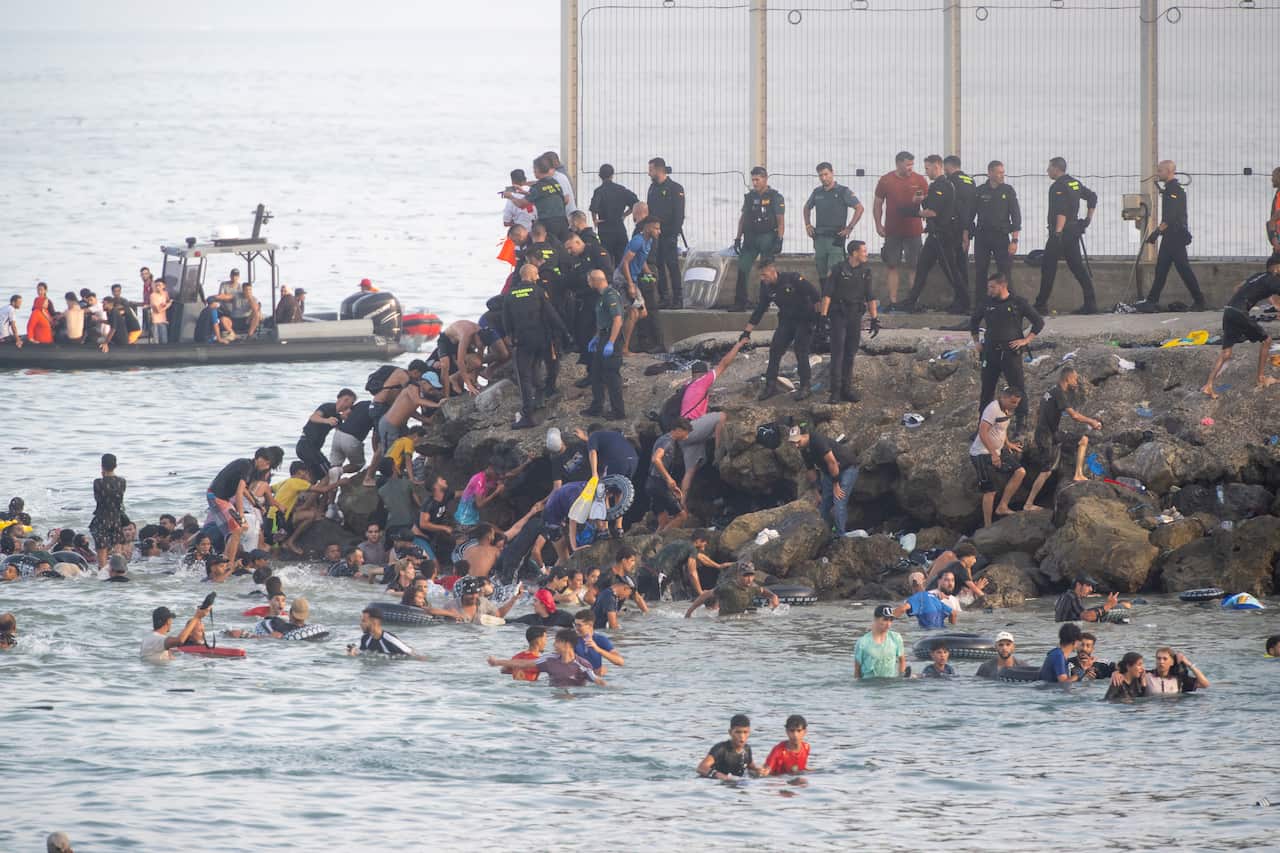
"This is an extraordinary measure, adopted to safeguard national security and prevent possible repercussions for our nation," Italian Prime Minister Giorgia Meloni, a right-wing leader who campaigned on a pledge to reduce illegal immigration, wrote on X.
Italy, which does not share a land border with Spain, also said it had agreed with France to strengthen controls along their border to try to prevent undocumented migrants from crossing.
Spain's centre-left prime minister, Pedro Sanchez, criticised the decision as "selfish, polarising and unlawful".
United States President Donald Trump, whose mass immigration crackdowns have been a key pillar of his second term, held a cabinet meeting about what he called a "catastrophe" and what "looks like an invasion" in Spain.
"That same thing is going to happen to us if the Republicans don’t get elected," he said.
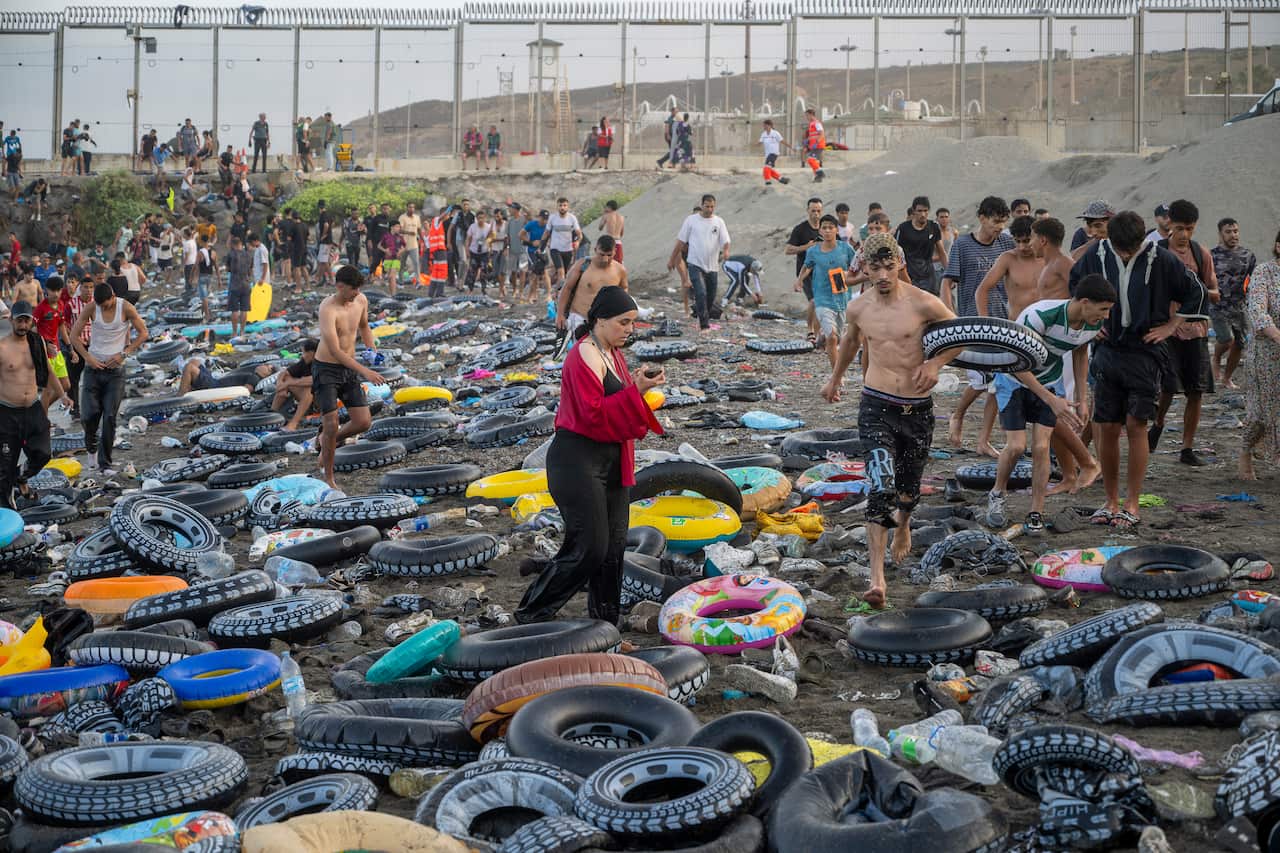
Spain said migrants who entered Ceuta irregularly would not be allowed to travel onwards to mainland Spain or elsewhere in the Schengen area.
It said order had been restored within 24 hours and that reinforced police and military deployments would remain for as long as necessary.
Migrants return
Hundreds of migrants continued to make their way back to Morocco on Saturday, some saying they had done so voluntarily, leaving Ceuta after what they described as degrading treatment on the Spanish side of the border.
They walked along a long stretch of beach before slipping into Morocco through a small breach in the border fence.
"I decided to come back on my own," Ouail Lamzeiz told AP.
"I spent eight days in Ceuta, and I was about to get a bed at the migrant centre, but I hadn’t eaten for days. Even the Moroccans there didn't help."
Migrants told AP they spent their nights sleeping in the forests around Ceuta because they could not find shelter, and that they often fought over food.
Others have said they do not intend to return.
Mohamed Hatri, a 23-year-old Moroccan, said he was determined to stay.
"They've closed everything down so that we can’t buy anything to eat, to force us to return to our country," he told AP.
— With reporting by Reuters news agency and Associated Press
For the latest from SBS News, download our app and subscribe to our newsletter.







