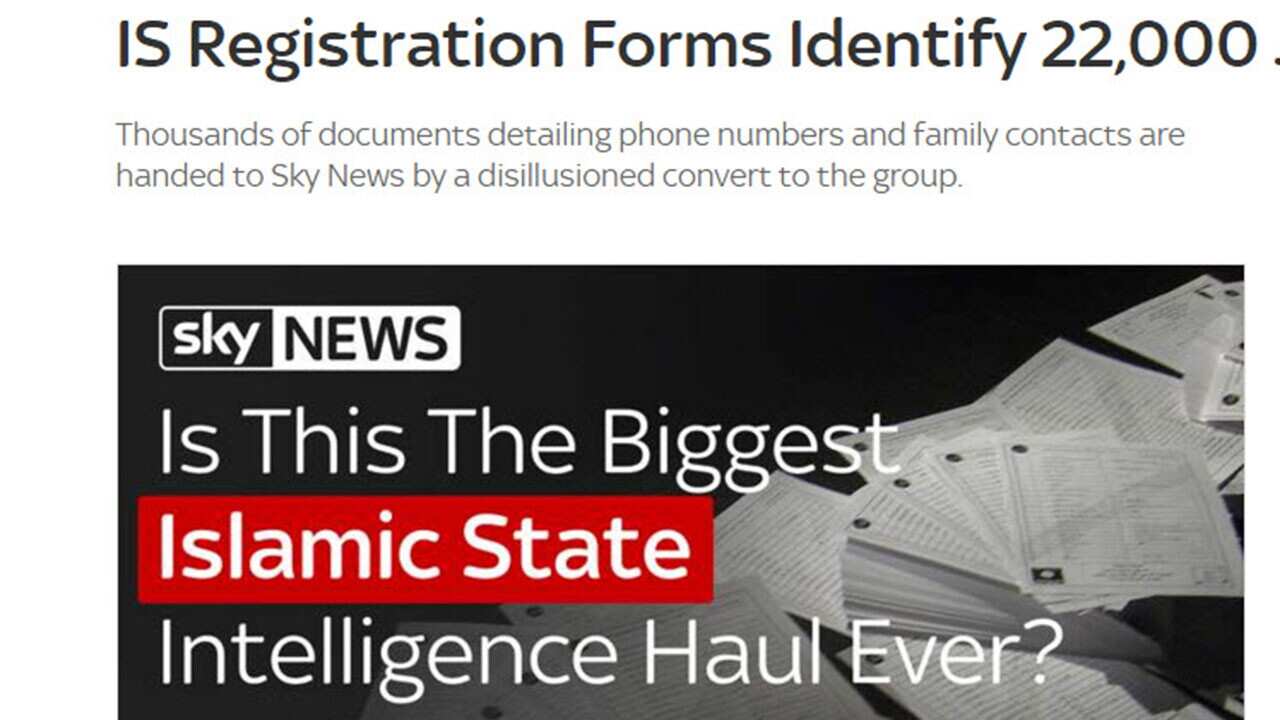
A huge leak of Islamic State documents could be a "gold mine" for security services and law enforcement, an expert has said.
Intelligence agencies are examining more than 22,000 files said to show the addresses, telephone numbers and family contacts of jihadis who signed up to join the group.
Authorities will comb through the cache with a particular focus on British individuals.
Nationals from more than 51 countries including the UK filled in a 23-question "registration" form as they were inducted into IS, according to Sky News, which obtained the data.
Shashank Joshi, a senior research fellow at the Royal United Services Institute (RUSI) security think tank, described the leak as "incredibly important".
News that makes sense
Your trusted source for staying up-to-date with the world around you. Get free daily news updates and analysis, straight to your inbox.
He said: "It is a law enforcement gold mine. It means it might make it easier to prosecute those who have returned.
"Beyond that it is also an intelligence gold mine because it may include people whose departure wasn't known and a lot of information about other contacts because there is an entry about who recommended this individual."
He added: "Rarely do intelligence organisations get complete caches of documents in this way."
The documents were reportedly stolen by a former member of the Syrian Free Army who joined IS and then became disillusioned, saying it had been taken over by soldiers from the Iraqi Baath party of Saddam Hussein.
One of the forms shows the details of Junaid Hussain, a Briton married to Sally-Anne Jones, a former member of an all-girl punk rock group.
His form reveals his fighter name Abu Hasayn Al Britani, his mother's maiden name, his date of birth, the fact that he has a secondary level education and was previously an "electronics specialist".
Hussain was killed in a US air strike in August.
Reyaad Khan, from Cardiff, was also named as one of those appearing in the files. He was killed in an RAF drone strike.
UK Home Secretary Theresa May said IS - also known as Daesh - poses a "severe threat".
Speaking as she arrived in Brussels for a meeting of EU justice and home affairs ministers, she said: "Daesh poses a severe threat. The threat level in the UK is at severe and we have seen the attacks that have been perpetrated on mainland Europe over the last year.
"That is why it is so important for us to work together to counter this threat."







