
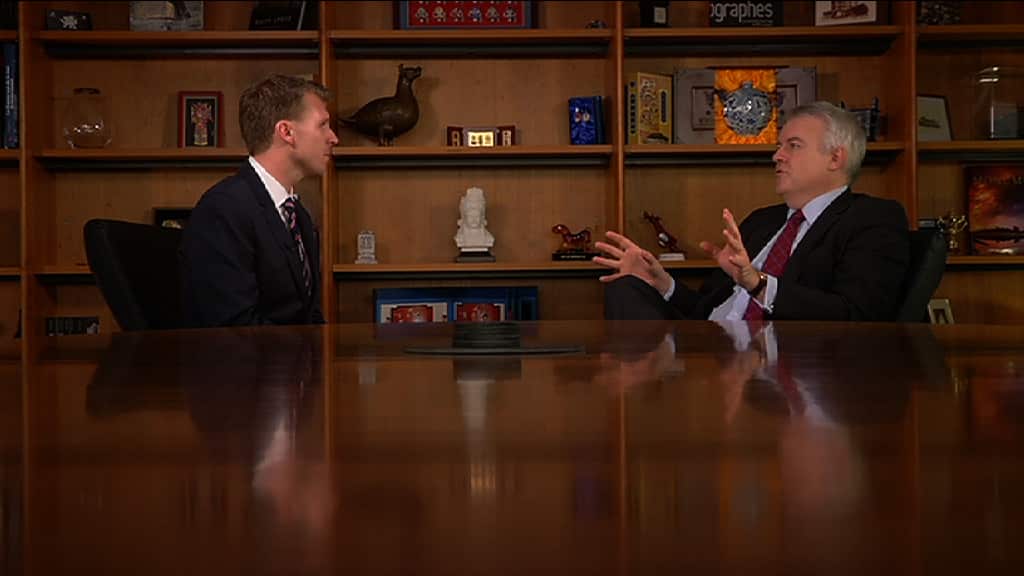
In an exclusive interview with SBS Europe Correspondent Brett Mason in the Cabinet Room of the Welsh Assembly, Carwyn Jones said that unless England, Wales, Scotland and Northern Ireland can agree on a framework "fit for the 21st century" the United Kingdom "won't last".
British Prime Minister David Cameron promised greater powers to all four nations in the wake of what his Conservative colleagues described a "political near miss" in the recent Scottish independence referendum.
Despite pleading to put Wales "at the heart" of devolution negotiations, the Welsh First Minister has described the process as "incoherent".
"The problem is we should be sitting down as four nations and saying 'ok, what do we want the UK to look like, what sort of structure should it have?'
"The tragedy is for me, as somebody who is a proud Welshman, but who wants to see the United Kingdom continue, is that unless this is dealt with, literally in the next year of two, then I've got real fears about the UK staying together.
"It [the UK] can't carry on as it is. It won't last".
"It [the UK] can't carry on as it is. It won't last".
When asked if he had genuine fears for the United Kingdom's survival, the Welsh Labour Leader replied "yes".
"We've seen a weakening of the bonds that have traditionally existed between the four nations.
"If the United Kingdom is going to last then we have to make sure that we all sit down and come to an agreement about how the United Kingdom is going to function in the future and I see no sign of that.
"We're not even at the start of that process yet."
"It's all conversations in different rooms at the moment. We're not even at the start of that process yet."
The First Minister said that despite fears of a "domino effect" following Scotland's push for independence, he remains committed to Wales being part of the United Kingdom and the European Union, but with a modernised constitution that delivers greater autonomy to individual nations which are directly accountable to their people.
"The first thing you do is say 'look, all power doesn't come from London'. And that does mean that parliamentary sovereignty comes to an end".
On 18 September 2014, Scotland voted against breaking away from the United Kingdom. Two days before the vote all three major political parties campaigned against independence, promising increased self-governance and "extensive new powers" for the Scottish Parliament.
This pledge has sparked ongoing debate around the need for similar devolution across all four nations, however, this process is complex and presents multiple political challenges for all parties and nations.
The upcoming General Election – and predictions of yet another minority government – has further complicated the implementation of a modern framework.
"The difficulty, looking at the Australian system of government, is that with the Australian states, you don't have one state that's 85% of the population of Australia. And the equivalent of that for us of course is England.
"Scotland has 5 million people, Wales has just over 3 million, Northern Ireland just over 1.5 million, so England is vast compared with all three of us put together".
"You can't have a federal structure like there is in Australia because there is such an imbalance".
Even before last year's referendum, Wales has never enjoyed the same powers of self-governance as Scotland.
The calls to resolve this equality are growing louder.
Like their northern neighbours, the Welsh have found their voice.





