The problem we face with fossil fuels being ultimately a finite resource has exposed our need for renewable fuels. But research is underway on new and more environmentally-savvy ways to fuel our growing planet – among them algal biofuels.
The situation is made more challenging with expected global population growth, increased pressures on food production and higher demand for energy and fuel.
News that makes sense
Your trusted source for staying up-to-date with the world around you. Get free daily news updates and analysis, straight to your inbox.

Third-generation biofuels, such as algae, are created without interference with human food production or land use, and are the subject of current investigations for capture and use.
This is particularly important for Australia, as only 6% of our continent's surface is cultivatable.
Algae are the ideal crop to address all these issues – often simultaneously.
Hang on … what are algae?
Algae are aquatic organisms inhabiting freshwater and marine environments. They range from microscopic single cells called microalgae (visible with the aid of a microscope), to macroscopic, multi-cellular organisms (macroalgae).
Irrespective of size, these organisms convert carbon dioxide using the sun's energy into organic carbon, just like plants.

Algae evolved when the surface waters of Earth were highly enriched in nutrients and trace elements. Algae, like plants, require nutrients and trace metals from their environment for growth – a process known as fertilisation.
Algae can absorb and store high levels of metals such as iron, copper and manganese, and nutrients such as nitrogen and phosphorous, often more efficiently than plants.
Therefore algae are ideally suited to remediate metal and nutrient-rich waste waters.
What's happening now?
The algal biofuels industry is still in its infancy and it is yet to be confirmed whether the technology can consume emission and produce substantial volumes of bio-fuel.
As is the case in other countries, Australia is doing its bit to develop algal biofuels and provide the leg up to help the industry mature.
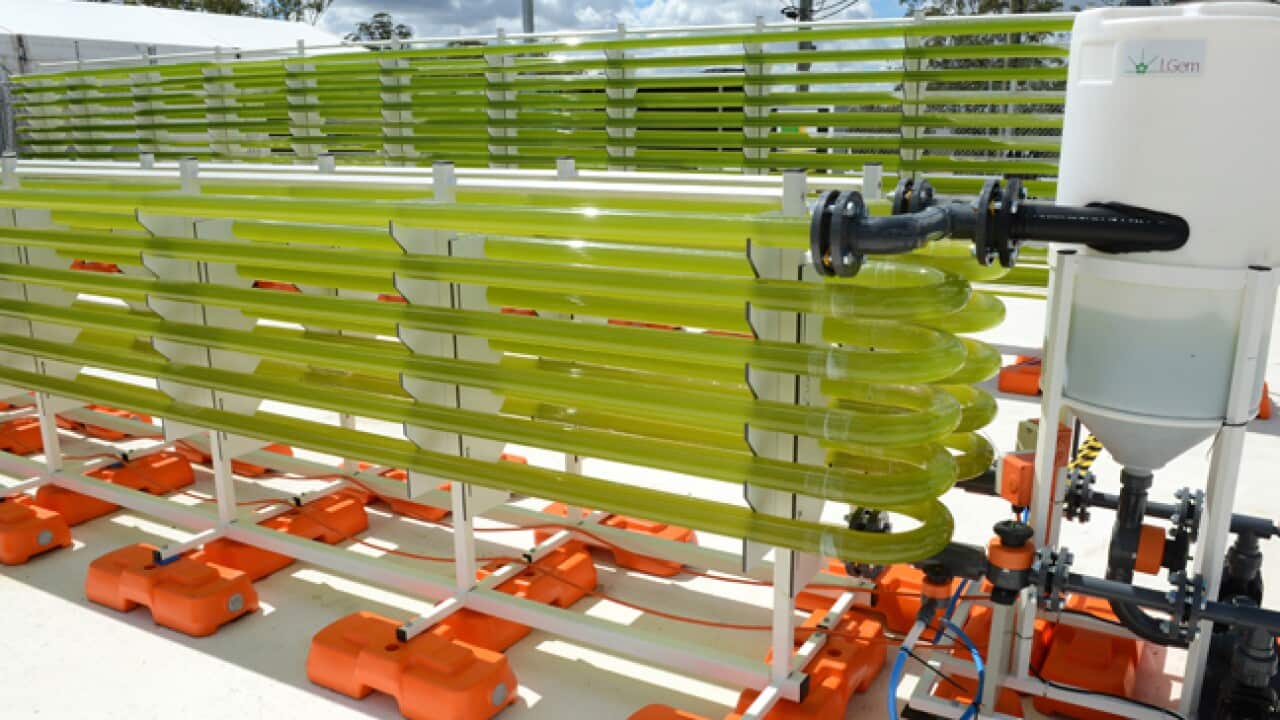
A pilot project site at Tarong in Queensland is the first of its kind, testing and providing insights into the operating potential of algal synthesiser technology when attached to industrial power plants.

It is a vital pilot program that will help to shed light on automation, harvesting and processing options for the biomass. Testing and improving the technology is paving the way for more efficient, large-scale and low-labour carbon abatement operations.
Research into algal biofuel conversion to look into the potential of macroalgae – macroscopic, multi-cellular organisms such as seaweed – has been supported by funds from ARENA.
Specific funds have been earmarked for the development of renewable aviation fuels.
Aside from government funding, oil companies, airlines and aircraft engine manufacturers are joining Australian federal and state funding schemes to accelerate the development of algal biofuels nationally and globally.
What are algal synthesisers?
Algae synthesisers are vessels used to cultivate algal biomass. There are various types of systems technologies. These are classified as open, closed or hybrid systems, with initial costs being lowest for open system, and highest for closed systems.
Open systems are more prone to invasions by unwanted organisms compared to closed systems. Invasions present a challenge for the newly developing algal industry as they can be detrimental for target end product quality.

In all of these systems, carbon dioxide is converted to biomass carbon using the energy from the sun.
All these different systems tailor features of the operation depending on the end products of choice, the characteristics of the algal strain being cultivated, and the environmental conditions at a site.
Kirsten Heimann works for James Cook University. She receives funding from the Advanced Manufacturing Cooperative Research Centre for research and development relating to biomanufacturing using microalgae and methane remediation from underground coal mine ventilation air.








