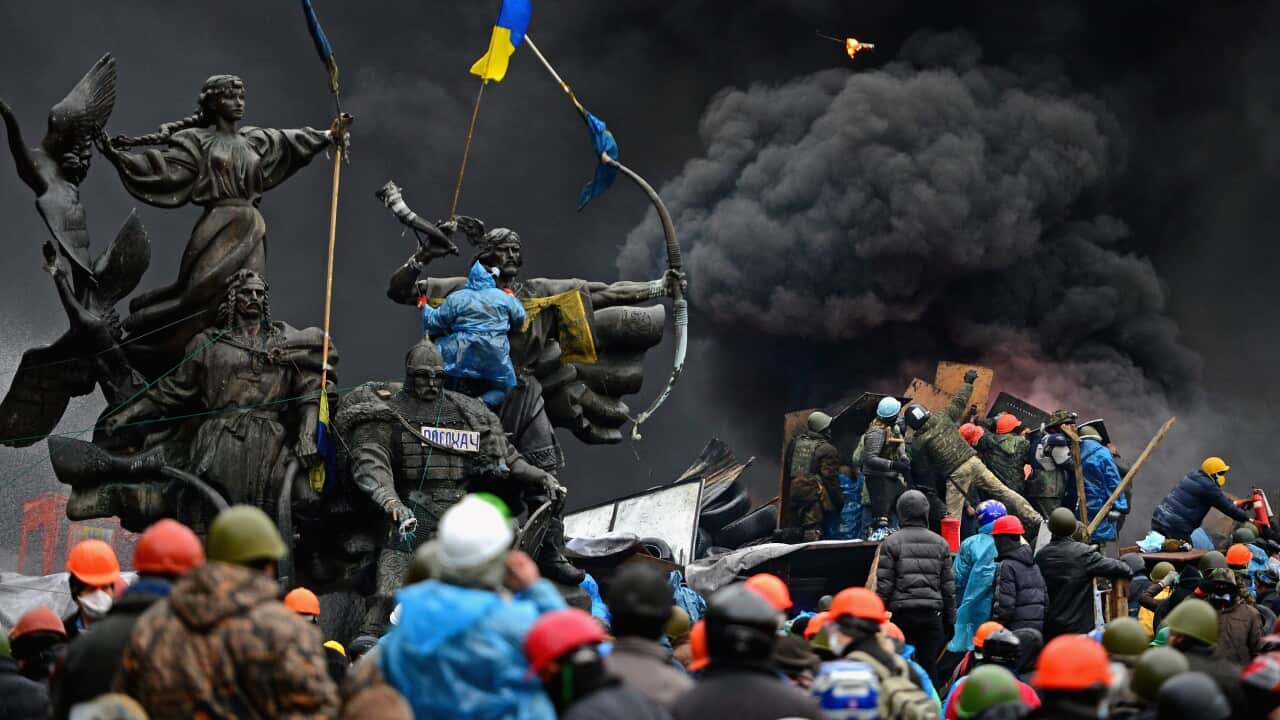
High-profile protest leader Arseniy Yatsenyuk was Wednesday picked to head up the government of Ukraine until presidential elections are held in May.
The move came after months of protests which left nearly 100 dead.
The protests were originally sparked after President Yanukovych failed to live up to a promise he would sign political and free-trade agreements with the European Union.
The country has long been divided according to ethnic and linguistic divisions, as illustrated in the map below.
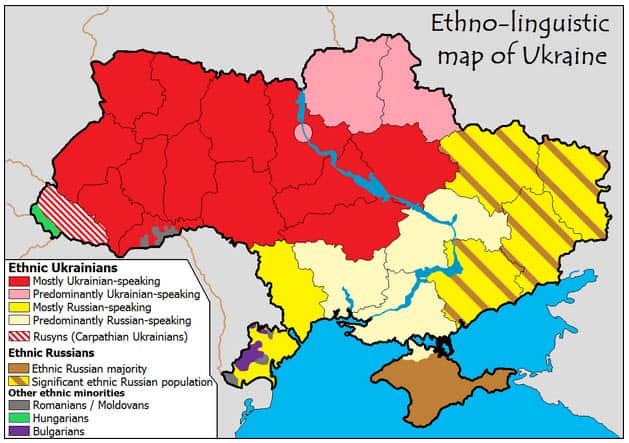
(Wikimedia Commons)
The Ukrainian-speaking population of Ukraine generally believe that further integration into the EU will reduce corruption in the country and hold the government to greater account while the ethnic Russian and Russian-speaking populations of Ukraine tend to favour closer ties to Russia.
But Dr John Besemeres, of the ANU Centre for European Studies, told SBS that while these divisions existed, they were not the sole reason for the country's recent revolution. An extended interview with Dr Besemeres can be found below.
Q. How far back do the ethnic divisions in Ukraine go?
There was a long history of Russian and Soviet imperial domination of Ukraine, in which Ukrainian language and culture was suppressed or marginalised. In the Soviet period, though some space was allowed for symbolic amounts of national culture, Russification was the de-facto policy, and in the Stalin's time Moscow's Ukrainian policies were often pursued with huge brutality, as in the holodomor (the deliberate policy of grain confiscation leading to the deaths of more than 3 million people in Ukraine in the 1930s).
But in a sense the contemporary divisions go back to World War II, because the strongly Ukrainian component within the present Ukrainian population is very heavily concentrated in the west of the country, in areas which belonged to Poland before WWII and to the Austro-Hungarian Empire before WWI.
READ MORE: An insider's look at the protests in Kiev
The Soviet Union, as a result of its victory in WWII and its desire to set up a very large buffer zone and - you might say - a Soviet empire of communist countries, took over that area of Ukrainian settlement and incorporated it into what had previously been the Soviet-Ukrainian republic. And in that way it imported a very large amount of people who didn't really correspond fully to Moscow's expectations. They were strongly nationalist and there they were being pitchforked into a Russified Ukrainian-communist state. They had [obviously] some like-minded fellow-countrymen within Ukraine itself, but they were different because they could remember periods of much greater cultural freedom than other Ukrainians. And they've continued to be, throughout the post-war Soviet period, a difficult problem for Moscow to control. In the first years after WWII there was still a guerrilla war running between Soviet secret police and the army, and these Ukrainian nationalists who were putting up resistance. They wanted their own independent Ukrainian state, which is not unreasonable.
Q. How do ethnic divisions affect Ukrainians day-to-day?
There is a tension in a broader sense but it's not a day-to-day problem, and the tensions we’ve been seeing recently in Kiev are not generally speaking of that kind. Although, quite a lot of the more-nationalist west Ukrainians have been involved in the events in the Maidan and became increasingly more prominent as time went on. They were being bussed in from the west to reinforce the numbers in the Maidan demonstrations, but there was no particular tension between them and the people who were already there - which included a lot of people from eastern Ukraine. I think while the ethnic and other divisions in Ukraine are important, one can make too much of them.
I think it needs to be remembered that the revolution that has taken place in Ukraine has been a revolution of people rejecting the Yanukovych government above all. So that's not a straight east-west issue, although it certainly has an important west-east component.
Q. Was the conflict sparked by a desire to overthrow the government?
Well what touched it off of course was Yanukovych's decision to abandon his efforts to achieve a negotiated association agreement with the EU. Yanukovych is often thought of as a more pro-Russian figure. He's an easterner. He speaks Russian much more readily and easily than Ukrainian. He has good connections with the Russian Orthodox Church. Nonetheless, like most Ukrainian leaders since independence, he has tried to balance those two things to some degree and in his case he gave a great deal of security and military cooperation to Russia but at the same time, he tried to balance that by cultivating good relations with the EU and working toward an association agreement which would have freed up trade - which would have meant a free-trade agreement, among other things. Yanukovych, in other words, although he leaned to the east, was trying to maintain the best possible relationships with Western Europe. But at a certain point three or four months ago, he had a couple of secretive meetings with Putin. No one knew exactly what was happening at these meetings. The then-prime minister announced that Ukraine would no longer be pursuing the association agreement. It was suspending all negotiation. This came as a tremendous shock to all Ukrainians because there was a strong majority support, including from many people in the east.
It was a sudden about-face on an absolutely vital geo-political issue - an issue of national identity - and something for which Yanukovych had absolutely no popular mandate.
So the Ukrainians who were disappointed by this came out on the streets. They were also motivated by disgust at the gross corruption of the Yanukovych regime and indeed the corruption of the Yanukovych family in particular. And as time went on, they were increasingly outraged by Yanukovych's use of force to try to disperse the Maidan.
Q. What does it mean now that Yanukovych has fled Ukraine?
I think Yanukovych was pretty much damaged goods by the end of three or four months of Maidan. I don't think he’s a man of necessarily violent instincts. Initially, he seemed to be trying to play for time.
He thought that as winter got more and more bitter, the demonstrators would go home; they would have had enough, and he didn't use any particular force on them for quite some time.
But then on a number of occasions he did use force, and when he did that it was deeply counterproductive. On each of these occasions, all he achieved was an increased number of people coming out on the streets and he aggravated his own problem by his efforts to resolve it. Toward the end, there was the problem that he has to deal with Mr Putin. Ukraine is in a dire economic position and Putin had said he would give him the equivalent of $15 billion and also lower the price of Russian gas by one third. Yanukovych had been trying for this for years with Moscow. When the violence and the efforts to disperse the demonstrators in Maidan didn't succeed, what Putin probably did was say to Yanukovych, "You have to try harder, you can't make far-reaching concessions to them," or something along those lines. And that was, I suspect, a key reason Yanukovych went for more and more violence.
Q. Is Ukraine facing civil war?
I don’t think so, although it can't be ruled out. And similarly I don’t think the introduction of any kind of Russian forces that could lead to suppression by Russian units is imminent. Again, it can't be ruled out, but at this stage I think we’ll see further tensions but they'll take a different form. Pro-Russian politicians in the eastern regions and in the Crimea have been saying for weeks now that they think in light of all this "bad behaviour" in the Maidan, that they will have to break off from Kiev and have their own, autonomous governments in their regions. If these federalisation initiatives went further this could generate a great deal of tension.
Q. Will the country's future be with Europe or Russia?
I think pretty much with the European Union. That doesn't exclude the possibility that there may ultimately be some playing around with the borders of the country.
I think in the future this thing is going to continue to bubble along, but for the greater part of the city the orientation is quite clearly westward.
In the months leading up to the troubles, there was a clear majority in public opinion polling for the association agreement with the EU and a much smaller number for joining up with the Customs Union, which is Putin's preferred alternative project for the "reintegration" of the former republics of the USSR.





