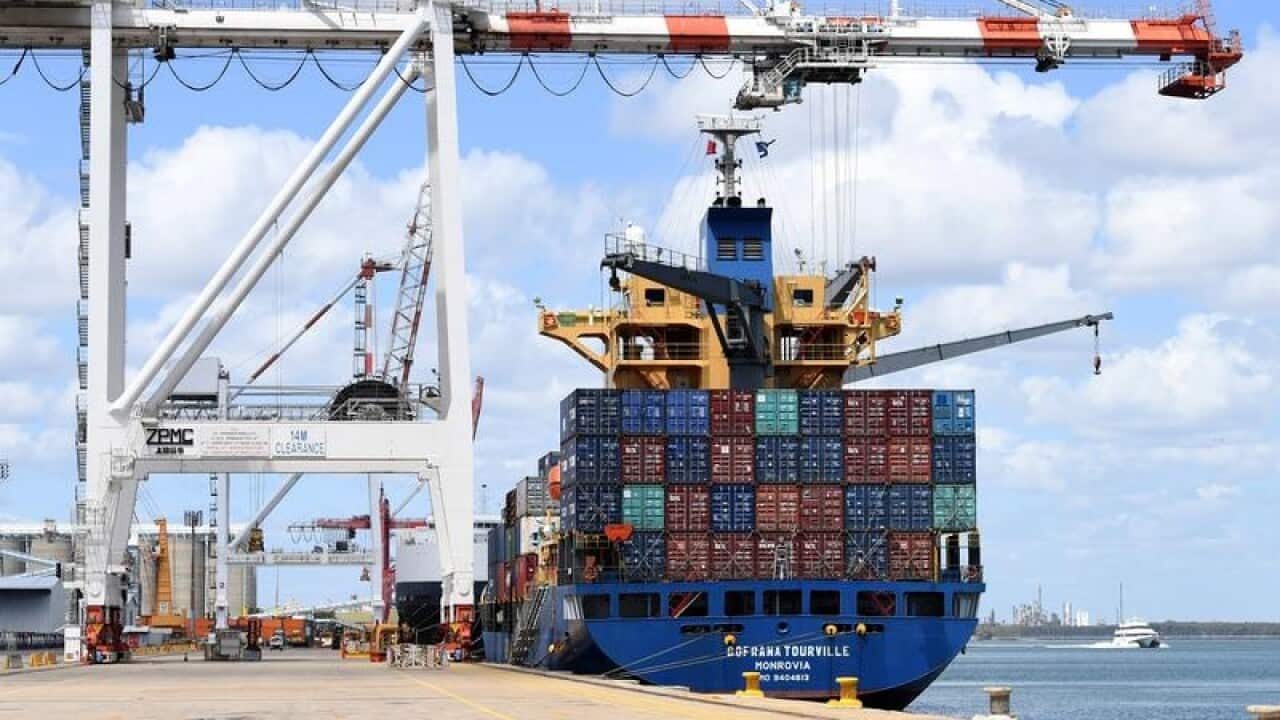
A surprise surge in gold exports helped Australia's trade balance return to surplus in January, where it is expected to remain for the coming months due to strong commodity prices.
A surplus of $1.06 billion in January beat market forecasts of a $200 million surplus, and was a turnaround from December's $1.15 billion deficit.
Exports were up four per cent in the first month of 2018, while imports were two per cent lower, the Australian Bureau of Statistics said.
Australia's trade balance has overwhelmingly been positive recently, posting only two monthly deficits in 2017, in April and December.
CBA senior economist Gareth Aird said January's larger-than expected surplus was mainly due to an unexpected $700 million rise in non-monetary gold exports.
News that makes sense
Your trusted source for staying up-to-date with the world around you. Get free daily news updates and analysis, straight to your inbox.
Exports of mineral fuels also rose, while receipts for iron ore and coal exports edged higher as prices rose and volumes fell.
"Firmer commodity prices so far in 2018 are supporting export revenue," Mr Aird said.
"It looks like the higher Australian dollar - up around 80 US cents in early 2018 - has started to have a negative impact on the tourism trade balance.
"As a result, the monthly tourism trade surplus has shrunk a little."
JP Morgan economist Tom Kennedy said the surge in exports was also due to liquefied natural gas (LNG), which is starting to benefit from stronger prices.
"We retain the view that both the nominal and real trade data will strengthen in the first half of 2018," he said.
"We see scope for coal export volumes to recover in the coming months, in turn supporting the trade balance and net exports."
Mr Kennedy said imports suffered broad-based weakness, with consumption goods particularly disappointing, dropping 6.5 per cent.
"We characterise this sharp drop as mostly normalisation given imports have averaged close to three per cent month on month growth since September," he said.
The figures gave the Australian dollar a modest boost, peaking at 78.39 US cents, from 78.27 US cents just prior to their release at 1130 AEDT.







