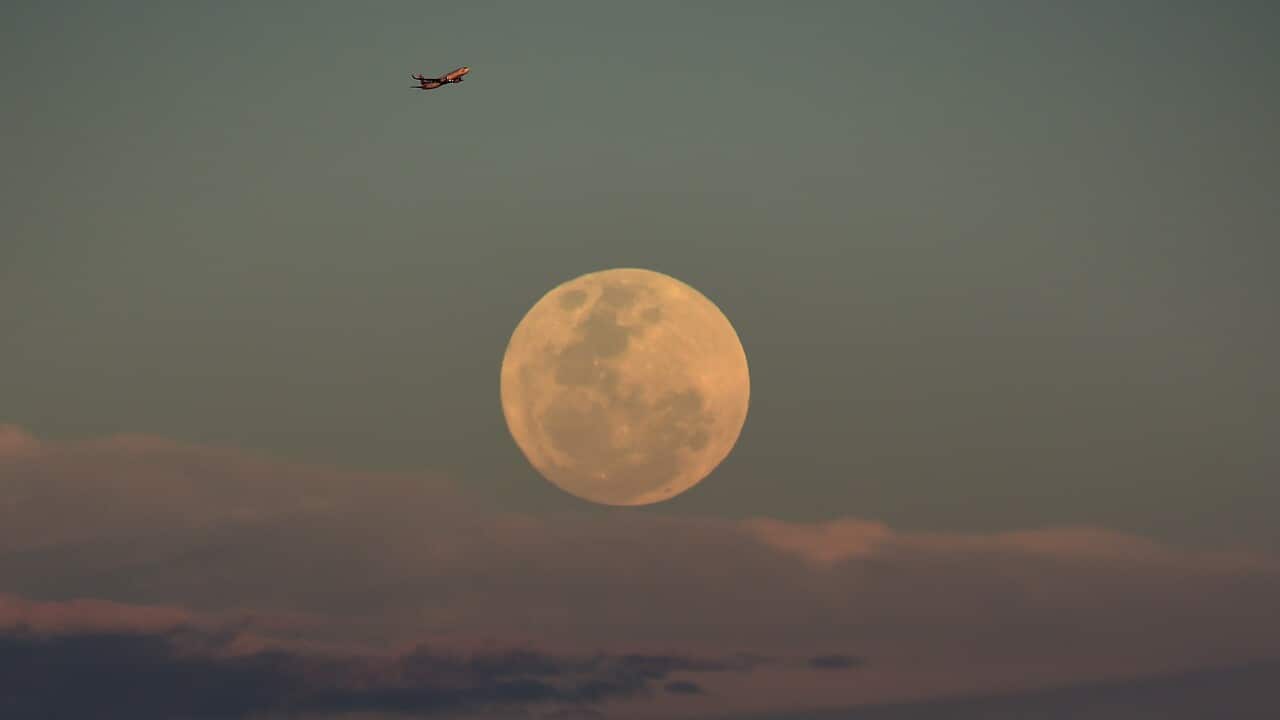
Queenslanders and West Australians claimed bragging rights when the so-called supermoon lit up the night sky on Monday, as thick clouds blanketed much of the rest of the country, spoiling many people's views.
The moon came closer to earth than any full moon since 1948 on Monday night. NASA says we won't see another like it until 2034.
Amateur photographers, young families and astronomy enthusiasts jostled for prime position atop Brisbane lookout Mount Coot-tha to watch the rare lunar event unfold.
Brisbane's mild, still and mostly clear conditions on Monday night were a far cry from the bulk of Australia's east coast.
News that makes sense
Your trusted source for staying up-to-date with the world around you. Get free daily news updates and analysis, straight to your inbox.
Thousands of people across Sydney lined the coast near popular landmarks to soak in the dazzling night-time rays, but were left largely disappointed at gazing instead at drab grey clouds.
Conditions were more favourable south of the border, with Melburnians urged to exodus the city limits to experience the best view.
Astronomers suggest if sky-watchers take a photograph of the moon on Monday night and then again in a few weeks' time they'll appreciate the difference in scale.
"Unless you are really paying attention it's going to be hard to notice," Associate Professor John O'Byrne from the University of Sydney's physics school told AAP.
"(But) the moon will look genuinely fully illuminated with no hint of a shadow at the edges.
"The difference between the moon at its minimum and maximum is 14 per cent in diameter and that translates to about 30 per cent in area."
That larger surface area means a supermoon reflects almost a third more light than when the moon is farthest from earth. Hence it appearing so bright.
Prof O'Byrne says the moon will be at its brightest after midnight in the early hours of Tuesday.
'More super than others'
Delhi residents were hoping toxic smog shrouding the world's most polluted capital in recent weeks would abate to allow spectacular views as the supsersized moon rises over the Red Fort, the former Mughal emperor's residence.
Picnics were being organised in downtown Hong Kong for residents to watch the supermoon rise over the financial hub's famous skyline, while hikers were heading to the greener, more distant corners of the Chinese city to enjoy views with less light pollution.
The landmark Taipei 101 skyscraper in Taiwan, one of the world's tallest buildings, was set to welcome skygazers, with astronomers predicting it would be one of the biggest moons seen from the island in nearly 100 years.
Special viewing events were being organised by astronomy groups, with members of one in Indonesia's Yogyakarta - the heart of an ancient sultanate - taking to the rooftop of their club headquarters to get a glimpse of the supermoon as it rises over the city's historic buildings.
Meanwhile, professional astronomers were at the ready at observatories across the region to explain the phenomenon to curious members of the public.
"We are getting students calling in, there are many who want to come," said Mario Raymundo, head of the Philippine government's main observatory.
The supermoon will also mean a stronger high tide, something that gets surfers giddy with excitement, not only at the prospect of riding bigger waves, but doing so at night.
Tides were predicted to be higher than usual on the popular Indonesian holiday island of Bali, a favourite with surfers.
In Thailand, astrologers were variously predicting the supermoon would bring disaster or great fortune.
Soraja Nuan-yoo, renowned for predicting the 2004 tsunami that killed many in Thailand and other countries round the Indian Ocean, warned that when the moon gets close to the Earth, "natural disasters happen".
Astronomers say it can be hard to notice that the Moon appears brighter than usual. Once it is high in the sky, it would be hard to tell the Moon is larger but on the horizon, it could appear quite spectacular.
To get the best view, Pascal Descamps of the Paris Observatory recommended that people choose somewhere with a well-known landmark in the foreground.
Supermoons are actually quite common -- there is one every 14 months on average.
"But some supermoons are more super than others," said Descamps.







