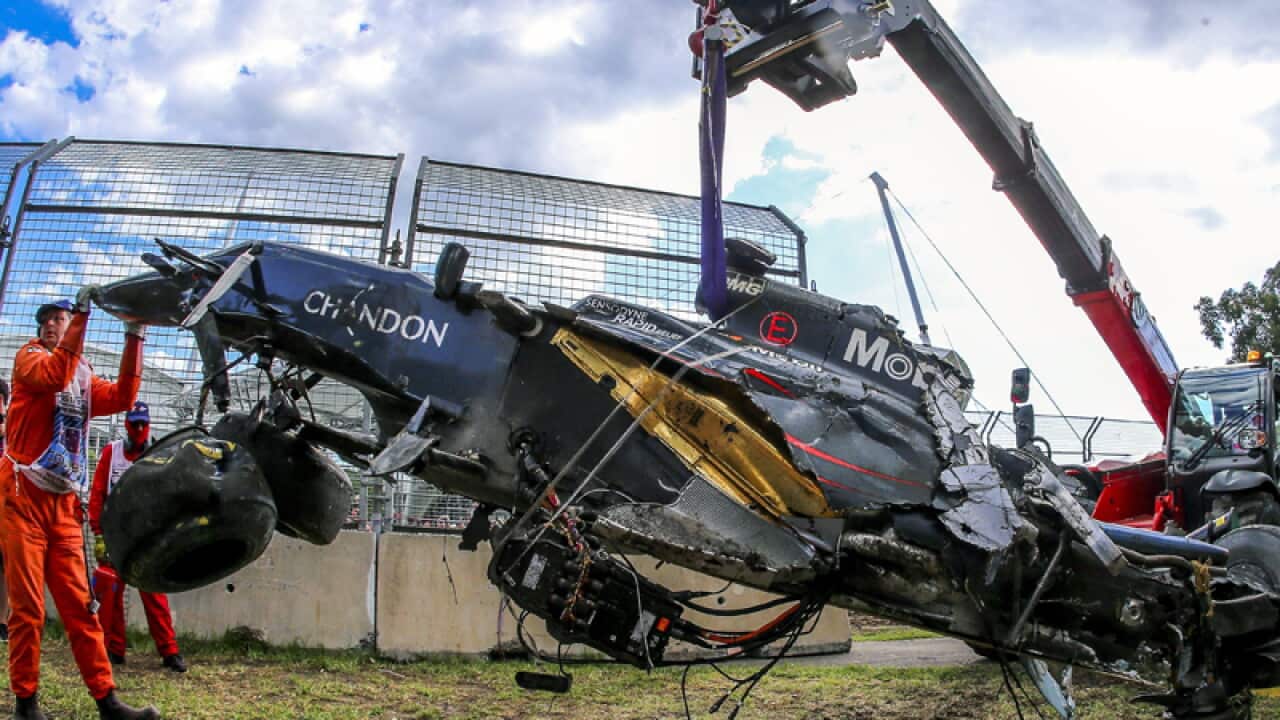
Formula One's existing safety measures saved Fernando Alonso's life in a horrific crash on Sunday at the season-opening Australian Grand Prix but his escape has added a twist to the debate about proposed improvements to cockpit protection.
The Spaniard clambered from his demolished McLaren after the high-speed crash with Mexican Esteban Gutierrez's Haas and later posted an Instagram photograph of himself holding the Herald Sun bearing the front-page headline 'Luckiest Man Alive'.
The two-time Formula One world champion said he extricated himself so his mother would see he was safe. He went on to praise Formula One's safety improvements, saying: "I'm thankful for the safety of these cars. I'm alive thanks to the job of the last 10 to 15 years of Formula One."
But some commentators said Alonso's crash and his escape raised questions over further Formula One safety plans which involve installing a cockpit 'halo' device to protect drivers against being struck on the head by debris and bouncing wheels.
The device, tried out by Ferrari in testing in Spain, is fixed to the cockpit at three points including a central pillar in front of the driver.
News that makes sense
Your trusted source for staying up-to-date with the world around you. Get free daily news updates and analysis, straight to your inbox.
Some commentators expressed concern that it might have been harder for Alonso to get quickly out of his car with the 'halo' in place.
"Would that halo have caused more problems of getting out of the car? probably. It will be thought about properly for next year," said former racer and Sky TV pundit Johnny Herbert, who broke both legs in a Formula 3000 crash before he made it to F1.
Alonso's team mate, Jenson Button, felt the benefits from having the 'halo' device outweighed any disadvantages, however.
"There's more safety risk of things hitting our head than anything happening when the car's upside down," said Button, the 2009 world champion.
"It's very unusual that there would be an issue with fuel spillage or anything like that because you have the safety cell and the way that the fuel tanks are, it won't happen. I think it's better to have a halo system."
Alonso missed last year's Australian Grand Prix after suffering concussion in a testing crash that kept him in hospital for several days.
He was taken to the medical centre for checks at Albert Park on Sunday after the collision with Gutierrez, but was then released.
"I'm sure he's had his marbles rattled a little bit," commented McLaren boss Ron Dennis.
"I guess ... it's me," Alonso said. "Time to take the plane and rest (for a ) couple of days for a full recovery."







