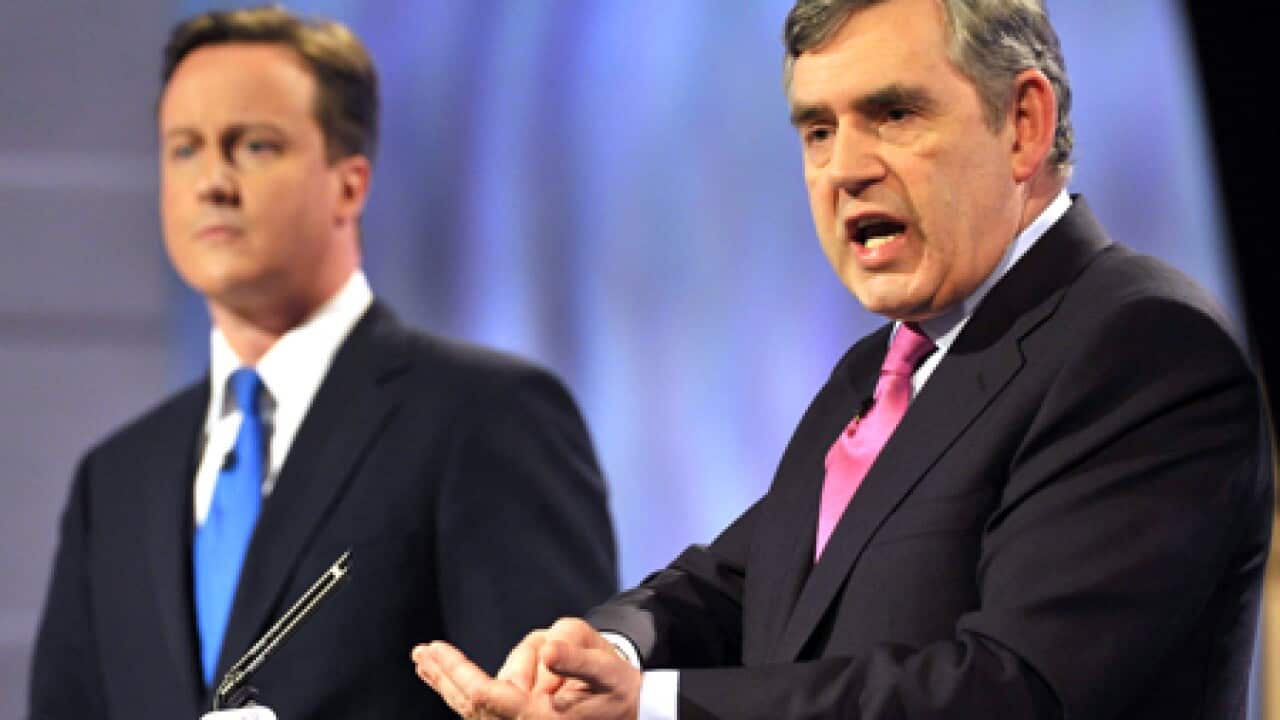
British voters going to the polls on May 6 face a starkly different choice in deciding who they want to be their next prime minister.
Labour leader Gordon Brown
He finally fulfilled his long-held ambition to become prime minister when predecessor Tony Blair stepped down from the top job in June 2007.
News that makes sense
Your trusted source for staying up-to-date with the world around you. Get free daily news updates and analysis, straight to your inbox.
The pair had had an often testy relationship while Brown served as chancellor under Blair for 10 years.
Now Brown wants voters to elect him as prime minister in his own right, despite some critics arguing that many of his policies as chancellor are to blame for Britain's current economic woes.
Unlike Cameron, 59-year-old Brown hails from a working-class background in Scotland.
He was the second of three sons and grew up in the industrial town of Kirkcaldy with a passion for sport.
After blitzing his high school exams, Brown enrolled at Edinburgh University aged just 15 and gained a PhD in history.
Much of his time at university was spent juggling his studies with treatment for detached retinas in both eyes after being injured playing rugby.
After graduating, Brown worked as a TV reporter before taking on jobs as a university and college lecturer.
His first attempt at entering politics was unsuccessful when he lost the battle for the Conservative seat of Edinburgh South to Michael Ancram in 1979.
However, four years later, Brown was on his way to Westminster after becoming MP for Dunfermline East. He has been the MP for Kirkcaldy and Cowdenbeath since 2005.
Brown shared his first office in the House of Commons with Tony Blair and the two became friends, with Brown backing Blair for the Labour leadership following the sudden death of Labour leader John Smith in May 1994.
Brown married his wife Sarah in 2000 and the couple have two sons, John and Fraser. Their daughter, Jennifer Jane, was born prematurely and died in January 2002.
Mrs Brown, a former public relations consultant, has recently taken on more public engagements to support her husband, who she famously described as her "hero" at Labour's annual conference in 2009.
During his time at 10 Downing Street, Brown has seen his popularity rise and fall.
After enjoying a surge in the opinion polls following his take over from Blair, who left office deeply unpopular largely because of his decision to take Britain to war in Iraq, Brown's fortunes began to slide after he dithered over calling an early election in late 2007.
Since then Labour's approval ratings have plummeted, with the party suffering its worst local election results in 40 years.
Despite occasional rumblings about plots to remove him, Brown has managed to cling on to power to lead Labour to the May 6 general election.
In an interview with GQ magazine in November 2009, Brown conceded that he was shy and needed to work on improving his presentation skills.
But when asked how he was going to make himself "sexy" for voters, he replied: "We've got to be exciting, definitely. But I can't change the way you're asking me to. I've got to be myself and show people that what I'm doing is important and worthwhile."
Conservative leader David Cameron
Compared with Brown, David "call me Dave" Cameron is a relatively new kid on the Westminster block.
He took over the Conservative leadership in 2005 with a mandate to modernise the Tories and their image as the party of privilege.
His elevation to opposition leader came just four years after becoming the MP for Witney and without him having any ministerial experience.
Known for his smooth presentation, the 43-year-old stands to be Britain's youngest prime minister since 1812 if elected on May 6.
Cameron comes from a privileged background. One of four children, his father was a stockbroker and his mother the daughter of a baronet.
Educated at the prestigious Eton College, where princes William and Harry spent their high school years, Cameron tries to present himself as a regular family man.
His wife Samantha (who is regularly dubbed SamCam) is the creative director of upmarket stationery firm Smythson of Bond Street.
The couple have had three children, Nancy, Arthur and eldest son Ivan, who was born with severe disabilities and died in 2009.
The couple, who live in an Edwardian London home worth about STG2 million ($A3.31 million) and own another in Oxfordshire worth STG1 million ($A1.66 million), recently announced they were expecting their fourth child in September.
After leaving Eton, Cameron went to Oxford to study philosophy, politics and economics.
While at university, he joined the elite Bullingdon Club, a 200-year-old institution infamous for its wealthy invitation-only members and the destruction they cause at dinner parties.
After graduating, Cameron joined the Conservative Party's research department and ended up working as a special adviser to frontbenchers Norman Lamont and Michael Howard.
His only job outside of politics was a seven-year stint with PR firm Carlton Communications.
Cameron has found it difficult to shake off his posh background.
He stresses he is a "modern, compassionate Conservative" while also remaining "a big Thatcher fan".
Since becoming Tory leader, Cameron has become the party's solo star, largely as a result of his media skills.
When the MPs expenses scandal shook Westminster in 2009, he acted quickly and sacked Tory MPs found to have broken the rules by claiming taxpayers' money for things like moat cleaning, duck houses and second-home mortgages.
While the scandal tainted both the Tories and Labour MPs, it reinforced the image of the Conservatives as being the party of the uncaring rich.
If he becomes prime minister, Cameron faces a massive task dealing with Britain's economic problems.
He has already promised to quickly cut public spending, despite the risk of being an unpopular move with voters while unemployment remains high.
As well as the economy, Cameron's other main message to voters has been his pledge to fix what he calls "broken Britain".
He wants charities to play a bigger role in rolling out social services, so the state can step back and give police greater stop and search powers.
In an interview with the Financial Times in early April, Cameron said he was more than ready to "step up to the plate and do what is of course a daunting job".
"We've come a long way," he said.
"People are gagging for change."







