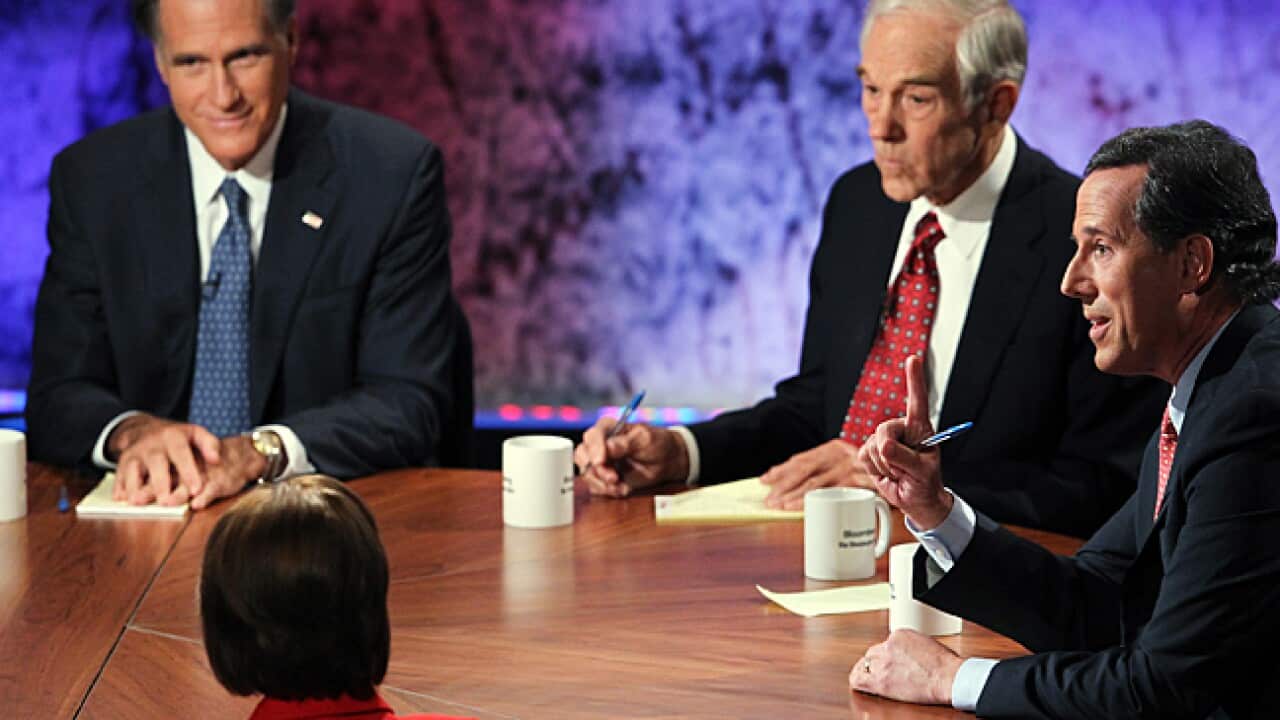
As the field of Republican presidential candidates has diminished, it's lost some of its more gaffe-prone interpreters of US foreign policy.
Rick Perry raised eyebrows when he said that NATO member Turkey was ruled by Islamic terrorists. Herman Cain admitted that he knew little about Ubeki beki beki stan stan.
On more serious topics - such as Iran and China - there's some daylight to be found in the stances between the hawkish Rick Santorum, the apparent liberal Mitt Romney, libertarian Ron Paul and veteran lawmaker Newt Gingrich, even if foreign policy as a whole is not central to their campaigns.
News that makes sense
Your trusted source for staying up-to-date with the world around you. Get free daily news updates and analysis, straight to your inbox.
We spoke to Dr Adam Lockyer of Sydney University's US Studies Centre to find out more about their differences.
When compared to the others, is Rick Santorum the 'toughest' on Iran?
You can pretty much define Santorum's foreign policy as 'Iran.' He's running the hardest on the Iran line, trying to paint himself in the field as the 'hard man' on foreign policy, and he sees Iran as a good case where he can be tough. When foreign policy is mentioned he goes straight to Iran, straight to Israel, and it's pulling the rest of the field in. Mitt Romney, who probably started with a more moderate stance on Iran, is having to drift to the extreme side just to keep up. This is how the primaries work…they don't want to be outflanked on the right, but as soon as they win the nomination, they tack back towards the centre. At times Santorum is saying some outlandish things about Iran which would be almost neo-conservative.
Ron Paul called for all US troops to come home – is he alone on that one?
Yes, his foreign policy is the most consistent of all the candidates. He's the libertarian candidate which means he is interested in small government and he wants a far more limited foreign policy…he describes the US commitment overseas as an empire based on military strength and he would like to cut the commitments down across the board. Not just in Iraq, but also in Europe. He wants to invest in production at home.
Has Iraq figured at all?
When Obama announced he wanted to withdraw the last troops, that popped up – particularly on Mitt Romney's radar. He came out and made statements saying it would leave Iraq to the US's enemies, particularly Iran.
Newt Gingrich said Palestinians were an 'invented' people. Is he on his own on that one or are all candidates coming from the same place where Israel/Palestine is concerned?
They've all got to talk about Israel. In any speech on foreign policy Israel will be the country that is mentioned the most, not just on the Republican side. One area of American foreign policy you can't look weak on at all is your commitment to Israel. If there is one candidate who is less gung-ho on Israel it is probably going to be Ron Paul, but the rest of them have to waive the Israeli flag at every opportunity.
Is there a differentiation in their relationships to the Israeli lobby?
When they're talking about Israel they're not always talking directly to the Israeli lobby, they're also talking to others, particularly evangelical Christians. The conservative base is who they are chasing after in the Republican primaries; any weakness on Israel is going to affect that relationship.
There's also been some tough talk on China. Many Americans say the currency is undervalued to keep Chinese exports competitively priced –where do the candidates stand on this?
China is the more interesting case. With their rhetoric towards China you can see some daylight between the candidates. Gingrich talks about China in more moralistic ways. He talks about freedom, human rights. Although the trade relationship is important, democracy (and) human rights can't take a back seat. Whenever the US engages with China they've got to be pushing the human rights issue. Ron Paul differentiates himself by saying the US has to out-compete China by looking to themselves; don't look at what China is doing wrong, look at what the United States is doing wrong.
Mitt Romney is coming from a business background; he's more interested in the economics of it. He wants the Chinese to play by the rules, he wants no barriers to trade between the US and China, and through that the US is going to be able to out compete China, but it needs to have fair economic rules.
And Rick Santorum shows very little interest. Whenever foreign policy is mentioned he goes straight to Iran, straight to Israel. When you do and find bits and pieces (on it) it's always tough talk but he doesn't seem that interested in it.
So the Asia-Pacific hasn't featured very strongly?
Foreign policy more generally hasn't featured that strongly! It's not an issue where these guys are going to get elected, particularly in the primaries...When we talk about things on their position on the Australian relationship, it just hasn't come up.
One thing that has come up is foreign aid. Gingrich and Romney have said they would slash it, Pakistan came in for criticism. Are there any big differences?
As far as it has popped up they have all run a similar line; they're all going after a similar base. One, they see foreign aid going to countries that may seem undesirable, such as Pakistan. But it's also some of the programs, say in Africa (with) AIDS reduction, as well as women's health programs. It's getting a big play right now, women's health and whether contraception should be part of it or not.
Does President Obama have strong foreign policy credentials going into the election? The navy SEAL team killed bin Laden, after all.
From an outside observer his foreign policy has been pretty good. He killed bin Laden, and when the pirates captured Americans off Somalia he sent in SEALTeam 6, too. He's acted with strength when he needed to, and the recent sanctions on Iran play into that. Then he has successfully withdrawn troops from Iraq and is deescalating the commitment to Afghanistan as he pledged he would. He has used UAVs (unmanned aerial vehicles)…and this may be questioned by international lawyers, but it is 'tough'.
But all of this may not be enough; a Republican on a podium may still be able to say 'You have not been tough enough. Sanctions on Iran are great but I would use air strikes', and Santorum would probably say he is willing to invade. They'll attack him for his policy of leading from behind Libya. Republicans will say 'this is not how America does business. We do not lead from behind.'







