

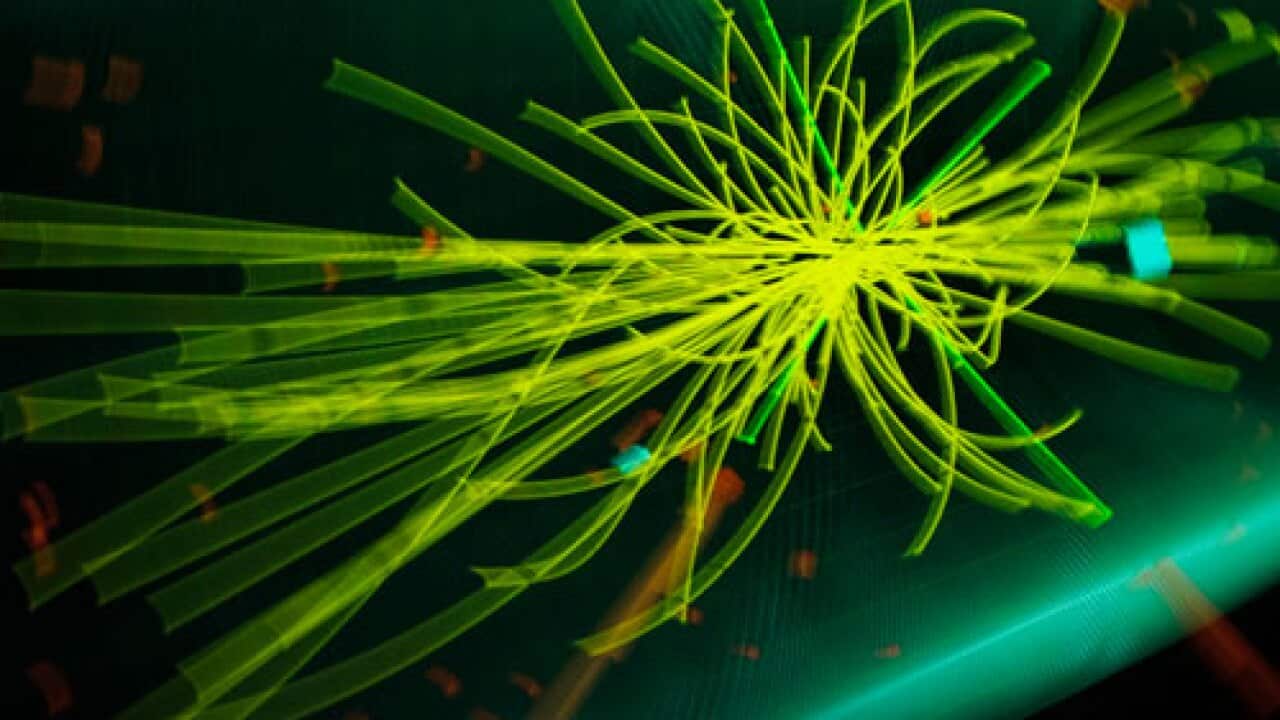
Since 2008, scientists at the Large Hadron Collider (LHC) facility near Geneva have been hoping to prove or disprove the existence of the Higgs boson, a sub-atomic particle which is believed to confer mass.
WHAT IS THE HIGGS BOSON?
The Higgs particle has been predicted by scientists for several decades, as a way of explaining how particles get their mass.
In 1970s, physicists Peter Higgs, Robert Brout and François Englert responded to new breakthroughs in the field of particle physics by suggesting all particles had no mass just after the big bang.
They proposed that a very hot soup of particles got their mass a fraction of a second after the big bang, through an interaction with a Higgs field.
News that makes sense
Your trusted source for staying up-to-date with the world around you. Get free daily news updates and analysis, straight to your inbox.
The prediction fit with existing models of particle physics, and provided the 'last piece' in a 12-part puzzle to explain the very building blocks of the Universe.
THE RACE TO FIND PROOF
In order to provide proof to support the theory, scientists have attempted to replicate the process of particles attaining mass through interaction with force.
The Tevatron collider, a product of Fermilab in the US, found promising results before being shut down in 2011.
Since 2008, scientists at the Large Hadron Collider (LHC) facility near Geneva have been working towards the same goal.
WHY SEARCH FOR THE HIGGS BOSON?
The discovery of the Higgs boson would help answer important unresolved questions in particle physics, such as, what is the origin of mass? And why do some particles have no mass at all?
WHY IS IT SO HARD TO FIND?
Scientists believe the Higgs is produced fleetingly when particles smash into each other at high speed.
It is supposedly the device that gives other particles their mass, but the Standard Model doesn't offer any clues as to what the Higgs itself weighs.
Researchers have been looking for evidence in a wide mass range, using a process that is largely trial and error.
In addition, the Higgs is believed to decay almost instantly after it interacts with other particles to endow them with mass, making it especially slippery.
WHAT IS THE LARGE HADRON COLLIDER?
The LHC is a particle accelerator, the largest in operation at the European Organization for Nuclear Research (CERN) on the Franco-Swiss border.
The LHC is made up of four huge labs, interspersed around a ring-shaped tunnel near Geneva, Switzerland. The tunnel is 27 kilometres long and up to 175 metres below ground.
Beams of hydrogen protons are accelerated in opposite directions to more than 99.9999 percent of the speed of light.
Powerful superconducting magnets, chilled to a temperature colder than deep space, then "bend" the beams so that streams of particles collide within four large chambers.
In top gear, the LHC is designed to generate nearly a billion collisions per second. Above ground, a farm of 3,000 computers, one of the largest in the world, instantly crunches the number down to about 100 collisions that are of the most interest.
HOW MUCH DID THE LHC COST TO BUILD?
Completed in 2008, the LHC cost 6.03 billion Swiss francs (five billion euros, $6.27 billion dollars, at today's rates of conversion).
WHAT HAPPENS IF THE HIGGS BOSON IS FOUND?
Scientists will be able to apply the new knowledge to existing theories of particle physics with much more certainty.
Even if the results from CERN and the Large Hadron Collider are positive, lab tests and data analysis will continue for many years before the theory will be considered proven by the scientific community. WHAT HAPPENS IF IT ISN'T?
Physics experts claim they'll be equally excited, because this will mean new theories must be developed to better understand questions of mass in the universe.
Professor Geoff Taylor from the Australian Research Council says science can only benefit from the research.
“The theorists have many other ways of trying to provide the same basic effect, so it's not the only way of getting there, but it's the simplest way.”