
At the University of Western Australia, there’s a petrol station of the future. Kind of. It’s just one “bowser”, but it’s a fast charger for an electric vehicle.
It can charge a compatible electric vehicle in less than 30 minutes up to 80 per cent of its capacity – a substantial improvement of AC charging, which can take up to 10 hours.
Fast chargers do already exist, but the UWA one offers dual outlets for the Japanese and American standards - a commercial first in Australia.
"This is really the milestone forward in electric vehicle infrastructure."
Perhaps more importantly, this charger is also a research tool for the University of Western Australia, which is championing the use of electric vehicles.
“I think this is really the milestone forward in electric vehicle infrastructure,” said Thomas Braunl from the University of Western Australia.
“What we’ve seen before is people home charging and that takes about ten hours, which is convenient at home, but not during the day.”
The fast car charger uses direct current electricity to charge the cars, bypassing the need for it to be converted in the vehicle.
But the university wants to know how this could affect the car's batteries.
“There may be consequences if people keep charging using fast chargers all the time, that the individual battery cells get out of balance,” said Professor Braunl.
“That’s one of the questions that we’re investigating at the moment, but evidence seems to show that if people do a mix of the fast charge and the slow charging that batteries still stay balanced so we're quite confident this can be used on a daily basis.”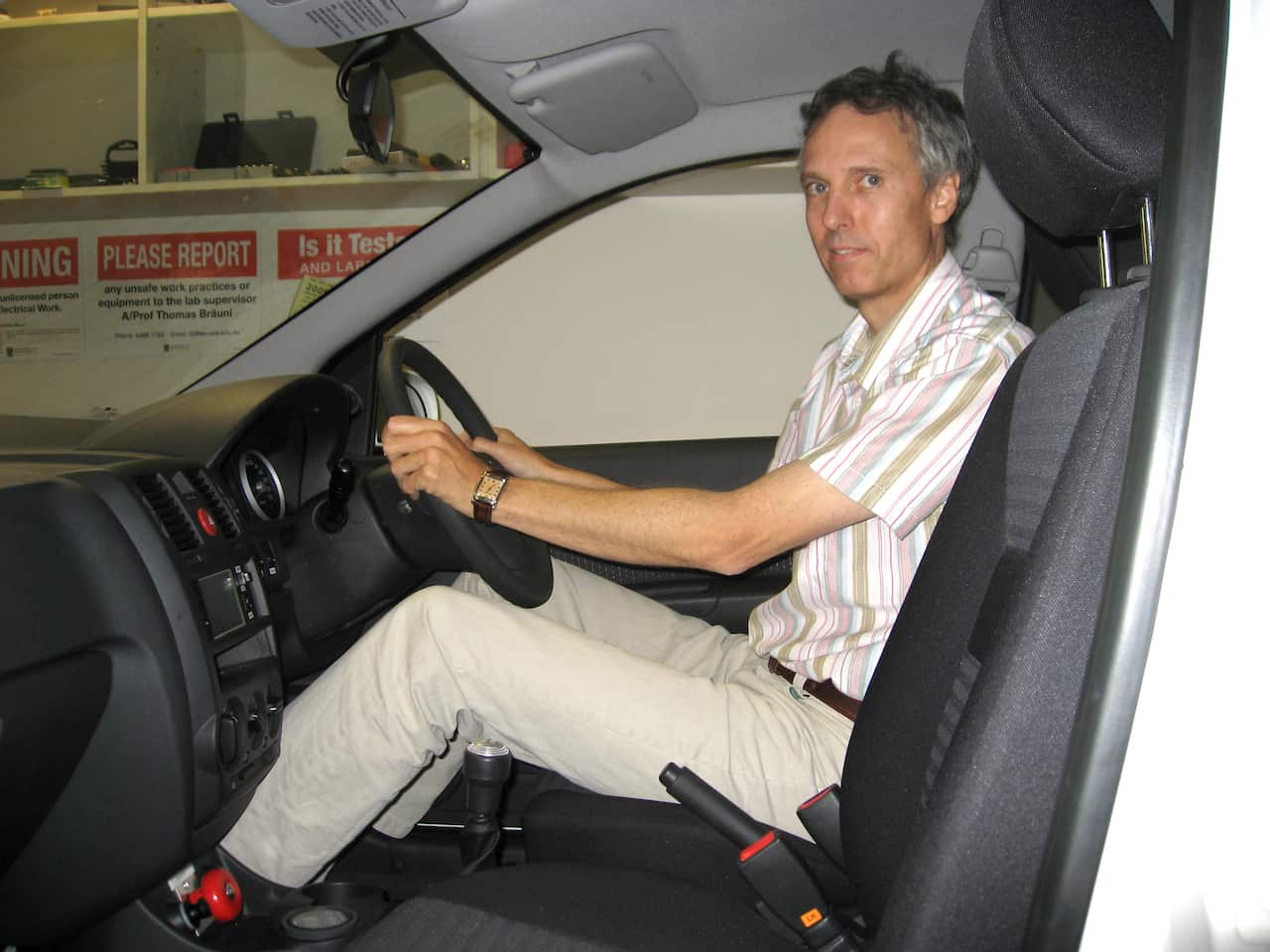 Electric car owner Joseph Law said the fast charger would change the way he used his electric BMW.
University of Western Australia Professor Thomas Braunl at the wheel of the electric-converted Hyundai Getz. (AAP)
“It’s called opportunity charging,” he said. “So therefore, it’s like your iPhone. When you go to somewhere you just plug your iPhone in, but you don't necessarily need to get a full charge on your iPhone."
“But to get it back to 100 per cent then you would need to wait like two hours, but generally just plug your car in wherever you have a charging spot.”
Fellow electric car owner Richard Baird said fast chargers bring electric cars closer to being like a petrol car.
“Fast chargers will actually make a big difference,” the auto electrician said.
“Whereas this car normally takes about six hours to charge at home from flat, the fast chargers can charge to 80 per cent in about 20 minutes.
“You can actually do more running during the day and take advantage of the fast chargers to give you a top up.”
Six years ago, the University of Western Australia converted two petrol cars – including a Lotus sport car, into electric ones to prove that it could be done.
"I like the idea that I don’t have to go to a petrol station ever again."
Now car companies are on board and building electric cars from scratch. But not cheaply.
Joseph Law's BMW is upwards of $80,000, although Richard Baird's second-hand Mitsubishi iMieve is decidedly cheaper.
“Well, I like the idea that I can actually fill my car up from home and that I don’t have to go to a petrol station ever again,” Mr Baird said.
“I actually have solar on my house, so my nett fuel bill is zero.”
But Professor Braunl said it would be years before electric cars became mainstream.
“All the car companies are now realising that electric cars are coming,” he said.
“Most car companies have introduced electric cars now, which will be coming to Australia as well.
“I think it’s going to grow from there. The problem is still the high prices that electric cars cost at the moment
“I understand that some of the electric car companies are still making a loss at these prices.
“So they’re not really promoting electric cars at the yet because they’re not yet profitable to them.”
The professor said it was a chicken and egg scenario. Which comes first? More charging stations or more electric cars? Perhaps faster charging might help crack that riddle.
Share


