US President Donald Trump announced punishing steel and aluminium tariff on Thursday, teeing up a possible trade war with China and Europe.
Wall Street stocks fell sharply Thursday after Mr Trump made the announcement, with the Dow Jones Industrial Average tumbling 1.7 per cent to close 24,608.98, above the worst levels of the day.
The broad-based S&P 500 dropped 1.3 per cent to end at 2,677.67, while the tech-rich Nasdaq Composite Index fell 1.3 per cent to 7,180.356. News of the tariffs drove the stocks of US domestic steel and aluminium makers sharply higher.
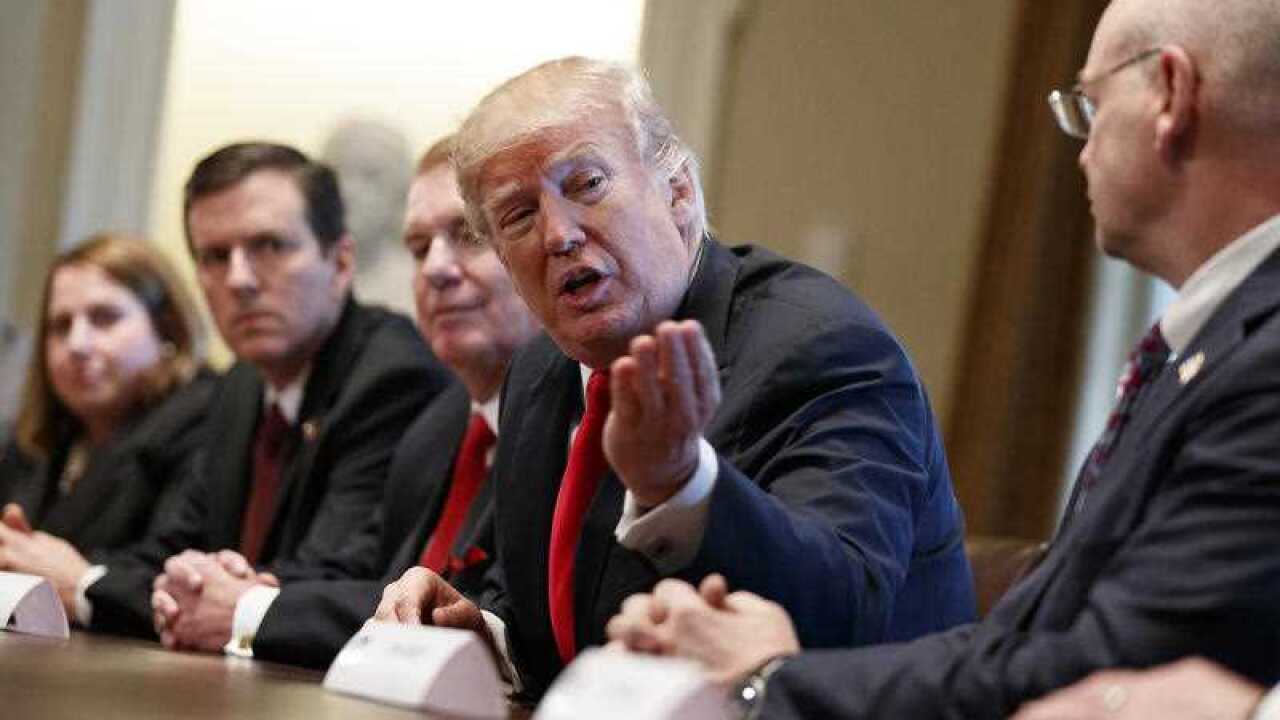
Mr Trump, speaking after a meeting with US steel and aluminium makers, said the duties would be formally announced next week.
“We’re going to build our steel industry back and our aluminium industry back,” he said.
News that makes sense
Your trusted source for staying up-to-date with the world around you. Get free daily news updates and analysis, straight to your inbox.
EU 'will react firmly'
The EU "will react firmly and commensurately to defend our interests" in response to tough US steel and aluminium tariffs, the European Commission chief Jean-Claude Juncker said Thursday.
"The Commission will bring forward in the next few days a proposal for WTO-compatible countermeasures against the US to rebalance the situation," he said in a statement, referring to the World Trade Organization.
US President Donald Trump on Thursday announced he would sign off on measures designed to protect US producers, teeing up a possible trade war with China and Europe.
'Unacceptable'
Canada's Trade Minister Francois-Philippe Champagne said Thursday a US proposal to slap tariffs on steel and aluminium imports would be "unacceptable."
"We're following this situation very carefully," Mr Champagne told parliament.
"Any tariffs or quotas that would be imposed on our Canadian steel and aluminium industry would be unacceptable. Any such decision would have an impact on both sides of the border."
Night of 'chaos'
The move, which came after what one person with direct knowledge of the discussions described as a night of “chaos” in the White House due to frequent switching of positions in the administration, was sharply criticised by some senior Republican legislators.
“Every time you do this, you get a retaliation. Agriculture is the number one target. I think this is terribly counterproductive for the agriculture economy,” Senator Pat Roberts, who chairs the chamber’s agriculture committee, said.
China has already threatened to curb imports of US soybeans in retaliation, while the European Union has said it will consider action as well. China’s top trade official Lui He is in Washington for trade talks.
After Mr Trump’s statement, AK Steel Holding was up almost 12 per cent, US Steel Corp was up 8 per cent and Nucor rose 3.6 per cent. By contrast, industrial stocks such as Boeing fell, with traders citing tariffs, which would hit manufacturers’ costs.
The administration says duties would protect US industry, but critics say they would raise costs for industry and fail to deliver on a campaign pledge to boost domestic jobs.
It had appeared unlikely Mr Trump would announce the tariffs on Thursday after a night of back and forth inside the administration.
“There was a lot of movement within the past 12, 16 hours,” the source - who had knowledge of the discussions, but who declined to be named due to the sensitivity of the issue - said.
“It was going to happen. It wasn’t going to happen and then it did happen.”
The administration has also cited national security interests for its action, saying the United States needs domestic supply for its tanks and warships.
Contrary to the action announced by Mr Trump on Thursday, the Department of Defense had recommended targeted steel tariffs and a delay in aluminium duties.
Although China only accounts for two per cent of US steel imports, its massive industry expansion has helped produce a global glut of steel that has driven down prices.
Trade tensions between the United States and China have risen since Mr Trump took office in 2017 and the administration is also pushing on what it regards as forced technology transfers to China.
Shares of Asian steel producers such as South Korea’s POSCO and Nippon Steel fell overnight.
Few more jobs from tariffs
While American steelmakers have lost three-quarters of their jobs between 1962 and 2005, a major study by the American Economic Association showed much of this had been due to improved production technology as output per worker rose fivefold.
“Thus, even if trade protection leads to increased domestic production, increases in employment may be far less than many hope,” a report from the highly-regarded independent Econofact economist network said last week.
Mr Trump's announcement came after Australian Prime Minister Malcolm Turnbull held discussions with Mr Trump, Treasury Secretary Steven Mnuchin and Commerce Secretary Wilbur Ross last week.
Mr Turnbull, speaking to reporters on Saturday at the end of his four-day Washington DC trip, confirmed tariffs were part of the Australian delegation's talks.
"We believe we have made a very compelling case, but obviously the administration has to finalise its decision in this area," Mr Turnbull said at the time.







