
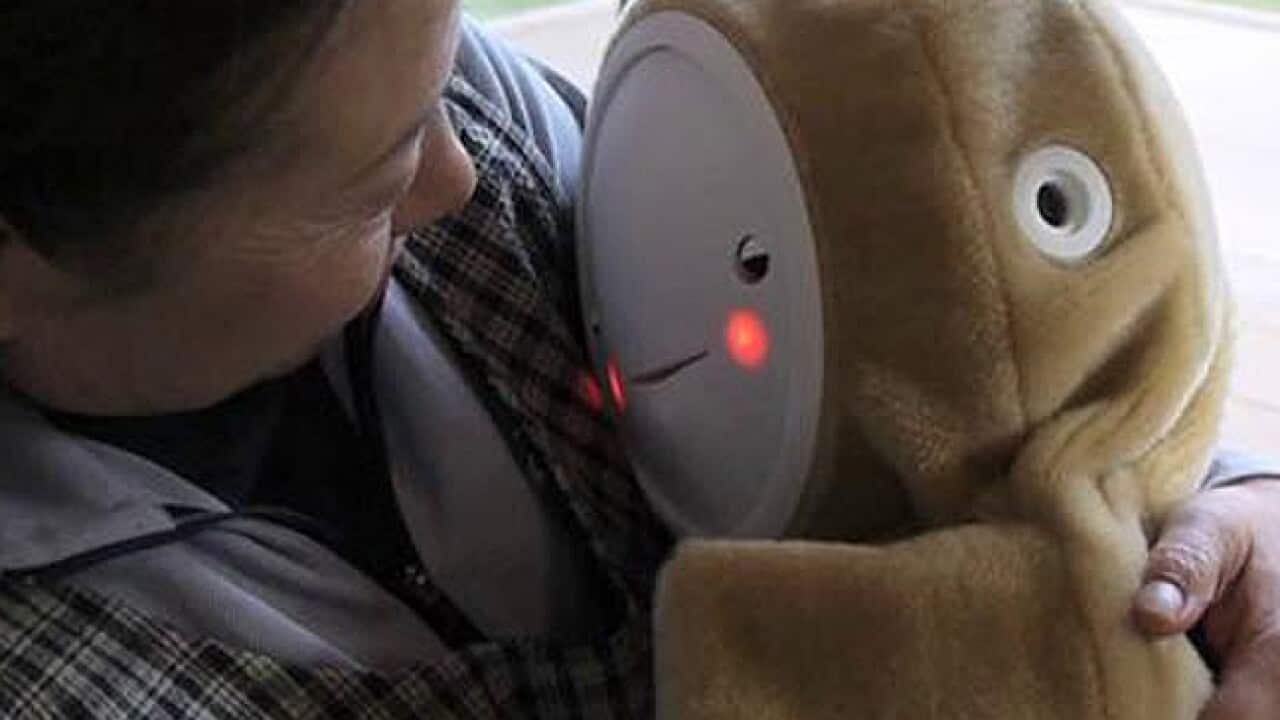
It might just look like a large fluffy toy. But Babyloid, Japan's latest therapeutic robot baby, is also designed to help ease depression among older people by keeping them company.
Towards the middle of its round, silicone face are two black dots that act as blinking eyes and a small slit that poses as a mouth and that can produce a smile. The cheeks have LED lights embedded and turn red to signify when it Babyloid contented. Blue LED tears are produced when it is unhappy.
Developed by Masayoshi Kanoh, a professor at Chukyo University in Aichi prefecture, Japan, Babyloid knows what's going on through its acceleration, temperature, touch, pyroelectric and light sensors. If you hold the crying Babyloid and rock it, it might - if you're lucky - fall asleep.
Kanoh, who presented the latest version of Babyloid at a robotics conference in Japan last week, says the basic design - with a simplified, smiling face - was chosen "to avoid the creepiness a realistic baby face can have."
Babyloid can produce more than 100 different sounds. Kanoh is a father of three and he recorded the sounds of his youngest when she was an infant for the robot.
During experimental studies at a retirement home, Kanoh found that users interacted with Babyloid an average of seven to eight minutes in a sitting with a total of 90 minutes per day, which helped ease symptoms of depression.
The prototype model cost about 2 million yen (£16,500) but Kanoh hopes Babyloid can be available to consumers for 100,000 yen (£830) should it reach the market.





